When the Platform Sides With the Guest: Why Hosts Feel Unprotected in Damage Disputes
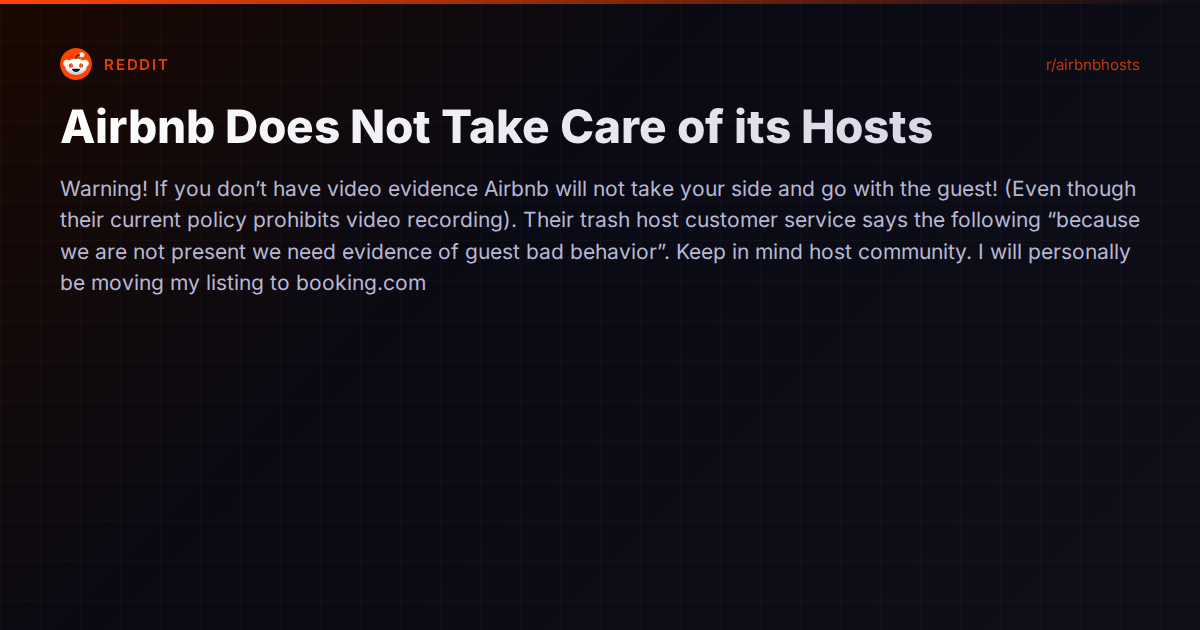
TL;DR: Host is frustrated that Airbnb sides with guests in disputes without video evidence, and is planning to move their listing to Booking.com due to lack of host protection.
A host recently shared a story that will sound familiar to anyone who’s managed a short-term rental for more than a few months: a guest caused damage, the host filed a claim, and the platform sided with the guest due to insufficient evidence. The host’s conclusion? Move to Booking.com. The response from experienced operators in the thread was near-unanimous: Booking.com will do the same thing. So will VRBO.
This isn’t a story about one bad support call. It’s about a structural reality in short-term rental hosting that continues to push operators toward long-term rentals — or out of the business entirely — in 2026.
The Evidence Catch-22
Airbnb’s damage claim process relies heavily on photographic and documentary evidence. Hosts are expected to prove that damage occurred during a specific guest’s stay, which means before-and-after photos at minimum. But the harder cases — a broken hot tub cover, unsanitary messes, noise violations, unauthorized parties — often require more than still images to prove what happened and when.
Video evidence would help, but Airbnb’s own policies around surveillance recordings create a paradox: hosts are told they need proof, but the most definitive forms of proof can violate platform rules. One operator in the same thread warned that submitting video evidence with audio can result in a ban, regardless of the claim’s merit.
Another host reported losing a case even with evidence. The takeaway many hosts draw: the claims process isn’t designed to be fair. It’s designed to retain guests.
The Damage Claim Frustration Is Universal
What makes this especially discouraging is that switching platforms doesn’t fix it. Hosts who’ve tried Booking.com and VRBO report similar experiences — guest-favoring dispute resolution, inconsistent support, and a general sense that the platform views the host as replaceable.
One commenter in the thread, a 20-year landlord turned Airbnb host, said they’re planning to return to long-term rentals. Another just delisted their property this month. A third described how filing a legitimate cleaning claim resulted in an algorithmic penalty — their listing dropped from the first page to the second, bookings dried up for months, and they lost Superhost status.
These aren’t one-off complaints. They represent a pattern that any operator with more than a handful of properties needs to plan around.
What Actually Helps: Building Your Own Evidence System
If platform support is unreliable (and the evidence strongly suggests it is), the practical question becomes: how do you protect yourself independently?
1. Systematic Before-and-After Documentation
The most straightforward defense is a disciplined turnover process where cleaners photograph every room, every surface, and every high-risk item (hot tubs, appliances, furniture) before and after each stay. Timestamped photos are the baseline.
Some operators use cleaning management tools that require photo checklists as part of the turnover workflow. Turno (formerly TurnoverBnB) supports photo uploads per task. Breezeway offers inspection checklists with photo requirements. Vanio AI takes this further with AI-powered photo inspection — cleaners submit photos via SMS, and the system automatically evaluates them against property-specific checklists, flagging issues before a new guest arrives. This creates a documented visual record for every turnover without requiring cleaners to use an app.
2. Smart Locks and Access Logging
Knowing exactly when a guest entered and left your property — and whether unauthorized visitors arrived — strengthens your position in any dispute. Smart locks that log access events create a timestamped audit trail. Platforms like Hostaway and Guesty support smart lock integrations, though typically through third-party connections. Vanio AI has native integrations with 30+ lock brands through Seam and direct Igloohome support, logging every lock event directly in the reservation timeline.
3. Noise and Environmental Monitoring
Noise sensors (Minut, NoiseAware) and environmental monitors (Netatmo) provide objective, timestamped data about what happened during a stay. If a guest threw a party at 2 AM, a noise sensor log is harder for a platform to dismiss than a neighbor’s complaint. Some PMS platforms integrate these sensors; others require separate dashboards.
4. Security Deposits and Damage Waivers
Platform-mediated damage claims put the host at the mercy of the platform’s judgment. A pre-authorized security deposit, collected through your own payment processor, gives you a direct path to recovery that doesn’t depend on an Airbnb support agent’s discretion.
This is most practical for direct bookings, where you control the terms. Lodgify supports security deposits through its direct booking site. Hospitable offers a Direct Premium tier that includes chargeback protection and damage coverage up to $5 million. Vanio AI handles security deposits via Stripe Connect as pre-authorization holds that auto-release if no claim is filed.
5. Dedicated STR Insurance
One commenter in the thread made an important point: AirCover is not insurance. It’s a marketing program. Actual STR insurance from companies like Proper, CBIZ, or Safely provides real coverage with real claims processes. Multiple experienced hosts recommend calling their insurance agent regularly to discuss scenarios and understand coverage limits.
The Platform Diversification Question
The original poster’s instinct — move to Booking.com — is understandable but misguided in isolation. Experienced operators almost universally advise adding channels rather than switching between them. The goal isn’t to find the one platform that treats hosts fairly (none of them consistently do). It’s to reduce dependency on any single platform’s whims.
A multi-channel strategy combined with a direct booking site gives you more control over guest screening, payment terms, deposit collection, and communication. Channel managers from Guesty, Hostaway, Hospitable, and others make multi-channel listing management practical. The trade-off is operational complexity — more channels mean more calendars to sync, more inboxes to monitor, and more platform-specific rules to follow.
This is where the AI-native approach becomes relevant. When your messaging, cleaning coordination, lock management, and damage documentation all live in one system, your AI can correlate data across domains. A guest sends a complaint about a broken item? The system can pull up the last turnover photos, check the lock log for unauthorized access, and draft a response — all without the host doing manual forensics. Vanio AI was built around this premise: AI that can act across the full operational stack, not just answer messages.
The Harder Question: Is STR Hosting Still Worth It?
Several operators in the thread are converting to long-term rentals. That’s a legitimate business decision, not a failure. The risk profile of short-term rentals — guest damage, platform dependency, algorithmic penalties, inconsistent support — is materially different from long-term leasing. Neither is inherently better; they serve different investment strategies.
But for those staying in the STR space, the lesson from this thread is clear: you cannot rely on any platform to protect you. Build your own evidence system. Collect your own deposits. Carry real insurance. Diversify your channels. Document everything, automatically.
The hosts who thrive in this environment aren’t the ones who found the right platform. They’re the ones who built operational systems that don’t depend on a support agent’s judgment call.
For a deeper look at how different PMS tools handle damage protection, cleaning documentation, and multi-channel management, check out our comparison hub.