Review Extortion: When Guests Weaponize Star Ratings Against Hosts
YouTube
TL;DR: Guest manipulated host by threatening a negative review to extort freebies, and Airbnb won't support hosts in removing retaliatory reviews.
If you’ve managed short-term rentals long enough, you’ve either experienced it or heard the story from someone who has: a guest demands a freebie — a refund for unused nights, an early check-in, a discount for some imagined slight — and when the host politely declines, the guest drops a low star rating that poisons the listing’s performance for months.
This isn’t a fringe complaint. It’s a structural problem baked into how platform review systems work, and it’s one of the most demoralizing parts of running an STR business.
The Pattern
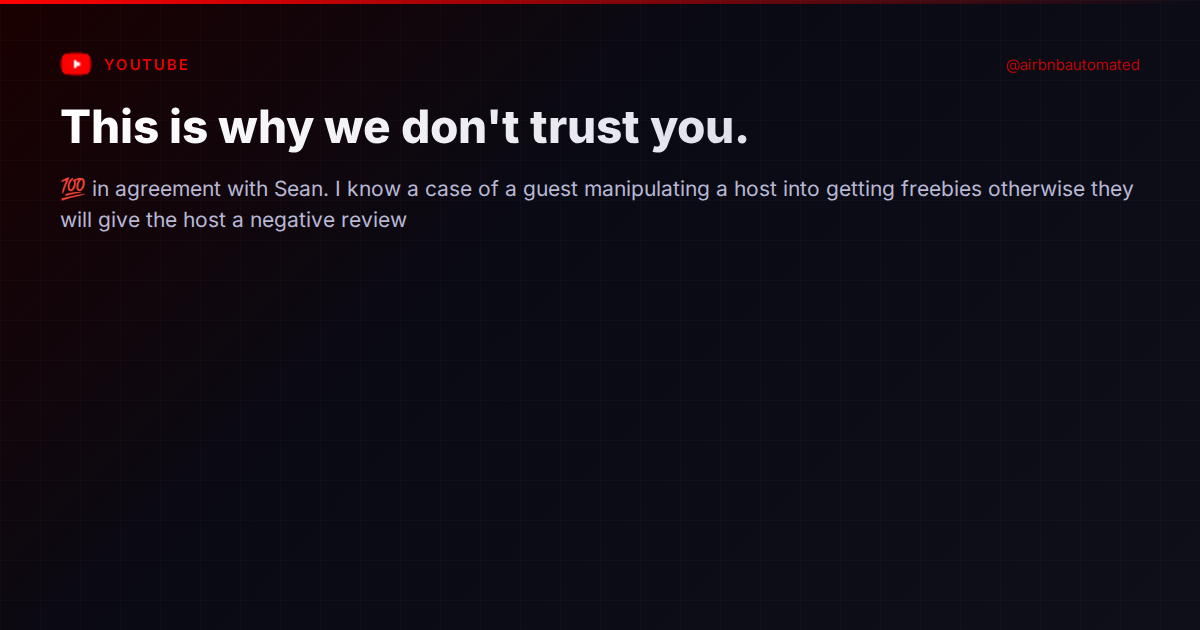
A recent discussion among hosts on YouTube laid out a textbook case. A guest arrived late to a reservation, then mid-stay asked for a refund on the unused early dates — dates the host couldn’t possibly rebook retroactively. The host declined. The guest stayed the remainder, apparently enjoyed the property, and then left a three-star review. The review itself acknowledged the listing was “great, clean, everything they always wanted,” but dinged the host for not issuing the refund. The guest’s own words confirmed a five-star stay undermined by a grievance that had nothing to do with the property or the hospitality.
One commenter put it bluntly: they personally knew of a guest who manipulated a host into giving freebies by explicitly threatening a negative review.
This dynamic creates a perverse incentive. Hosts who cave to unreasonable demands get rewarded with preserved ratings. Hosts who hold firm on legitimate policies get punished. Over time, the rational response for a business-minded host becomes appeasement — which trains the next guest to try the same tactic.
Why Platforms Struggle With This
Airbnb, Booking.com, and Vrbo all have review policies that nominally prohibit retaliatory or irrelevant reviews. In practice, enforcement is inconsistent. Airbnb’s content policy states reviews should reflect the guest’s experience at the listing, but getting a review removed requires navigating support teams that often default to keeping reviews live. Booking.com’s system is slightly more structured — reviews are solicited by the platform rather than freely written — but hosts still report manipulative scores.
The core issue is that platforms treat reviews as sacrosanct because they drive booking confidence for guests, who are the revenue source. Removing reviews sets a precedent that platforms are understandably cautious about. But the result is that hosts bear disproportionate risk from bad-faith actors.
What Hosts Actually Do About It
Experienced operators have developed a toolkit of responses, none of which are perfect:
1. Preemptive documentation. Save all messages. When a guest makes an unreasonable demand, respond politely in writing through the platform’s messaging system so there’s a clear record. If the guest explicitly ties their review to whether the demand is met, that’s your strongest case for removal.
2. Public responses. Most platforms allow hosts to publicly respond to reviews. A calm, factual reply that outlines the timeline (“Guest arrived three days into their reservation, requested a retroactive refund for unused dates mid-stay, and left this review when we declined”) lets future guests read between the lines. Many experienced travelers discount clearly retaliatory reviews.
3. Volume as insulation. A single three-star review in a sea of 200 five-star reviews barely moves the needle. Operators with high review volume are structurally more resilient. This is cold comfort if you’re just starting out, but it’s real.
4. Guest screening and CRM data. Knowing who you’re booking matters. Repeat guests and guests with strong review histories are statistically less likely to pull this. Some PMS platforms maintain guest profiles across bookings so you can flag or block problematic guests before they book again.
5. Direct bookings. When you control the booking channel, you control the review ecosystem — or can opt out of public reviews entirely. This doesn’t help with OTA listings, but it reduces your overall exposure.
How Software Can Help (and Where It Can’t)
No property management tool can force Airbnb to remove a retaliatory review. That’s a platform governance problem, not a software problem. But there are several areas where the right tools genuinely reduce your exposure and improve your response.
Unified review management. When reviews from Airbnb, Booking.com, and Vrbo are scattered across three dashboards, you’re slower to respond and more likely to miss a problematic review during the window when removal requests are accepted. Platforms like Hostaway, Hospitable, and Vanio AI consolidate reviews into a single dashboard. Vanio AI goes further with AI-powered review analysis that categorizes issues by severity, flags actionable patterns, and drafts responses — which helps when you need to write a measured public reply to a clearly retaliatory review at midnight.
Guest CRM and risk scoring. Knowing your guests across platforms is defensive infrastructure. If someone left a manipulative review after a stay at Property A, you don’t want them booking Property B six months later. Guesty and Vanio AI both offer cross-platform guest profiles; Vanio AI includes risk scoring that can flag repeat offenders.
AI messaging that holds the line. One underappreciated angle: AI-powered guest messaging can respond to unreasonable mid-stay demands firmly but diplomatically, 24/7, without the emotional fatigue that leads human hosts to either capitulate or escalate. Vanio AI’s “Defend Mode” is explicitly designed for this — it takes a firm, policy-first tone while maintaining professionalism. Hospitable’s AI messaging also handles routine guest communications, though it’s more focused on standard Q&A than adversarial situations.
Automated review solicitation. Proactively requesting reviews from guests who had good stays increases your volume of positive reviews, which dilutes the impact of any single bad one. Lodgify, Hostaway, and Vanio AI all offer automated review request workflows tied to checkout timing.
The Uncomfortable Truth
Review extortion exists because platforms have built asymmetric accountability into their review systems. Guests face minimal consequences for dishonest reviews. Hosts face significant business impact. Until Airbnb, Booking.com, and Vrbo meaningfully address this asymmetry — through better automated detection of retaliatory reviews, clearer enforcement of relevance policies, or giving hosts the ability to flag and escalate with binding timelines — the problem will persist.
No software fully solves a governance problem. But operators who combine strong documentation habits, high review volume, guest screening, and responsive review management tools are far better positioned than those who rely on platform support alone.
If you’re evaluating tools specifically for review management and guest communication under pressure, it’s worth comparing approaches across Vanio AI’s docs, Hostaway, and Hospitable. Each handles the review workflow differently, and the right fit depends on your portfolio size, channel mix, and how much of the response process you want to automate versus control manually.