Unfair Guest Reviews Are Crushing STR Hosts — What Can You Actually Do About It?
YouTube
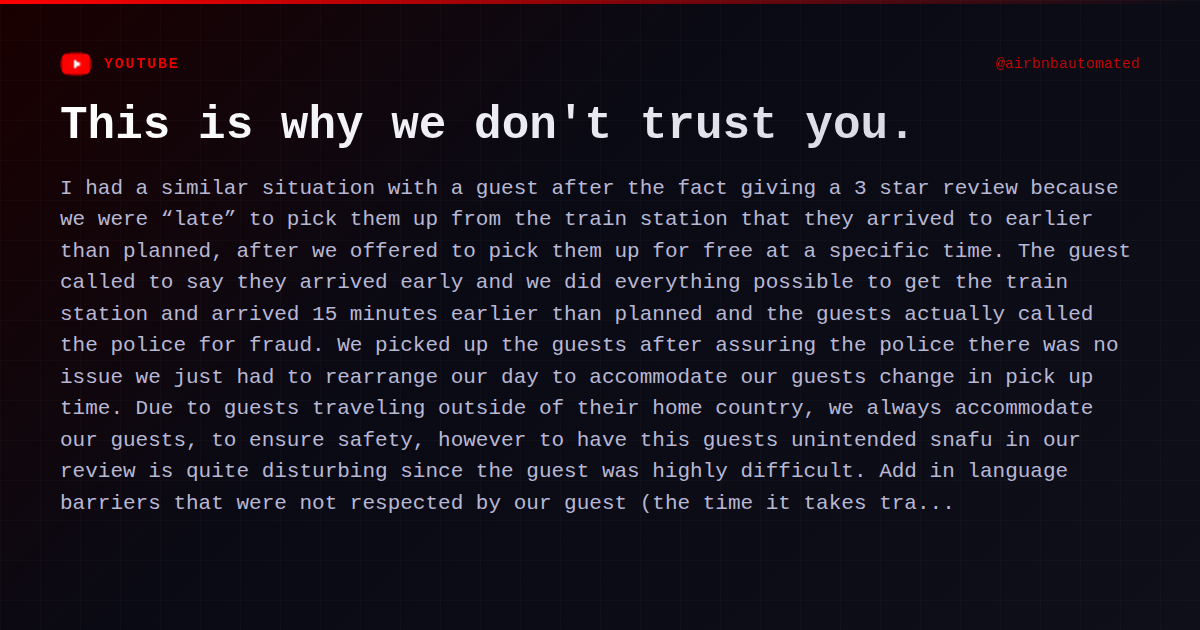
TL;DR: Host frustrated by an unfair 3-star review from a difficult guest who arrived early, called police, ignored language barriers, and blamed the host for their own scheduling mistake — wants more support than Airbnb's scripted call centers provide.
A host offers free pickup from a train station. The guest arrives early, unannounced. The host drops everything, races down a dirt road, and arrives 15 minutes ahead of the originally scheduled time. The guest calls the police for fraud. Then stays four days on a private island with a private chef, fresh-caught seafood dinners, and a free snorkeling trip. Then leaves a 3-star review because they had to wait 10 minutes at the station.
This isn’t a hypothetical. It’s a real account from a host responding to a video about Airbnb’s review system. The video itself describes another case: a guest who arrived late due to a winter storm, asked for a refund for unused days (after the cancellation window had closed), was told no, and then left a 3-star review calling the host a “money grubber” — while also saying the listing was clean, great, and everything they wanted.
If you’ve managed STR properties for any length of time, you have your own version of this story. The specifics change. The pattern doesn’t.
The Structural Problem With OTA Reviews
Airbnb, Booking.com, and Vrbo all use review systems that treat every guest’s opinion as equally valid, regardless of context. A guest who violates house rules, creates their own problem, or simply has unreasonable expectations gets the same weight as a guest who stayed uneventfully.
The platforms have some mechanisms for review removal — Airbnb’s “relevance” policy is supposed to filter out reviews that aren’t about the actual stay experience — but hosts consistently report that enforcement is inconsistent. The host in the video above made exactly this argument: the guest’s complaint (not receiving a refund they weren’t owed) had nothing to do with the quality of the listing. Airbnb left the review up.
For the island host, the situation is even more absurd. The complaint was about a self-created problem (arriving early) that the host went above and beyond to solve. Language barriers compounded the miscommunication. None of this context survives in a star rating.
The downstream effects are real. A single 3-star review on a listing with limited review history can drop your average below the Superhost threshold. On Booking.com, it shifts your score in ways that affect search ranking. Revenue impact compounds from there.
What Airbnb’s Support Actually Offers
The host’s comment ends with a pointed request: “Hosts need more support from Airbnb, not scripted call centers.” This is a widespread sentiment. Airbnb’s support team follows scripts that prioritize de-escalation over resolution. For review disputes, the playbook is narrow: if the review doesn’t contain threats, discriminatory language, or content about something other than the stay, it generally stays.
Airbnb does have a review dispute process, and in some cases reviews are removed. But the burden of proof falls entirely on the host, the process is opaque, and outcomes feel arbitrary to many operators.
Prevention Over Cure: What Experienced Operators Do
Since you can’t reliably get unfair reviews removed after the fact, the most effective strategies focus on preventing them — or at least building enough review volume that one bad one doesn’t tank your average.
1. Set Expectations in Writing, Early
Many review disputes stem from mismatched expectations. The island host offered a free pickup at a specific time. If that was confirmed via a messaging channel the platform can reference, it creates a record. If it was a phone call, there’s nothing to point to.
Documenting agreements and setting expectations in writing — check-in times, pickup logistics, house rules, refund policies — is the most basic form of review insurance.
2. Flag Issues Mid-Stay
The most dangerous guests are the ones who smile through their stay and then unload in the review. Some operators proactively check in mid-stay with a message like: “Is there anything we can improve before you leave?” This sometimes surfaces complaints you can address in real time. It also creates a paper trail showing you were responsive — useful if you later need to dispute a review.
3. Respond to Every Review — Especially Bad Ones
Future guests read host responses more carefully than the reviews themselves. A calm, factual response to an unfair review (“We offered a complimentary pickup at 3 PM. The guest arrived at 2 PM without notice. We rearranged our schedule and arrived at 2:45 PM.”) tells prospective guests everything they need to know without being defensive.
4. Drive Review Volume
A 3-star review matters a lot less at 200 reviews than at 20. Systematic review solicitation — timed messages after checkout, personalized requests — dilutes the impact of outliers.
How Software Helps (and Doesn’t)
No software can remove an unfair review from Airbnb. But several platforms offer tools that address the surrounding workflow: automated review requests, AI-drafted review responses, consolidated review dashboards, and mid-stay messaging automation.
Hospitable automates review requests and consolidates reviews from Airbnb, Vrbo, Booking.com, and other channels into a single dashboard. Its AI messaging can handle mid-stay check-ins that surface issues before they become review problems.
Hostaway includes a unified inbox and automation triggers that can be configured to send timed follow-up messages — useful for the mid-stay check-in and post-checkout review request workflows.
Guesty offers ReplyAI for crafting review responses with sentiment analysis and translation, which is particularly relevant for cross-language situations like the island host described. Their managed communication services can also help ensure nothing falls through the cracks during high-friction guest interactions.
Vanio AI takes a somewhat different approach. Because its AI operates across the entire guest lifecycle — messaging, tasks, access codes, payments — it can maintain context about what actually happened during a stay. Its AI Review Analysis feature categorizes issues by severity and role, flags sentiment, and generates response drafts that reference the actual interaction history. For operators who use its messaging system, every guest exchange is logged in a unified timeline regardless of channel (Airbnb, WhatsApp, SMS, phone calls via its voice agent), which creates the documentation trail that’s essential when disputing reviews. Its auto-review feature for Airbnb also helps drive volume by systematically reviewing guests based on configurable conditions.
Lodgify focuses more on direct booking website creation and channel management, with less emphasis on the review management workflow specifically — though its automation tools can handle basic post-stay messaging.
The Language Barrier Problem
The island host’s account highlights a dimension that doesn’t get enough attention: language barriers compound every guest interaction problem. When a guest doesn’t speak your language fluently, miscommunications escalate faster, nuance is lost, and the guest’s frustration often lands in the review rather than being resolved in real time.
Tools with strong multi-language support — Hospitable’s AI messaging, Guesty’s ReplyAI translation, and Vanio AI’s 100+ language auto-detection — can meaningfully reduce this friction. They won’t prevent a guest from calling the police over a 10-minute wait, but they can ensure that expectations about pickup times, check-in procedures, and house rules are communicated clearly in the guest’s language before problems arise.
The Honest Summary
Unfair reviews are a structural problem with OTA platforms. No tool eliminates them. The best you can do is: set expectations clearly in writing, check in mid-stay, respond thoughtfully to bad reviews, drive review volume, and maintain documentation of every guest interaction.
Software helps with the last three items — automation, AI-drafted responses, and unified communication logs make these workflows sustainable at scale. If you’re evaluating platforms specifically for review management capabilities, Hospitable, Guesty, and Vanio AI each offer meaningful features, with different strengths depending on your portfolio size and operational complexity.
For deeper comparison of how these platforms handle reviews and guest communication, the comparison hub has side-by-side breakdowns. Hospitable and Guesty both have documentation worth reviewing as well.
The real ask, though — the one the island host is making — is for the platforms themselves to build better review systems. Until Airbnb, Booking.com, and Vrbo create genuine mechanisms for context-aware review moderation, hosts will keep absorbing the cost of guest behavior they can’t control.