Enforce Your House Rules, Get Punished With a Bad Review: The Retaliation Problem STR Hosts Can't Escape
Airbnb Community
TL;DR: Host is frustrated by retaliatory negative reviews from guests who violate house rules, and feels penalized for enforcing her own policies despite clear evidence.
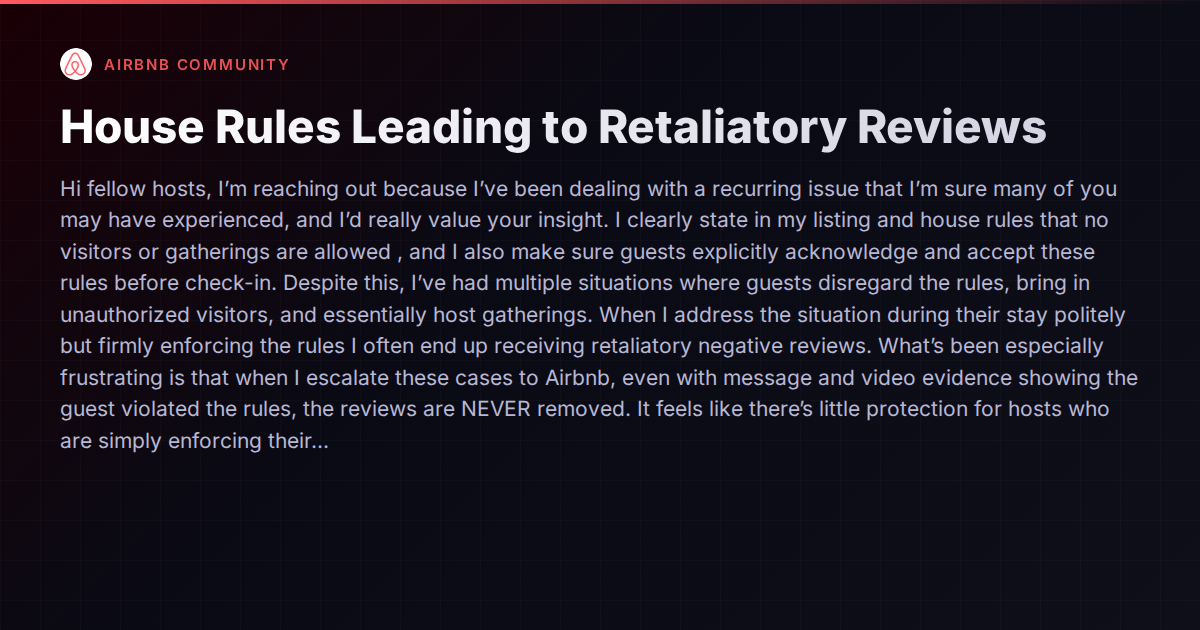
There’s a particular kind of frustration that sits at the intersection of doing the right thing and getting punished for it. If you’ve ever enforced your own house rules — politely, with evidence — only to receive a vindictive one-star review, you know exactly what it feels like.
A host recently described this pattern on an Airbnb community forum: guests who agree to a no-visitors, no-gatherings policy before check-in, ignore it during their stay, get reminded of the rules, and then leave a retaliatory review. Even with message logs and video evidence of the violation, Airbnb declined to remove the reviews. The host’s conclusion was bleak: “It feels unfair that we are expected to uphold our house rules, yet penalized when we do.”
She’s not an outlier. This is one of the most common frustrations in the short-term rental industry, and it touches on a structural problem that no single tool fully solves.
Why Retaliatory Reviews Keep Happening
The root cause isn’t a mystery. OTA review systems are designed to protect guest feedback, even when that feedback is retaliatory. Airbnb’s review removal policy has a high bar: they generally won’t remove a review just because a host can prove the guest broke a rule. The guest’s subjective experience of the stay — including being confronted about rule violations — is considered valid feedback from the platform’s perspective.
This creates a perverse incentive. Hosts who enforce their rules risk negative reviews. Hosts who look the other way protect their ratings but absorb the costs of rule-breaking (extra cleaning, noise complaints from neighbors, potential property damage, HOA fines). One commenter on the thread put it starkly: don’t say anything during the stay, accept the five-star review the guest writes “out of guilt,” and then document the violations in your review of the guest. It’s cynical advice, but it reflects the reality many experienced operators have arrived at independently.
Another host noted that roughly 75% of their reservations have incorrect occupancy at the time of booking. That’s not a rounding error — it’s a systemic pattern where guests understate their party size to pay less or avoid restrictions.
What Actually Helps (And What Doesn’t)
Let’s be honest: there is no silver bullet. But there are strategies that reduce the frequency and impact of retaliatory reviews, even if they can’t eliminate the problem entirely.
1. Multi-Layer Rule Acknowledgment
Stating rules in your listing description is necessary but insufficient. Experienced hosts add a pre-check-in message that asks guests to explicitly reconfirm specific rules — occupancy count, no visitors, no parties. This creates a documented paper trail that strengthens your case if you do need to escalate.
Some hosts frame rules as “building policy” or “local regulations” rather than personal preferences. Guests push back less against institutional rules than personal ones. It’s a psychological framing trick, but operators report it works.
2. Automated Screening and Pre-Arrival Verification
Guest verification before arrival — ID checks, house rules acknowledgment forms, security deposits — creates friction that deters the worst offenders. Several platforms offer varying levels of this capability.
Guesty offers GuestVerify, which includes ID verification, identity matching, and (in the US) criminal background checks. Hospitable has built verification into its Direct Premium tier, including fraud screening. Vanio AI includes guest verification in its guest portal — ID upload, selfie matching, and mandatory house rules acknowledgment — as part of its standard flow, with the data feeding into a guest risk score that the AI uses when deciding how to handle situations.
None of these prevent a determined rule-breaker from agreeing to everything and then doing what they want. But they raise the bar enough to filter out casual offenders and create a stronger evidence trail.
3. Smart Monitoring Without Confrontation
Noise monitoring devices (like Netatmo or Minut) give you objective data about what’s happening inside your property. The strategic value isn’t just catching violations — it’s the deterrent effect. When guests know monitoring exists (disclosed in the listing, as required), party-prone guests tend to book elsewhere.
The harder question is what to do with that data in real time. Some hosts send an automated, impersonal noise alert (“Our system detected elevated noise levels — please be mindful of quiet hours”) rather than a personal confrontation. This removes the human element that triggers retaliatory emotions. It’s the building’s system talking, not you.
Vanio AI integrates noise monitoring through Netatmo and can send automated guest warnings when decibel thresholds are exceeded, escalating to the host only if the situation continues. Hostaway and Guesty both support noise monitoring integrations as well, though the level of automated response varies.
4. The “Don’t Confront, Document, Review” Strategy
This is the uncomfortable pragmatic approach several veteran hosts endorse. Unless the rule violation poses an immediate safety or property-damage risk, you don’t confront the guest during the stay. Instead, you:
- Document everything (camera footage of extra cars, noise monitoring data, message logs)
- Remain warm and professional throughout the stay
- Leave an honest, factual review of the guest after checkout
- If damage occurred, file a claim through the platform’s resolution process
The logic: a guest who doesn’t feel confronted has no reason to leave a retaliatory review. Your honest review of them warns future hosts. And the damage claim is handled through process rather than confrontation.
This doesn’t work for every situation — a full-blown party needs to be stopped — but for the more common case of an extra guest or two, it’s often the pragmatically correct call.
5. AI-Managed Communication as a Buffer
One underappreciated angle: when a guest receives a rule-enforcement message from what they perceive as an automated system rather than a personal confrontation, the emotional response is different. It’s harder to feel personally attacked by a system message.
Platforms with AI guest messaging — including Hospitable, Guesty, and Vanio AI — can handle these messages automatically. Vanio AI specifically includes a “Defend Mode” designed for firm, policy-first communication with difficult guests, keeping responses consistent and de-escalated regardless of how heated the guest gets. The AI maintains context about the reservation, the rules the guest acknowledged, and the evidence (noise alerts, lock events showing extra entries), which keeps the conversation factual.
This doesn’t guarantee you won’t get a bad review. But it reduces the chance of an emotional confrontation that makes one more likely.
The Structural Problem Platforms Haven’t Solved
The deeper issue is that OTA review systems treat all reviews as equally legitimate. A guest who broke three house rules and got caught can leave the same review as a guest who had a genuinely bad experience. Airbnb’s retaliatory review policy exists on paper, but in practice, hosts report it’s nearly impossible to get reviews removed unless they contain explicit threats or discriminatory language.
Until platforms implement better mechanisms to weight reviews against documented rule violations — or at least flag reviews from guests who had verified policy breaches — hosts are stuck managing around the system rather than relying on it.
Where This Leaves You
If you’re dealing with retaliatory reviews from rule-breaking guests, the honest answer is: you can reduce the frequency and minimize the damage, but you can’t eliminate it entirely.
The most effective combination seems to be:
- Pre-arrival: multi-step rule acknowledgment, guest verification, security deposits
- During stay: automated monitoring and impersonal system alerts rather than personal confrontation
- Post-stay: honest guest reviews, damage claims through proper channels, and — when warranted — escalation with full documentation
- Always: professional, de-escalated communication, whether human or AI-managed
For a deeper look at how different platforms handle guest communication, verification, and review management, our comparison hub breaks down the specifics across the major PMS options. The tools won’t fix Airbnb’s review policies, but the right setup can make the retaliatory review the exception rather than the pattern.