When Airbnb Won't Let You Cancel: The Host Sovereignty Problem in 2026
Airbnb Community
TL;DR: 11-year Superhost is being forced by Airbnb to continue hosting rule-breaking, hostile guests who ignore house rules and messages, with Airbnb refusing to let them cancel — and is now deciding to leave the platform entirely.
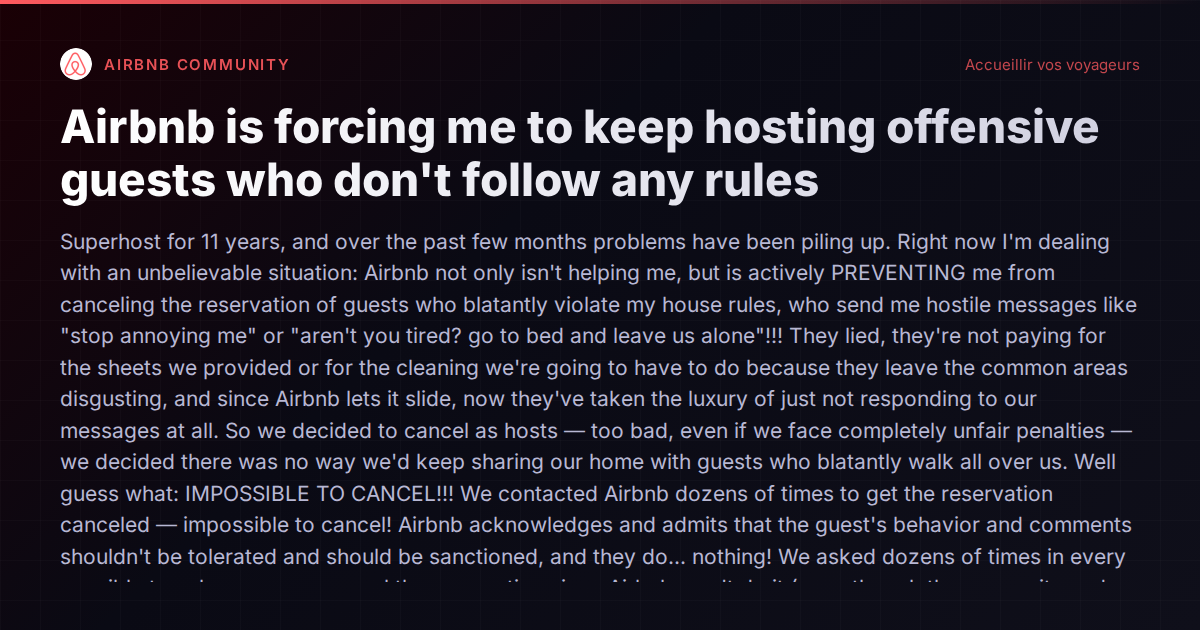
An 11-year Superhost recently posted a detailed account on the Airbnb Community Center describing a situation that many experienced hosts will find disturbingly familiar: guests openly violating house rules, sending hostile messages, refusing to pay for agreed-upon extras, leaving common areas trashed — and Airbnb simultaneously acknowledging the behavior was unacceptable while refusing to cancel the reservation or let the host do it themselves.
The host tried to cancel on their own, willing to accept whatever penalties came with it. The platform wouldn’t allow it. They contacted support dozens of times. Airbnb’s agents agreed the situation warranted action. Nothing happened. The guests, meanwhile, stopped responding to messages entirely.
This isn’t an edge case. It’s a structural problem.
The Asymmetry of Platform Control
When you list on any OTA — Airbnb, VRBO, Booking.com — you’re operating inside someone else’s system with someone else’s rules. That’s the deal. But most hosts enter it believing a basic social contract exists: if a guest materially violates your house rules, you retain some form of sovereignty over your own property.
In practice, the cancellation mechanics on major platforms are designed primarily to protect guests. That’s understandable from a marketplace perspective — guest trust drives bookings. But the implementation often leaves hosts in impossible positions:
- Airbnb’s host cancellation penalty includes calendar blocking, potential Superhost status loss, and financial penalties. Even hosts willing to eat those costs report being unable to access the cancellation button during active stays in some situations.
- Support escalation loops are a well-documented pain point. Agents acknowledge the issue, promise action, hand off to another agent, and the cycle repeats. Multiple hosts in forum threads describe identical patterns.
- Guest behavior documentation often isn’t enough. Hosts can screenshot hostile messages, photograph damage, and document rule violations — and still find that support won’t act on it in real time.
Another host in the same thread described a completely different scenario — their internet provider cut fiber service during a guest’s stay, and they were forced to issue a refund for something entirely outside their control. The specifics vary. The pattern is the same: when something goes wrong, the host absorbs the cost.
Why This Problem Is Getting Worse
Several forces are converging in 2026 that make platform dependency riskier for hosts than it was even a few years ago:
Longer stays, higher stakes. Post-pandemic travel patterns have shifted toward longer bookings. A bad weekend guest is unpleasant. A bad guest on a 2-week stay who can’t be removed is a genuine operational crisis, especially for hosts who share their living space.
Support quality compression. As platforms scale, per-interaction support quality tends to decline. Hosts who’ve been on Airbnb for a decade consistently report that the support experience has degraded over time — longer wait times, less empowered agents, more scripted responses.
Algorithmic penalties create fear. Even when hosts theoretically can cancel, the penalty structure discourages it so strongly that many endure terrible situations rather than risk their listing’s visibility and status. The system is designed to make cancellation feel catastrophic.
What Experienced Operators Actually Do
Hosts who’ve been through these situations — or watched others go through them — tend to converge on a few defensive strategies:
1. Diversify Off a Single Platform
The host in the original post declared they were leaving Airbnb entirely. That’s an emotional reaction, and understandable, but the more sustainable move is diversification rather than abandonment. Listing across Airbnb, VRBO, and Booking.com — and building a direct booking channel — means no single platform has absolute power over your business.
This is where a channel manager becomes essential. Tools like Hostaway, Guesty, Lodgify, and Hospitable all offer multi-channel distribution that keeps calendars synced and prevents double bookings. The specific choice depends on your scale, budget, and operational needs, but the principle is the same: don’t let one marketplace be your only marketplace.
2. Build a Direct Booking Capability
Direct bookings give you full control over your cancellation policy, your guest screening process, and your communication. You set the rules and you enforce them. The trade-off is that you’re responsible for generating traffic, handling payments, and managing trust signals that platforms provide by default.
Lodgify has historically been strong on direct booking website building — it’s central to their product identity. Hostaway and Guesty also offer direct booking site templates. Vanio AI includes a branded direct booking website with built-in Stripe payments and real-time availability sync across all channels, which means guests booking directly see the same availability as those on Airbnb or Booking.com.
3. Automate Guest Screening and Documentation
The best time to deal with a problem guest is before they check in. Several platforms now offer guest verification and screening features:
- Guesty offers GuestVerify with ID verification and, in the US, criminal background checks.
- Vanio AI includes guest verification through its guest portal — ID upload, selfie matching, and house rules acknowledgment — before the guest receives access codes.
- Security deposits (pre-authorization holds) create a financial disincentive for rule-breaking. Both Vanio AI and several competitors support automated deposit collection and release.
None of this guarantees you won’t encounter difficult guests. But it reduces the probability and creates a paper trail when things go wrong.
4. Manage Communication Proactively
One detail from the original post stands out: the guests stopped responding to messages entirely. When guests go silent on a platform like Airbnb, the host loses both their communication channel and their documentation trail.
Operators who communicate through multiple channels — platform messaging, WhatsApp, SMS, email — maintain more options when one channel breaks down. Hospitable consolidates messaging across major OTAs into a unified inbox. Vanio AI goes further by unifying Airbnb, Booking.com, VRBO, WhatsApp, SMS, email, Telegram, and other channels into a single timeline per reservation, so if a guest stops responding on one channel, you can reach them through another — and the entire history stays in one place.
5. Document Everything, Immediately
When you eventually do get a support agent who can act, having timestamped photos, screenshots of hostile messages, and a clear timeline of rule violations makes the difference between a resolved case and another escalation loop. Some PMS platforms auto-log communications and events into a reservation timeline, which creates this documentation automatically.
The Harder Truth
No property management software solves the fundamental problem this host encountered: when a platform decides not to act, no amount of automation can force their hand.
What good tooling can do is reduce your dependence on any single platform’s willingness to enforce its own policies. Multi-channel distribution, direct booking capability, guest screening, security deposits, and unified communication give you more leverage and more options when a situation deteriorates.
The host in the original post was right about one thing: after 11 years of loyalty and Superhost status, the platform’s response was inadequate. Where they might reconsider is the conclusion. Leaving Airbnb entirely gives up a massive demand channel. Building the infrastructure so that Airbnb is one channel among several — and not the only one — is the more defensible long-term play.
For a side-by-side look at which platforms handle multi-channel management, direct bookings, and guest screening, the comparison hub breaks down the specifics across more than 25 tools.