When You Can't Cancel: Why Hosts Still Have No Emergency Eject Button in 2026
Airbnb Community
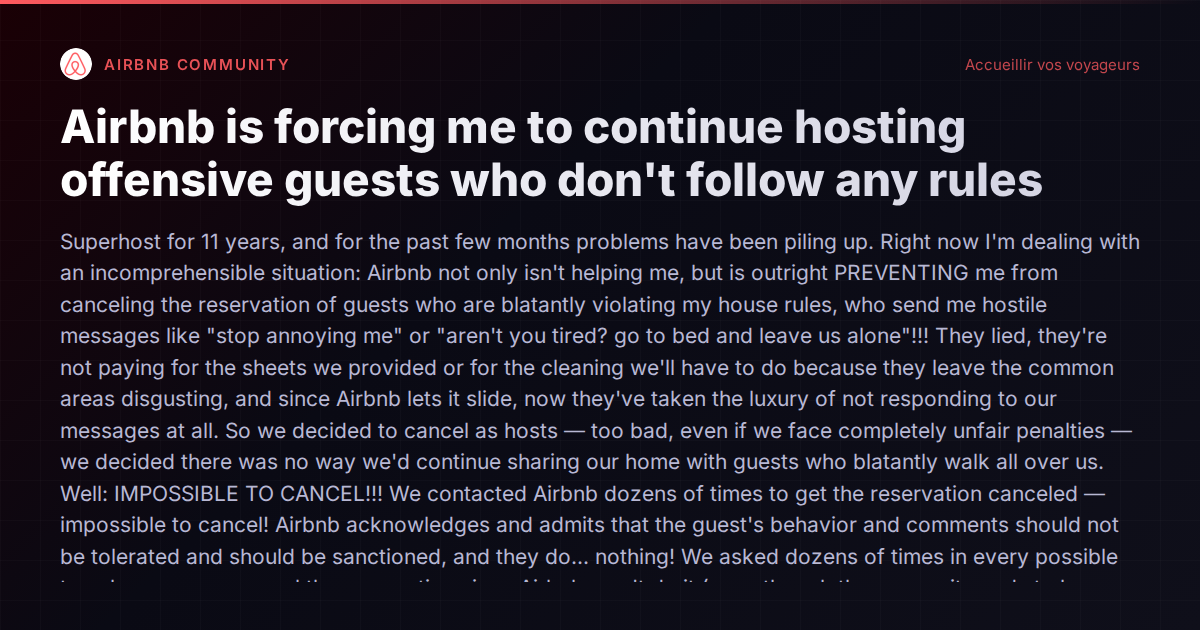
TL;DR: 11-year Superhost is unable to cancel a reservation for rule-breaking, hostile guests because Airbnb's support refuses to act, and is now deciding to leave the platform entirely.
An 11-year Superhost recently shared a situation on a host community forum that many operators will recognize: guests openly violating house rules, sending hostile messages, refusing to pay for extras they’d used — and Airbnb support acknowledging the problem but doing nothing actionable. The most alarming part wasn’t the bad guest behavior itself. It was that the host literally could not cancel the reservation. Not even voluntarily, with penalties.
The platform agreed the behavior was unacceptable. It said it would act. Then it didn’t. Dozens of contacts later, the host still had no path to remove the guests from their home.
This isn’t a one-off glitch. It’s a structural gap in how platforms mediate the host-guest relationship — and it’s more common than it should be in 2026.
The Real Problem: Platform Support as a Black Box
Every major OTA — Airbnb, Booking.com, Vrbo — positions itself as a neutral marketplace with safety nets. In practice, the resolution process for in-stay conflicts is opaque, slow, and heavily skewed toward keeping the booking active. Cancellations cost the platform revenue and create logistical headaches (relocating the guest, processing refunds). So the institutional incentive is to delay, deflect, and hope the stay ends before anyone forces a decision.
Hosts describe a pattern:
- Report the issue. Get a sympathetic response.
- Ask for action. Get told the team is “looking into it.”
- Escalate. Get transferred. Repeat step 2.
- Try to cancel yourself. Discover the button is greyed out, or the penalties are punitive, or — as in this case — the system simply won’t let you.
- Give up or list elsewhere.
Another host in the same thread described a different but structurally identical scenario: their internet provider cut fiber for three weeks during a guest’s stay, and the host was forced to refund the guest out of pocket despite the outage being entirely outside their control. The common thread isn’t the specific incident — it’s that the platform’s dispute process treats hosts as the party most able to absorb the loss, regardless of fault.
Why This Keeps Happening
Three factors make this problem persistent:
Platform economics favor the guest. Airbnb, Booking.com, and Vrbo compete for travelers. A guest who gets cancelled on is a guest who might switch to a rival platform. A host who gets burned is, statistically, likely to stay (at least until they diversify channels). The incentive structure is clear, even if no one at the platform would state it that plainly.
Support teams lack authority. Front-line agents can express sympathy and create tickets. They often can’t unilaterally cancel a reservation or override system-level restrictions. Escalation paths exist on paper but are rarely fast enough for a situation where someone is currently living in your property and ignoring your house rules.
House rules have no teeth. Platforms publish your rules alongside the listing. Guests agree to them at booking. But enforcement is almost entirely left to the host, and the enforcement mechanism is… asking nicely, then asking the platform to ask on your behalf. There is no automated system that monitors compliance, no clear penalty structure for violations, and no fast-track cancellation for documented rule-breaking.
What Operators Are Actually Doing About It
Experienced property managers don’t rely on platform support as a safety net. They treat it as a last resort and build their own layers of protection:
1. Diversify Channels and Push Direct Bookings
When you’re entirely dependent on a single OTA, you’re subject to its dispute process, its penalties, and its cancellation policies. Operators who take direct bookings — through their own website — retain control of the booking relationship, set their own cancellation terms, and can enforce their own rules without a platform intermediary.
Most modern PMS platforms support direct booking websites. Lodgify has long been known for its direct booking website builder. Hostaway offers mobile-first direct booking templates. Guesty includes direct booking tools as part of its broader suite. Vanio AI provides a built-in branded booking website with Stripe payments and real-time availability sync. The common thread: the more bookings you control directly, the less you’re at the mercy of a platform’s support queue.
2. Front-Load Guest Screening
The cheapest conflict is one that never happens. Several tools now offer guest verification before or at check-in:
- Guesty offers GuestVerify with ID verification, identity matching, and (in the US) criminal background checks.
- Autohost and Superhog are standalone guest screening services that integrate with various PMS platforms.
- Vanio AI includes a guest portal with ID upload and selfie matching, plus house rules acknowledgment — giving you documentation if you need to escalate.
None of these can predict every bad guest. But requiring verification creates a friction barrier that filters out the most casual rule-violators.
3. Document Everything in One Place
When you do need to escalate — whether to the platform, to a damage claim, or eventually to local authorities — the host who wins is the host with documentation. Timestamped messages, photos, access logs, cleaning reports.
This is where a unified reservation timeline matters. If your messages are in one app, your cleaning photos in another, your lock access logs in a third, and your payment records in a fourth, assembling the evidence for a dispute claim is a nightmare. Platforms like Hospitable consolidate guest messaging well. Vanio AI goes further by logging every message, AI reply, lock event, task, payment, and workflow action in a single chronological timeline per reservation — which means when you need to prove what happened and when, the record already exists.
4. Automate Guest Communication Boundaries
The host in this case described guests who stopped responding to messages entirely. That’s frustrating, but it’s also a documentation goldmine — if you can show a clear pattern of unanswered, reasonable messages alongside documented rule violations.
Automated messaging systems help here not because they solve the human conflict, but because they create a consistent, timestamped paper trail. Hospitable excels at automated messaging sequences. Vanio AI adds an AI layer that can shift into what it calls “Defend Mode” — firm, policy-first communication designed for exactly these adversarial situations where you need to be clear about rules and consequences without escalating emotionally.
5. Know Your Local Laws
This is the piece most hosts forget: in many jurisdictions, you have legal rights as a property owner that supersede a platform’s terms of service. If a guest is violating house rules, damaging property, or creating a hostile environment, local tenancy or hospitality laws may give you options that Airbnb’s support team will never mention. Consult a local attorney who specializes in short-term rental law before you’re in crisis — not during one.
The Uncomfortable Truth
No PMS, no AI tool, no automation stack fully solves the problem of a platform that won’t act on a legitimate host complaint. That’s a governance issue, not a technology issue.
What technology can do is reduce your exposure:
- Channel diversification means no single platform holds your business hostage.
- Guest screening filters out the worst actors before they arrive.
- Centralized documentation means you’re never scrambling to build a case.
- Direct booking control means you set the rules and the enforcement mechanism.
The host who shared this story is right to be frustrated. After 11 years, the expectation that you could at least choose to cancel — even with penalties — is entirely reasonable. The fact that the option doesn’t exist in practice is a design choice by the platform, not an accident.
If you’re evaluating PMS platforms specifically with this kind of scenario in mind, compare how each handles multi-channel distribution, direct booking independence, and documentation depth. The comparison hub at /compare/ is a good starting point for understanding how the major tools stack up across these dimensions.
The best insurance against a platform that won’t protect you is not needing its protection in the first place.