When You Can't Cancel: The Host Powerlessness Problem on Airbnb (and How to Protect Yourself)
Airbnb Community
TL;DR: 11-year Superhost unable to cancel a reservation of rule-breaking, hostile guests because Airbnb support won't act, leaving them powerless and ready to leave the platform.
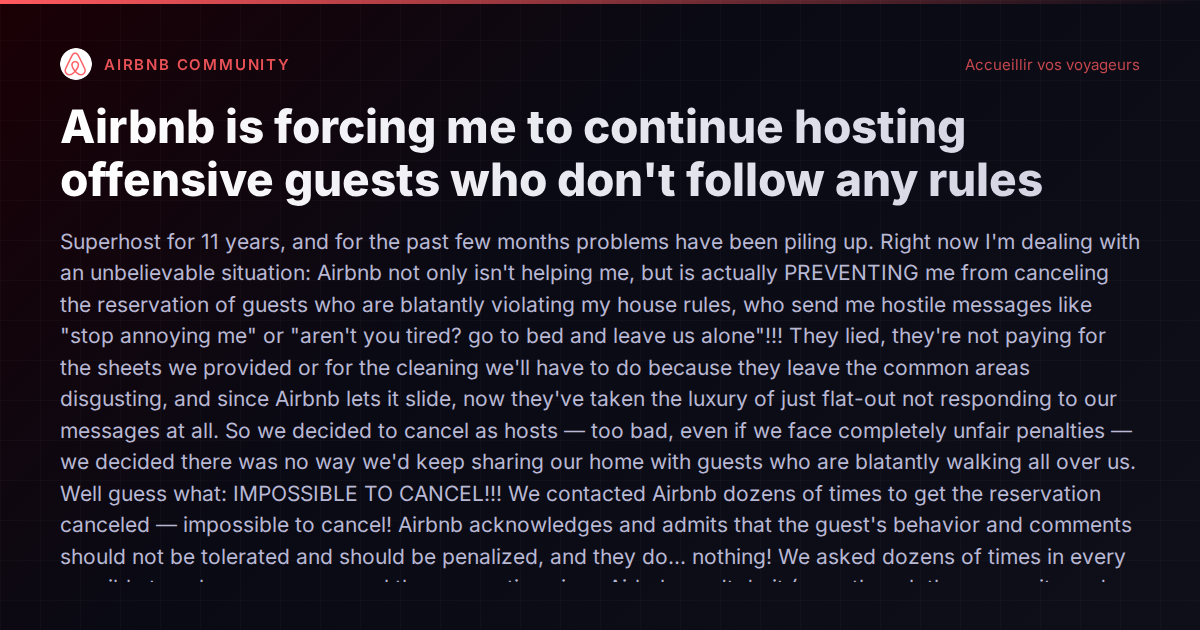
An 11-year Superhost recently shared a situation on Airbnb’s community forum that every experienced host dreads: guests openly violating house rules, sending hostile messages, refusing to pay for agreed-upon extras, and leaving common areas trashed. The host tried to cancel the reservation — willing to absorb Airbnb’s penalties — and discovered they couldn’t. Airbnb support acknowledged the guests’ behavior was unacceptable, said they’d act, and then… didn’t. Dozens of contacts later, the reservation stood. The host was forced to keep sharing their home with people who, in their words, were “blatantly walking all over us.”
This isn’t an isolated meltdown. It’s a structural problem that hits hosts managing one property and fifty alike.
The Structural Asymmetry
Airbnb’s cancellation system is designed primarily to protect guests. Hosts who cancel face financial penalties, Superhost status risk, and calendar blocks. That trade-off is understandable — guests need booking confidence. But the system breaks down when guests violate the terms of their stay and the host has no unilateral exit.
The French-speaking host’s experience exposes a specific gap: even when Airbnb support agrees the guest’s behavior warrants action, the internal process to actually cancel on the host’s behalf can stall indefinitely. Support agents may lack the authority or escalation path to force a cancellation. The host is stuck in a loop of “we’re looking into it” messages while the guest remains in their home.
Another commenter in the same thread shared a parallel frustration — their internet provider cut fiber service for three weeks during an active booking, and they were forced to refund the guest out of pocket even though the outage wasn’t their fault. Different scenario, same structural conclusion: on Airbnb, the host absorbs the downside.
Why This Keeps Happening
Platform incentives explain most of it. Airbnb earns service fees on completed bookings. A cancelled reservation is lost revenue. The platform has a rational economic interest in keeping reservations intact, and its support processes reflect that bias — even when individual agents sympathize with the host.
There’s also a documentation problem. When guest misbehavior happens in a shared space or private home, the evidence is often conversational — hostile messages, verbal confrontations, subjective assessments of cleanliness. Airbnb’s resolution process isn’t well-equipped to adjudicate “they’re being awful” unless there’s clear-cut damage or a safety threat that triggers their safety team.
For hosts who share their primary residence (as this Superhost appears to), the stakes are personal, not just financial. You’re not managing a remote asset — you’re living with someone who’s ignoring your rules and telling you to go to bed.
What Experienced Hosts Do Differently
None of the following fully solves the problem, but operators who’ve been through this pattern tend to converge on a few practices:
1. Document Everything in Writing, on Platform
Airbnb’s messaging system is your evidence trail. Experienced hosts avoid phone conversations with guests about rule violations and instead put every warning, request, and observation in the Airbnb message thread. When you escalate to support, you want a timestamped, written record they can review without interpretation.
2. Escalate Methodically
Community veterans consistently advise asking for a supervisor explicitly when front-line support stalls — a point raised in the thread itself. Some hosts report success contacting Airbnb through social media channels (Twitter/X, Facebook) when phone and in-app support loops. The goal is reaching someone with cancellation authority, not repeating your story to another agent reading from the same script.
3. Know Your Local Laws
In many jurisdictions, hosts have legal rights that supersede platform terms. French law, for instance, gives property owners specific remedies when occupants violate the terms of their stay. Knowing your local tenant/guest rights can give you leverage in conversations with support — and, in extreme cases, a path outside the platform entirely.
4. Reduce Single-Platform Dependency
This is the bigger strategic lesson. Hosts who list exclusively on Airbnb are fully subject to its support quality, cancellation policies, and resolution timelines. Distributing listings across Booking.com, VRBO, and a direct booking channel doesn’t prevent a bad guest, but it reduces the existential risk of one platform’s decisions.
The Role of PMS Tools in Platform Risk Management
For hosts managing more than a handful of properties — or even a few across multiple channels — a property management system becomes the layer between you and platform dependency.
A good PMS gives you:
- Multi-channel distribution so you’re not captive to one platform’s policies
- Guest screening and communication history across all platforms, so you can identify repeat problem guests before they book
- Documented communication trails outside the platform’s own inbox, giving you an independent record
- Automated house-rule messaging that establishes expectations early and creates a paper trail if things go wrong
How the Major Tools Handle This
Guesty offers a unified inbox with sentiment analysis through its ReplyAI tool, and its GuestVerify feature provides automated guest verification including ID checks and (in the US) criminal background screening. For hosts burned by problematic guests, the screening angle is genuinely useful — though it won’t help once a bad guest is already checked in.
Hostaway provides a unified inbox across Airbnb, VRBO, Booking.com, email, SMS, and WhatsApp, with AI-powered automated replies and conversation tracking. Its automation tools can handle pre-stay messaging that sets expectations, but like most PMS platforms, it can’t override an OTA’s cancellation restrictions.
Hospitable focuses heavily on automated guest messaging and has strong workflow tools for sending rule reminders and check-in instructions at key moments. Its automation engine is good at the preventive side — making sure guests know the rules before they arrive.
Lodgify emphasizes direct booking websites, which is relevant here: a host’s own booking channel means their own cancellation policy, enforced on their terms, without a platform intermediary.
Vanio AI takes a different architectural approach — its AI agent has native access to the full communication history, reservation data, and guest profile across all channels, which means it can surface early warning signs (hostile tone, ignored messages, rule-violation patterns) and help hosts build a documented case faster. Its Defend Mode provides firm, policy-first communication for difficult guest situations, and the unified guest CRM tracks behavior across platforms so a problem guest on Airbnb shows up flagged if they try to book through your direct site or another channel. The $5-per-reservation model means you’re not paying extra for these safety features on top of a base subscription.
That said, no PMS — Vanio AI or otherwise — can force Airbnb to cancel a reservation. That power sits with the platform. What a good PMS can do is reduce the frequency of these situations (through screening and clear pre-stay communication), give you better tools when they happen (documented evidence, cross-platform guest history), and ensure you’re not entirely dependent on one channel’s willingness to act.
The Uncomfortable Truth
In 2026, Airbnb hosts still don’t have a reliable kill switch for active reservations involving rule-breaking guests. The platform’s economic incentives, support structure, and cancellation penalties all tilt toward keeping reservations intact. Superhosts with a decade of perfect reviews get the same runaround as brand-new hosts.
This isn’t going to change through community posts or frustrated phone calls. It changes through structural decisions: diversifying your booking channels, building a direct booking presence, using tools that document and screen proactively, and understanding your local legal rights.
The host in this story said they’re leaving Airbnb. That’s one option. The more resilient option is to stop treating any single platform as your business — and to build the operational infrastructure that gives you leverage when things go sideways.
For a broader comparison of how different property management tools handle guest communication, screening, and multi-channel distribution, see our comparison hub.