Enforce Your House Rules, Get Punished With a Bad Review: The Retaliatory Review Problem in Short-Term Rentals
Airbnb Community
TL;DR: Host is frustrated that enforcing house rules (no visitors/gatherings) consistently leads to retaliatory negative reviews that Airbnb refuses to remove, and is seeking better screening, deposit, and prevention strategies.
There’s a specific kind of frustration that eats at experienced hosts: you set clear rules, communicate them multiple times, enforce them politely when violated — and then the guest leaves you a one-star review. The platform shrugs. Your rating drops. You did everything right and got penalized for it.
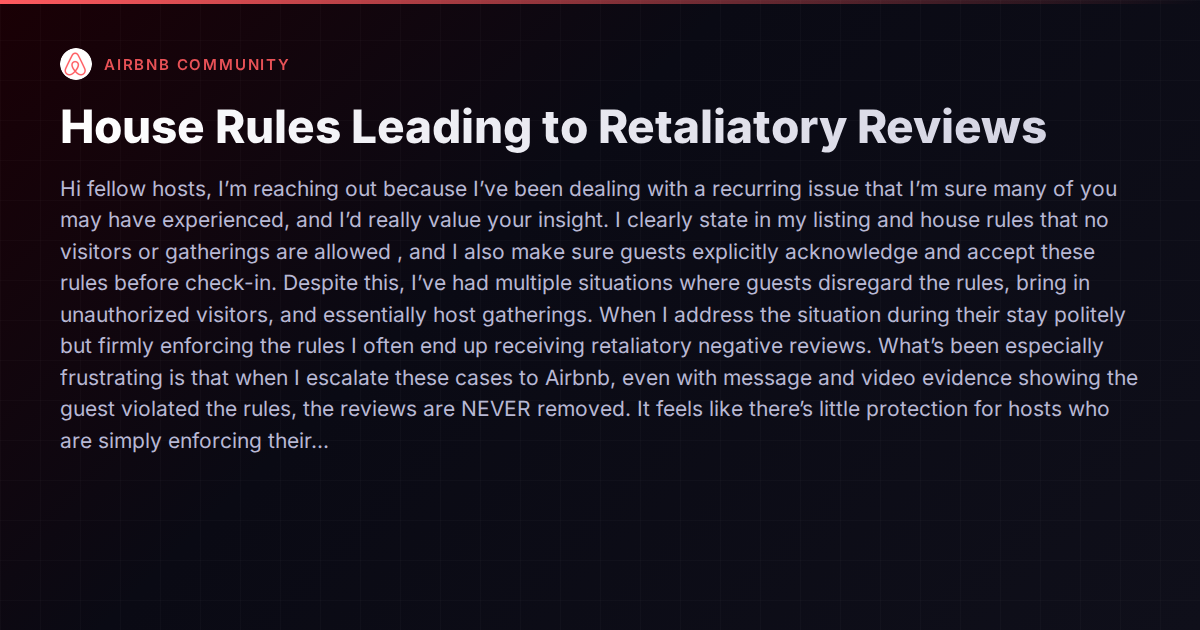
This isn’t a fringe complaint. It’s one of the most consistently reported pain points across host communities on Reddit, the Airbnb Community Center, and industry forums. A host recently described the pattern with precision: house rules clearly state no visitors or gatherings, guests acknowledge the rules before check-in, guests violate them anyway, the host enforces the policy respectfully, and the guest retaliates with a negative review. Despite submitting message logs and video evidence to Airbnb, the review stays up.
The host had done everything the standard advice articles recommend — pre-booking confirmations, explicit rule acknowledgment, polite enforcement. It didn’t matter. And judging by the responses, they’re far from alone.
Why Platforms Rarely Remove Retaliatory Reviews
Airbnb’s review policy technically prohibits “retaliatory reviews” — reviews motivated by a host’s enforcement of rules or a negative interaction rather than the actual stay experience. In practice, proving retaliation is nearly impossible from the platform’s perspective. The guest can always claim the review reflects their genuine experience (“the host was confrontational,” “I felt unwelcome”). Unless the review contains explicit threats or clearly violates content policies, Airbnb’s trust and safety team almost always lets it stand.
This creates a perverse incentive structure: hosts who strictly enforce rules face a higher risk of negative reviews than hosts who look the other way. Over time, some hosts learn to tolerate minor violations rather than risk their ratings — which is exactly the opposite of what platforms claim they want.
VRBO and Booking.com have their own review dispute processes, and the outcomes are similarly frustrating. The core problem is structural: platforms profit from bookings, not from rule enforcement, so review dispute systems are designed to minimize platform intervention rather than protect hosts.
What Actually Works (And What Doesn’t)
Let’s be honest about the standard advice and where it breaks down.
Pre-screening and rule acknowledgment
Sending a pre-booking message asking guests to reconfirm key rules — no visitors, no gatherings, maximum occupancy — creates a paper trail. Some hosts frame rules as “building policy” or “security requirements” rather than personal preferences, which can reduce pushback. This helps with disputes but doesn’t prevent the retaliatory review itself.
Security deposits and damage waivers
A meaningful security deposit can deter some rule-breaking, but Airbnb’s own deposit mechanism is notoriously weak — it’s really a post-stay claim process, not a true hold on funds. Hosts who manage direct bookings or use platforms with real pre-authorization deposits have more leverage. The deposit doesn’t prevent the review, but it changes the power dynamic.
Cameras and monitoring
Exterior cameras and noise monitors (like Minut or Netatmo devices) provide evidence and sometimes deter violations. But evidence doesn’t matter much when the platform won’t remove the review anyway. The real value is in real-time alerts that let you address issues early — before the guest has time to escalate the situation.
Review response strategy
Since you can’t reliably get retaliatory reviews removed, your public response becomes the mitigation tool. A calm, factual response that briefly notes the rule violation (without getting personal) signals to future guests that you’re a professional operator, not an unreasonable host. Something like: “This guest brought unauthorized visitors in violation of our clearly communicated house rules. We addressed the situation respectfully and stand by our policies.” Future guests read host responses. A measured reply to a clearly vindictive review can actually build trust.
Guest verification and screening
More rigorous guest verification can filter out some problematic bookings. Guesty offers GuestVerify with ID verification, identity matching, and (in the US) criminal background checks. This won’t catch every rule-violator, but it adds friction that deters the least serious guests. Hospitable focuses more on automated messaging workflows that create multiple acknowledgment touchpoints, reinforcing rules at each stage of the booking journey.
How PMS Tools Handle the Review Problem
Most property management platforms treat reviews as a reporting and response feature, not a prevention tool. Here’s what the main options offer:
Hostaway provides a unified inbox and automation tools that let you standardize your rule-communication workflow across channels. Their AI messaging can handle templated rule reminders, but the review management is primarily about monitoring and responding — not preventing retaliation.
Guesty has ReplyAI for automated guest communication with sentiment analysis, which can help you detect when a conversation is turning adversarial. Their review tools let you manage responses across platforms from one dashboard. For hosts dealing with this pattern repeatedly, the communication intelligence is useful for flagging risk early.
Hospitable is strong on automated messaging sequences — you can build multi-step rule acknowledgment workflows that fire at booking, pre-arrival, and check-in. Their review management consolidates responses across Airbnb, VRBO, Booking.com, and direct bookings. The automation ensures you never miss a rule-communication step, which at least ensures your paper trail is airtight.
Lodgify focuses more on direct booking websites and channel management. If your strategy is to shift guests toward direct bookings where you control the review ecosystem (or don’t have one at all), Lodgify’s website builder is relevant — but it doesn’t address the OTA review problem directly.
Vanio AI takes a different architectural approach. Because its AI agent has context across reservations, messages, guest verification, lock codes, and internal notes, it can coordinate enforcement actions and communication in a single system. For example, the AI can detect a noise alert from a monitoring device, cross-reference it with the reservation’s occupancy rules, message the guest with a policy reminder, and log the interaction — all automatically. The Defend Mode feature shifts AI communication to a firm, policy-first tone when situations escalate, which helps maintain professionalism without requiring the host to engage directly. AI-drafted review responses and auto-review of guests close the loop on the review side. None of this guarantees Airbnb will remove a retaliatory review, but it ensures every interaction is documented, consistent, and defensible.
The Uncomfortable Truth
No tool, workflow, or screening process will eliminate retaliatory reviews entirely. The problem is fundamentally a platform policy failure: OTAs don’t give hosts adequate recourse when reviews are clearly motivated by rule enforcement rather than stay quality. Until platforms implement meaningful review-retaliation protections — or allow hosts to flag and temporarily suppress disputed reviews during investigation — this will remain a cost of doing business.
The practical strategy is layered defense:
- Multiple acknowledgment touchpoints before check-in (automated messaging helps)
- Real-time monitoring to catch violations early, before they escalate
- Professional, firm enforcement — ideally through automated systems rather than personal confrontation
- A strong public response to every unfair review, written for future guests, not for the reviewer
- A volume strategy — the more five-star reviews you accumulate, the less any single retaliatory review impacts your overall rating
- Shifting bookings toward direct channels where you control the review environment
If you’re evaluating tools that can help automate the communication, monitoring, and review-response parts of this workflow, our comparison hub covers the major platforms side by side. The retaliatory review problem won’t disappear, but with the right systems, you can reduce its frequency and limit the damage when it happens.