Trapped in a PMS Contract That Didn't Deliver? You're Not Alone
Trustpilot
TL;DR: Author is trapped in a Duve contract that didn't deliver on promises, losing money and time, and wants out.
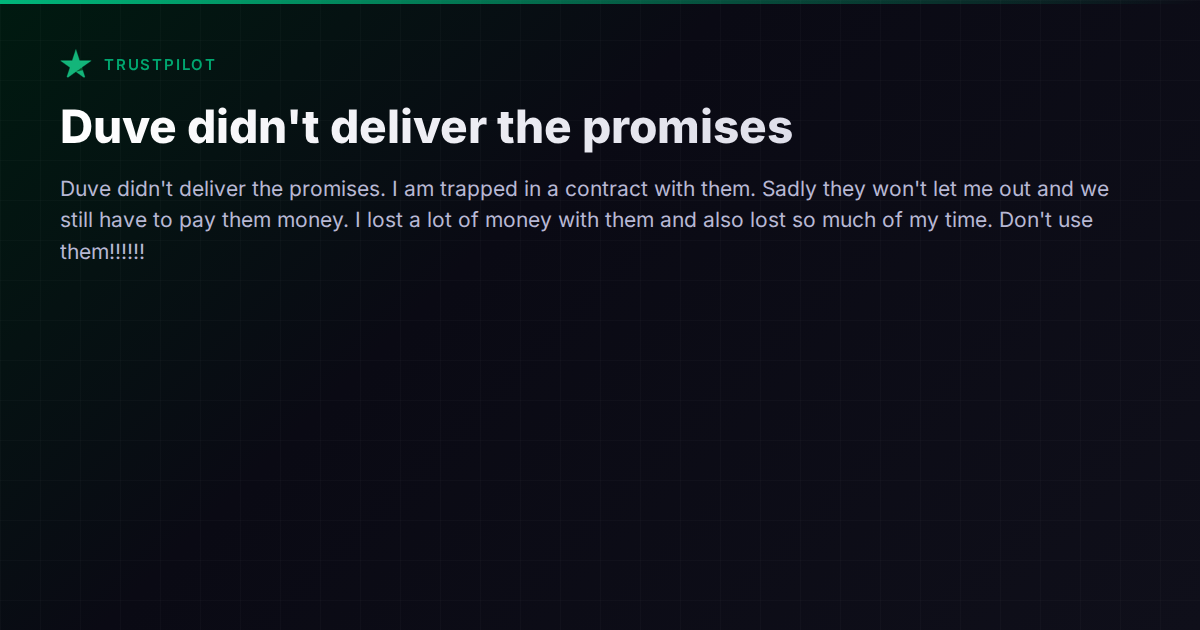
A recent Trustpilot review about Duve — the guest experience platform popular among hotels and short-term rental operators — captures a frustration that echoes across the property management software landscape in 2026: “Duve didn’t deliver the promises. I am trapped in a contract with them. Sadly they won’t let me out and we still have to pay them money. I lost a lot of money with them and also lost so much of my time.”
Six exclamation marks at the end of “Don’t use them” tells you everything about the emotional register. But the real story here isn’t about one platform. It’s about the contract structures and switching costs that keep STR operators paying for tools that aren’t working for them.
The Pattern: Locked In, Checked Out
If you manage vacation rentals long enough, you’ll meet this story in the mirror. The sequence usually goes:
- The sales demo looks great. Everything works. The rep understands your pain.
- You sign an annual contract — often with a discount that makes monthly feel irresponsible.
- Onboarding stalls, features underdeliver, or the product simply doesn’t fit your specific workflow. Maybe the channel integrations are buggy. Maybe the “AI messaging” is glorified templates. Maybe the guest portal doesn’t handle your lock hardware.
- You ask to cancel. The vendor points to clause 14(b) of the agreement. You’re locked in for 8 more months.
- You’re now paying for two systems — the one you can’t leave and the one you actually need.
This pattern shows up with remarkable consistency across platforms. Operators report it with Guesty (opaque pricing and rigid annual commitments), Hostaway (quote-based pricing that obscures what you’re actually signing up for), Duve, and plenty of others. The dollar amounts differ; the emotional trajectory is the same.
Why Contracts Exist (And Why They Hurt)
Let’s be fair to the vendors for a moment. Annual contracts exist because PMS platforms invest real resources in onboarding — API connections, data migration, training calls, custom configurations. Locking in revenue for 12 months lets them amortize that cost and offer lower per-month pricing.
The problem is the asymmetry. The vendor’s onboarding cost is a one-time hit. The operator’s cost of staying with the wrong tool compounds every month: missed messages, double bookings, manual workarounds, frustrated guests, and the opportunity cost of not using something better.
When a platform “doesn’t deliver the promises,” the annual contract becomes a penalty for trusting the sales process.
What to Look for Before You Sign
Here’s what experienced operators check before committing:
Contract terms
- Monthly billing option. Even if it costs 10-15% more, the flexibility to leave is worth it during the first 6 months while you’re validating fit.
- Cancellation policy in plain English. If it’s buried in a 20-page ToS, ask for a one-paragraph summary from the rep — in writing.
- Free trial that covers real usage. A 7-day trial where you’re still importing data on day 5 isn’t a trial. You need at least 14 days with live bookings flowing through.
Onboarding transparency
- How long until you’re fully live? If the answer is “4-6 weeks” and you’re paying from day one, factor that dead time into your ROI calculation.
- Who does the migration work? Some platforms handle it; others hand you a CSV template and wish you luck.
- What happens if onboarding stalls? Does the clock keep ticking on your contract? (It almost always does.)
Feature validation
- Test the specific integrations you need before signing. Channel manager syncs with Airbnb and Booking.com are table stakes. The edge cases — VRBO messaging quirks, your specific smart lock brand, your cleaning team’s workflow — are where things break.
- Talk to an operator at your scale. A platform that works beautifully at 5 listings may fall apart at 50, and vice versa.
How the Major Platforms Handle This
Guesty doesn’t publicly disclose pricing or contract terms, which means you’re negotiating in the dark. Enterprise-grade features, but the commitment can be steep — and the lack of transparency is itself a signal.
Hostaway similarly uses quote-based pricing with no public tiers. Operators report varying experiences with flexibility depending on their portfolio size and negotiating leverage.
Hospitable structures its offering in tiered plans and generally positions itself as more accessible to smaller operators. The specifics of cancellation terms vary by plan, but the existence of public pricing is at least a starting point for informed decisions.
Lodgify offers subscription-based pricing with an emphasis on onboarding support (they advertise free one-on-one onboarding valued at $700). For operators worried about the onboarding-stall trap, that’s a relevant data point — though it doesn’t tell you what happens if you want out.
Duve is primarily a guest experience layer (digital check-in, upsells, guest communication) rather than a full PMS. Operators often run it alongside a PMS, which means the contract pain hits twice — you’re potentially locked into two platforms simultaneously.
Vanio AI takes a different structural approach: per-reservation pricing at $5/booking with a 14-day free trial, no credit card required. The per-reservation model means your cost scales with actual usage rather than a fixed monthly commitment, which sidesteps some of the lock-in dynamics. It also functions as a full PMS with AI-native operations, so there’s no need to layer a separate guest experience tool on top. That said, any platform switch involves real migration effort — the billing model doesn’t eliminate that friction.
What To Do If You’re Already Stuck
If you’re in a contract that isn’t working, a few practical moves:
- Document the gap between what was promised and what was delivered. Emails from the sales process, feature lists from demos, and support tickets where issues went unresolved are your leverage in any cancellation negotiation.
- Escalate past support to account management or retention. Front-line support usually can’t authorize early termination. Retention teams sometimes can — especially if you have documentation.
- Check your local consumer protection laws. In some jurisdictions (particularly the EU), B2B contracts that fail to deliver promised functionality may have legal exit clauses that override the contract terms.
- Negotiate a reduced rate for the remaining term if full cancellation isn’t possible. Paying 50% of a useless tool is better than paying 100%.
- Start evaluating alternatives now so you can switch the day your contract expires. Don’t let renewal auto-trigger while you’re still deciding.
The Bigger Picture
The STR software market in 2026 is mature enough that no operator should feel trapped. There are dozens of capable platforms, and the switching costs — while real — are lower than they were five years ago thanks to better APIs, faster onboarding processes, and platforms that actively help you migrate.
The lesson from stories like this Duve review isn’t “avoid Duve” specifically. It’s: treat software contracts with the same diligence you’d give a property lease. Read the terms. Test before you commit. And if a vendor won’t let you do a meaningful trial before locking you in, that tells you something about how confident they are in their own product.
For a broader look at how different platforms compare on pricing transparency, contract flexibility, and feature depth, the comparison hub is a good starting point.