When Your Channel Manager Holds You Hostage: The Hidden Cost of Difficult PMS Exits
Trustpilot
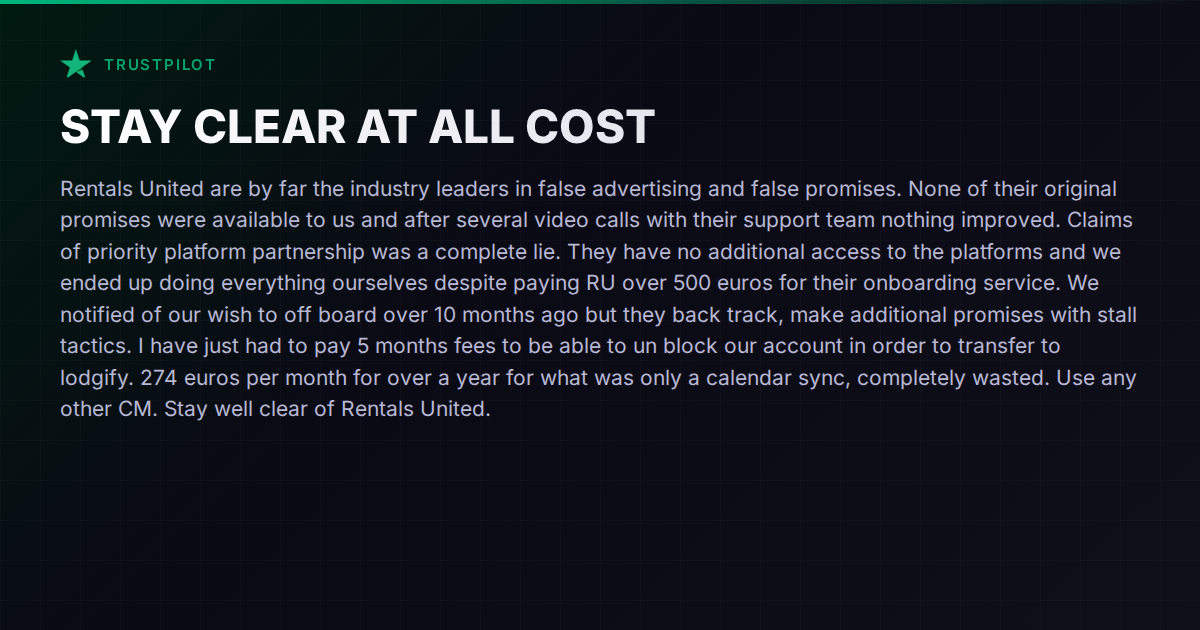
TL;DR: Author paid €274/month for over a year for Rentals United (reviewed under Guesty) which only provided calendar sync despite promises of priority platform partnerships; after 10 months of stall tactics trying to offboard, they had to pay 5 months' fees to unblock their account and are now migrating to Lodgify.
A property manager on Trustpilot recently described an experience that will sound familiar to anyone who has tried to leave a vacation rental software provider: after paying €274 per month for over a year for what they described as “only a calendar sync,” they spent ten months trying to offboard from Rentals United (now part of the Guesty ecosystem). The provider stalled with additional promises, and ultimately the operator had to pay five months of fees just to unblock their account and migrate to Lodgify. That’s roughly €4,600 in total for a service that never delivered on its original promises — and an additional lump sum just for the privilege of leaving.
This isn’t an isolated story. It’s a pattern that repeats across the short-term rental industry in 2026, and it’s worth understanding why it happens, how to spot the warning signs, and what your options look like when you’re stuck.
The Underlying Problem: Vendor Lock-In by Design
Channel managers and property management systems sit at the center of your business. They hold your calendar data, your pricing rules, your channel connections, and often your guest communication history. Once you’re wired in, the switching cost is real — not just in dollars, but in time, risk of double bookings during migration, and the possibility of losing your listing history or review momentum on OTAs.
Some vendors exploit this position. Common tactics include:
- Long contract terms with auto-renewal clauses buried in terms of service
- Multi-month cancellation notice periods that reset if you don’t follow the exact process
- Account locks that prevent you from accessing or exporting your data until outstanding invoices (sometimes disputed) are settled
- “Retention” calls disguised as support, where new promises are made to delay your departure
- Slow or nonexistent data export — your listing content, pricing history, and guest data may not be portable
The operator in the Trustpilot review hit several of these: stall tactics over ten months, additional promises that went unfulfilled, and a fee to unblock their account. The underlying service — advertised as offering priority platform partnerships — turned out to be basic calendar sync that the operator could have done themselves.
The “Priority Partnership” Claim
One detail worth calling out: the operator specifically flagged that claims of “priority platform partnership” were false. This is a marketing angle that some channel managers use — implying they have special access or preferred status with Airbnb, Booking.com, or VRBO that gives their users an edge.
In reality, the major OTAs maintain published API standards. Some channel managers are certified connectivity partners (Booking.com’s program is the most formal), but this doesn’t typically translate to better placement, higher search ranking, or faster support for individual listings. If a provider is selling you on “priority access” as a core differentiator, ask for specifics: which platform, what access, and what measurably changes for your listings.
What the Landscape Looks Like for Switching
If you’re in a similar situation — paying for a tool that under-delivers and struggling to leave — here’s how the major platforms handle migration and contracts.
Guesty
Guesty doesn’t publicly disclose pricing, which already makes it harder to evaluate before you commit. The platform is enterprise-grade and feature-rich, but the lack of transparent pricing and reports of rigid contracts are recurring themes in operator forums. Rentals United was acquired by Guesty, and while the two products operate somewhat independently, the review in question was posted under the Guesty brand on Trustpilot. If you’re evaluating Guesty, ask explicitly about cancellation terms, notice periods, data export capabilities, and what happens to your channel connections if you leave.
Lodgify
The operator in this case chose Lodgify as their destination. Lodgify positions itself as an all-in-one platform with a focus on ease of use and direct booking websites. They offer personalized onboarding and publish subscription-based pricing (though specific tiers aren’t always clearly disclosed). Their channel manager covers the major OTAs. For operators migrating from another channel manager, the key question is whether Lodgify’s OTA integrations are API-native for your specific channels or rely on iCal, which would put you back in “calendar sync only” territory for some platforms.
Hostaway
Hostaway is another common migration target. They emphasize their OTA connection quality and offer a unified inbox, direct booking website, and analytics. Pricing is quote-based (not published), so again, get contract terms in writing before committing. Hostaway generally supports migration from other channel managers, but the transition period — especially for Booking.com and Airbnb API connections — requires careful coordination to avoid gaps.
Hospitable
Hospitable focuses heavily on automated guest messaging and operational automation. Their channel manager handles Airbnb, VRBO, Booking.com, Agoda, and Google. Hospitable uses tiered pricing, though specifics aren’t always published. If your primary pain was overpaying for basic calendar sync, Hospitable’s automation-first approach may deliver more value — but verify which channels get full API integration versus iCal sync.
How to Protect Yourself Before You Sign
Whether you’re evaluating your first channel manager or planning a migration, these questions can save you from the scenario described above:
- What’s the minimum contract term? Monthly billing with no lock-in is the gold standard. If annual is required, negotiate a 30-day out clause after the first 90 days.
- What’s the cancellation process? Get it in writing — email address, notice period, what happens to your data and channel connections.
- Can I export my data? Listings, pricing history, guest data, communication logs. If the answer is vague, assume it’s difficult.
- Which channels are API-connected vs. iCal? iCal sync is not channel management — it’s calendar sync. If you’re paying channel manager prices, you should get API-level integration.
- What exactly do you mean by “priority partnership”? If they can’t name a specific certification or measurable benefit, it’s marketing.
- What happens to my OTA connections if I leave? Some channel managers require you to disconnect and reconnect through a new provider, which can temporarily disrupt your listings.
When AI-Native Platforms Change the Equation
One reason operators get trapped paying for tools that under-deliver is that the tool only does one thing (calendar sync, for instance) but charges as though it does everything. The newer generation of platforms — including Vanio AI, which is built as an AI-native all-in-one system — attempt to solve this by bundling channel management, guest messaging, operations, smart locks, and payments into a single platform with usage-based pricing ($5 per reservation). The argument is straightforward: when everything lives in one system, you’re not paying a channel manager fee for calendar sync, a separate messaging tool fee, a separate task management fee, and so on. Whether that model works for your portfolio depends on your specific channel mix and operational complexity, but the pricing transparency alone is a meaningful improvement over quote-based or opaque contracts.
The Takeaway
The short-term rental industry has a vendor lock-in problem. Operators invest significant time wiring their business into a platform, and some providers exploit that dependency with rigid contracts, stall tactics, and exit fees. The best defense is asking hard questions before you sign, getting cancellation terms in writing, and choosing providers with transparent pricing and clean exit paths.
If you’re currently stuck and evaluating alternatives, the /compare/ page on this blog covers head-to-head breakdowns of major platforms, including contract flexibility, pricing transparency, and migration support. Start there before you commit to the next tool.