Hidden Costs, Broken Sync, and No Refunds: The Real Risk of Choosing the Wrong Channel Manager
Trustpilot
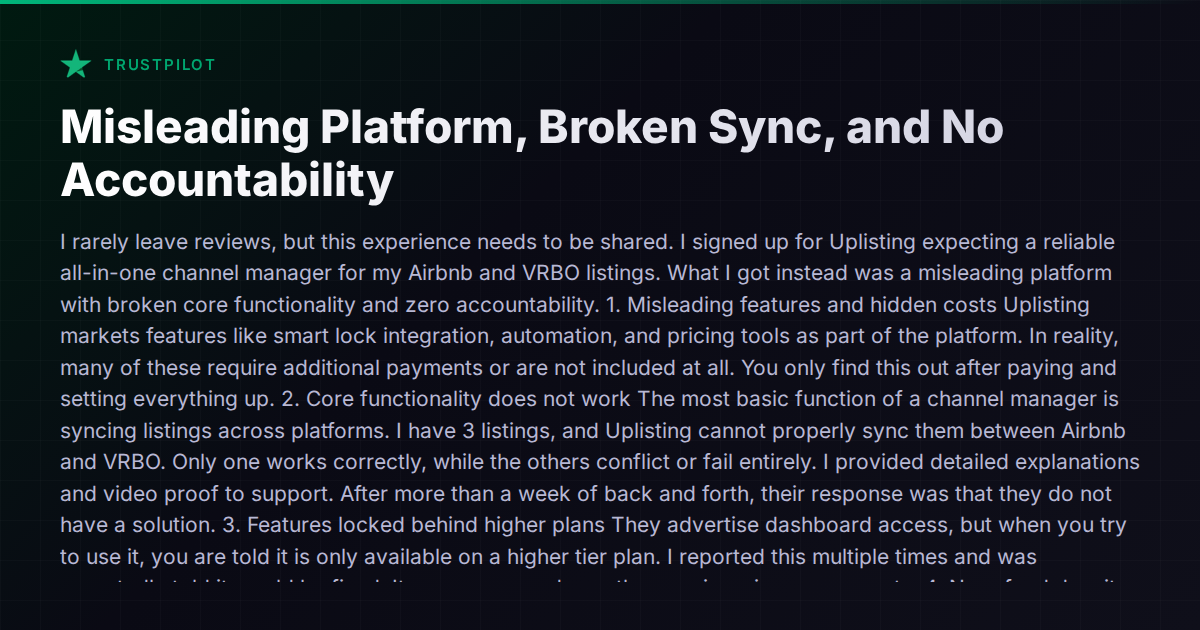
TL;DR: Host paid $900+ for Uplisting but its channel sync between Airbnb and VRBO is broken on 2 of 3 listings, smart locks and dashboard features were locked behind hidden upsells, and the company refused a refund.
A host recently shared a painful breakdown on Trustpilot after spending over $900 on Uplisting, a channel manager that promised all-in-one functionality for their Airbnb and VRBO listings. Of three properties, only one synced correctly between platforms. Smart lock integrations and dashboard features that appeared included turned out to require higher-tier plans or additional payments. After weeks of back-and-forth with support — including video evidence of the failures — the company said they had no solution. The refund request was denied.
This isn’t a one-off story. It’s a pattern that repeats across the short-term rental tool landscape, and it’s worth understanding the structural reasons behind it before you commit your next $900 — or $9,000.
The Bait-and-Switch Pricing Problem
Many property management platforms and channel managers advertise a feature list on their marketing site that doesn’t map cleanly to what’s included at each pricing tier. Smart locks, automation workflows, analytics dashboards, and pricing tools all sound like core functionality — until you discover they’re gated behind enterprise plans or require paid add-ons.
This isn’t unique to Uplisting. Operators report similar surprises with other platforms:
- Guesty doesn’t publicly disclose specific pricing at all, requiring a sales call to learn what’s included. Some hosts discover after onboarding that features they assumed were standard require premium bundles.
- Lodgify references promotional pricing and tiered plans, but the specifics of what’s gated behind higher tiers aren’t always clear upfront.
- Hostaway uses quote-based pricing with no public plan details, which means you won’t know the real cost until you’re already in a sales conversation.
The lesson: if a platform doesn’t publish clear, per-tier feature breakdowns on their pricing page, treat that as a signal. You’re likely to discover costs after you’ve already invested setup time.
When Core Sync Breaks, Everything Breaks
The most damning part of the Trustpilot review isn’t the hidden costs — it’s that the fundamental job of a channel manager (syncing availability and pricing across Airbnb and VRBO) didn’t work on two of three listings. The host provided video proof. The response after a week was, effectively, “we don’t have a fix.”
Calendar sync failures are the single most dangerous failure mode in short-term rental software. A broken sync means double bookings, which mean cancellations, which mean platform penalties and destroyed guest trust. For a host with just three listings, this is manageable chaos. For someone with 20 or 50 properties, a sync failure can cascade into thousands of dollars in lost revenue and reputation damage in a single weekend.
Not all channel managers are created equal here. The quality of a platform’s OTA integration depends on its API partnership level and how much engineering effort goes into maintaining those connections as Airbnb, VRBO, and Booking.com constantly update their APIs.
- Hostaway emphasizes “highest-status OTA connections” and positions reliability as a core differentiator.
- Hospitable offers real-time calendar syncing across Airbnb, VRBO, Booking.com, Agoda, and Google, with the channel manager built into even their base plan.
- Guesty manages over 500,000 listings and touts 99.99% uptime, which at that scale suggests battle-tested sync infrastructure.
Smaller or newer channel managers may not have the same depth of integration. That doesn’t make them bad products — but it does mean you should test sync reliability with real listings during a trial period before committing money.
The Refund Problem
The host in this case spent over $900 and days of setup time before discovering the platform couldn’t do its primary job. The refund was denied.
This is common across the PMS and channel manager space. Most platforms require annual contracts or charge upfront setup fees that aren’t refundable. Some offer monthly billing but include cancellation penalties. The industry norm is weighted heavily toward the vendor.
Before committing to any platform, ask these specific questions:
- Is there a free trial with real channel connections? Not a demo environment — actual Airbnb and VRBO sync with your real listings.
- What’s the refund policy if core sync fails during the first 30 days? Get this in writing, not just a verbal assurance from a sales rep.
- Is billing monthly or annual? Annual billing saves money but locks you in. If you’re trying a platform for the first time, start monthly even if it costs more per month.
- Are all advertised features included in your specific plan? Ask for a written feature matrix for the exact tier you’re purchasing.
How to Evaluate a Channel Manager Without Getting Burned
Based on what operators across host communities consistently report, here’s a practical framework:
Start with sync, not features. The sexiest dashboard in the world is worthless if your calendars aren’t in sync. During any trial period, create test blocks on Airbnb and verify they appear on VRBO (and vice versa) within the promised timeframe. Do this for every listing, not just one.
Test the integrations you actually need. If smart locks are important to your operation, connect them during the trial. Don’t assume “smart lock integration” means your specific lock brand is supported at your plan level.
Measure support responsiveness before you need it urgently. Send a support ticket during your trial with a moderately complex question. Track how long it takes to get a substantive answer — not an auto-reply, but an actual human response that addresses your specific situation. A week-long response cycle during a sync emergency is operationally unacceptable.
Check for transparent pricing. Platforms that publish clear per-tier pricing — what’s included, what costs extra, what the actual dollar amounts are — tend to have fewer surprises. Vanio AI, for example, publishes a flat $5-per-reservation model covering the full operational lifecycle (messaging, lock codes, task dispatch, reviews), with no hidden tier gates for core functionality. That kind of pricing transparency isn’t universal, but it should be your baseline expectation.
Read recent reviews, not just star ratings. A platform with a 4.5-star average but a cluster of recent 1-star reviews about sync failures is sending a signal. Weight recent reviews more heavily than older ones — API integrations degrade when they’re not actively maintained.
The Bigger Picture
The host who left this Trustpilot review lost $900 and days of setup time. That’s painful but recoverable. The deeper cost is the operational risk: if they’d gone live with guests on broken sync, the damage would have been far worse.
The short-term rental software market has dozens of options, and most of them do some things well. The challenge is finding the one that does the specific things you need, at the price it actually costs, with the reliability your business requires.
Don’t trust marketing pages. Test with real listings. Get refund terms in writing. And if a platform tells you after a week that they “don’t have a solution” for their most basic function, cut your losses and move on — the switching cost only gets higher from there.
For a structured comparison of how major platforms stack up on sync reliability, pricing transparency, and feature completeness, the comparison hub is a good starting point.