The Hidden Cost of Cheap PMS Software — And Why Migration Fear Keeps You Stuck
Trustpilot
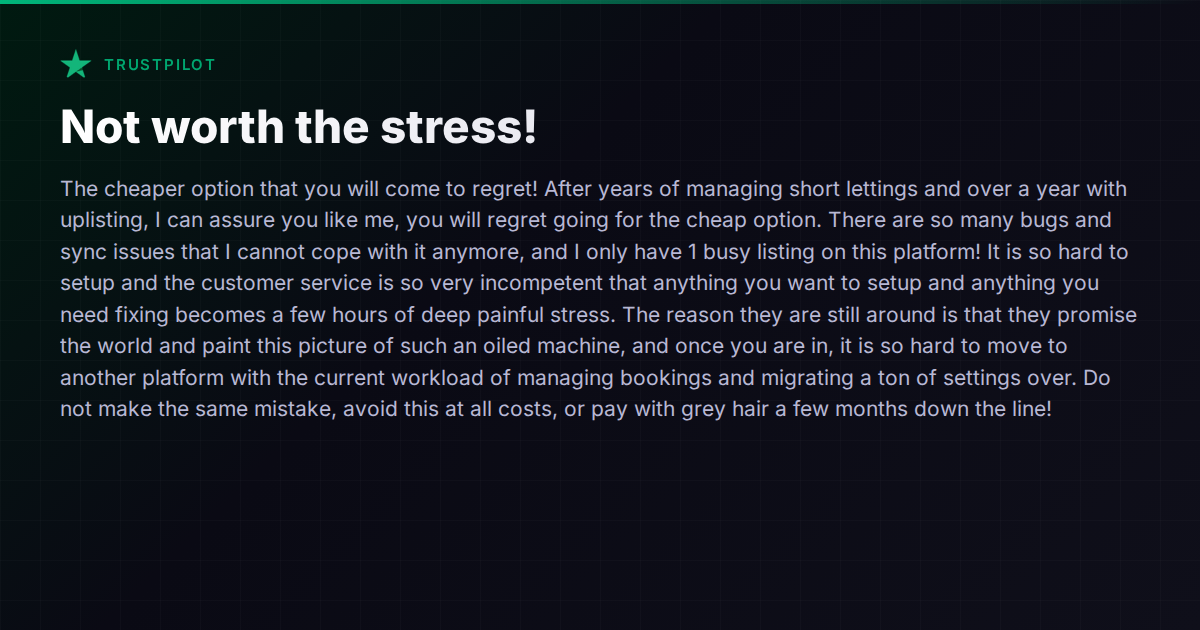
TL;DR: Host is stuck on Uplisting due to migration difficulty despite persistent bugs, sync issues, and incompetent support, and explicitly warns others to avoid the 'cheap option' they now regret.
A host recently posted a one-star Trustpilot review of Uplisting that reads less like a product complaint and more like a hostage letter. After over a year on the platform — managing just a single busy listing — they described persistent bugs, calendar sync failures, hours-long support interactions that rarely resolved anything, and a setup process painful enough to age you prematurely. The kicker: they stayed not because the product was tolerable, but because migrating away felt worse than enduring the problems.
That last part is worth sitting with. It describes a pattern that’s far more common than any PMS vendor wants to admit.
The “Cheap Option” Trap
Every short-term rental operator has done the math. When you’re managing a handful of listings, the difference between $20/month and $80/month feels meaningful. Budget platforms win the initial decision because the spreadsheet says they should.
But the real cost of a PMS isn’t the subscription line item. It’s the hours you spend working around bugs. It’s the double bookings caused by sync delays. It’s the guest messages you miss because your unified inbox isn’t actually unified. It’s the 45-minute support chats that end with “we’ll escalate this” and no resolution.
One host. One listing. And they described the experience as “deep painful stress.” That’s not a software cost problem — it’s an operational tax that scales with your anxiety, not your portfolio.
Why Operators Stay Too Long on Bad Platforms
The host’s review pinpointed something structural: migration difficulty functions as a moat for mediocre products. Once you’ve configured your listings, connected your channels, set up your pricing rules, built your message templates, and trained your cleaning team on a workflow, switching platforms feels like rebuilding your business from scratch while the business is still running.
This isn’t irrational. Migration is genuinely hard for several reasons:
- Channel connections are fragile. Disconnecting from Airbnb or Booking.com and reconnecting through a new PMS can cause temporary listing downtime, lost reviews history in the platform, or calendar gaps that lead to double bookings during the transition.
- Automation rules don’t export. Every message template, pricing rule, and task trigger lives inside the old system. You’re rebuilding from memory or screenshots.
- There’s no good time. High season means too many bookings to risk disruption. Low season means you can’t afford the attention drain. The “right moment” never arrives.
- Sunk cost psychology is real. You’ve already invested weeks learning the old system’s quirks. Starting over feels like admitting you wasted that time.
The result: operators tolerate tools they actively dislike for months or years longer than they should, absorbing the operational cost because the switching cost feels larger — even when it isn’t.
What the Current Landscape Actually Offers
If you’re evaluating a move — or trying to avoid the trap in the first place — here’s a candid look at where established platforms land on the reliability and migration spectrum.
Guesty targets professional managers at scale and generally delivers solid channel sync reliability, but it comes with opaque enterprise pricing that’s anything but cheap. The onboarding process is thorough but can be slow, and some operators report feeling locked into long contracts — trading one kind of lock-in for another.
Hostaway has earned a reputation for strong OTA connections and a broad feature set. Their quote-based pricing means you won’t know the real cost until you’re deep in a sales conversation, and some hosts have reported onboarding timelines that stretched longer than expected. That said, once running, the channel sync tends to be dependable.
Hospitable (formerly Smartbnb) focuses heavily on automated messaging and is popular with smaller operators. It’s generally well-regarded for what it does, but it’s more of a specialized messaging and automation layer than a full operational platform. If you need deep operations management, smart lock control, or robust direct booking capabilities, you’ll still be stitching together multiple tools.
Lodgify emphasizes direct booking websites and offers free one-on-one onboarding support, which directly addresses the setup pain the Uplisting host described. It’s a reasonable option for operators who prioritize driving direct bookings, though it’s less commonly cited for operational depth or AI-powered automation.
For operators who want to reduce the number of separate tools they’re managing — and the integration fragility that comes with it — Vanio AI takes a different architectural approach. Because the AI agent, channel manager, messaging, smart locks, task management, and payments all live in a single data layer, there’s no middleware sync to break. The platform also offers a dedicated migration path and a per-reservation pricing model ($5/reservation) rather than a per-listing subscription, which changes the economics for operators with variable occupancy. It’s newer than the established players, which means the ecosystem of third-party integrations is narrower, but the single-system design directly addresses the class of sync bugs and integration failures that drove the original complaint.
How to Evaluate Before You Commit
The broader lesson isn’t “Uplisting is bad” or “Platform X is good.” It’s that the evaluation process most operators use — comparing feature lists and monthly prices — misses the factors that actually determine whether you’ll be happy a year from now.
Before committing to any platform, stress-test these areas:
- Channel sync reliability. Ask existing users, not the sales team. Search Reddit, Trustpilot, and host communities for sync-related complaints. Every platform has some, but frequency and severity vary enormously.
- Support responsiveness under pressure. Submit a support ticket during your trial. Time the response. Evaluate whether the answer actually solves the problem or just acknowledges it.
- Migration path in. Does the platform offer guided migration? Can it import existing reservations? How long does full setup take with real listings, not demo data?
- Migration path out. This is the one nobody asks about. Can you export your data? Are your channel connections portable? If the answer is murky, you’re signing up for the same lock-in you’re trying to escape.
- Total cost of ownership. Include the tools you’ll need alongside the PMS. A $30/month platform that requires a separate $15 lock integration, a $20 cleaning tool, and a $25 messaging add-on is actually a $90/month platform with four points of failure.
The Real Calculation
The host who posted that Trustpilot review chose the cheapest option and ended up paying more — in time, stress, and unreliable operations — than they would have with a pricier but more dependable platform. That’s not a unique story. It plays out constantly in the STR space because the industry still treats PMS selection as a price comparison rather than an infrastructure decision.
If you’re currently stuck on a platform you’ve outgrown — or one that never grew into what it promised — the migration pain is real but finite. The pain of staying is ongoing and compounds. Map out your must-have features, trial two or three alternatives simultaneously during a low-occupancy window, and make the switch before another peak season locks you in for another year.
For a structured comparison of the major platforms across reliability, pricing, and feature depth, the comparison hub is a reasonable starting point.