When Your PMS Stops Sending Messages: The Hidden Cost of Automation Bugs
Trustpilot
TL;DR: Host is leaving iGMS because automatic messages frequently fail to send, leaving guests confused, and the platform has become unusable due to bugs.
There’s a particular kind of anxiety that comes from discovering your property management software silently stopped sending check-in instructions. You don’t find out because of a dashboard alert. You find out because a guest is standing outside your property at 11 PM, texting you “Where do I go?”
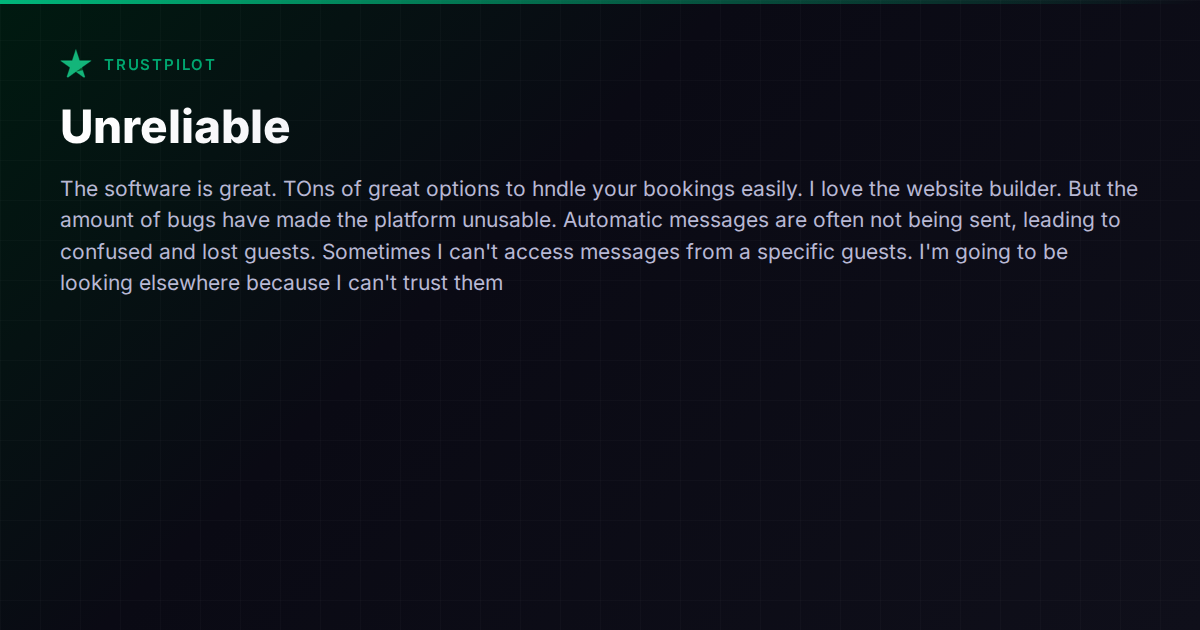
A recent Trustpilot review of iGMS captures this frustration concisely: the host praised the platform’s feature set and website builder, but described it as “unusable” due to bugs — specifically, automated messages that frequently fail to send. “I can’t trust them,” the host wrote, before announcing they’d be looking elsewhere.
This isn’t an iGMS-only problem. It’s one of the most common failure modes in short-term rental operations, and it cuts across platforms of all sizes.
Why Silent Message Failures Are So Damaging
Automated guest messaging is table stakes in vacation rental management. Pre-arrival instructions, check-in codes, house rules, Wi-Fi details, checkout reminders — these are the messages that make self-check-in work and keep your review scores above water.
When they fail silently — no error, no notification, just a message that never arrives — the downstream effects compound quickly:
- Guest confusion at check-in: The most immediate consequence. A guest who doesn’t receive door codes or directions is a guest who calls you at midnight or leaves a frustrated review.
- Missed review requests: Automated post-stay messages drive review volume. Silent failures mean lost social proof.
- Cleaning coordination gaps: If your task dispatch is message-based, a failed notification means a cleaner who doesn’t show up on time.
- Erosion of trust in your own system: This is the most insidious effect. Once you’ve been burned by a silent failure, you start manually checking every message — which defeats the entire purpose of automation.
The iGMS user’s complaint also mentioned being unable to access specific guest message threads at all, which suggests deeper platform stability issues beyond just the messaging queue.
The Root Cause: Messaging Reliability Is Harder Than It Looks
Building a feature that sends a message on a schedule is straightforward. Building a system that reliably sends messages across multiple channels (Airbnb, Booking.com, VRBO, WhatsApp, SMS, email) with proper error handling, retry logic, delivery confirmation, and failure alerts — that’s an engineering challenge many platforms underinvest in.
Common failure modes include:
- API rate limits or timeouts: OTA APIs (especially Airbnb’s) have rate limits and can timeout during high-traffic periods. If the PMS doesn’t implement proper retry logic, the message just disappears.
- Webhook delivery failures: Many platforms trigger messages based on incoming webhooks from channels. A dropped webhook means a dropped trigger.
- Queue processing delays: During peak booking periods, message queues can back up. If the system doesn’t handle this gracefully, messages arrive late or not at all.
- Channel disconnection: If the API connection to Airbnb or Booking.com silently drops, scheduled messages may queue locally but never reach the guest.
The platforms that handle this well typically have robust monitoring, automatic reconnection, delivery receipts, and — critically — operator alerts when something fails.
How the Major Platforms Handle Messaging Reliability
If you’re evaluating alternatives after experiencing message failures, here’s what to look for and how the main players stack up:
Hospitable
Hospitable has built its reputation largely on automated messaging reliability. It was originally called Smartbnb and messaging automation was its founding feature. The platform triggers messages at key booking lifecycle moments and supports templated responses to common guest questions. For hosts whose primary need is “messages that actually send on time, every time,” Hospitable is one of the more battle-tested options. The unified inbox aggregates across Airbnb, VRBO, Booking.com, and direct bookings.
Hostaway
Hostaway offers a unified inbox covering Airbnb, VRBO, Booking.com, email, SMS, and WhatsApp, with AI-powered automated replies and message templates. It also includes SLA tracking for response times, which is useful for property managers with teams. The platform’s messaging infrastructure is generally regarded as solid, though pricing is quote-based and opaque.
Guesty
Guesty provides automated messaging alongside its ReplyAI feature for AI-powered responses with sentiment analysis. They also offer a managed Guest Communication Services option where their team handles messaging for you — essentially outsourcing the reliability problem entirely. This makes sense for larger operations willing to pay for a managed layer, but it’s an added cost on top of already undisclosed pricing.
Lodgify
Lodgify includes messaging automation and real-time syncing, though it’s generally positioned more toward hosts who prioritize direct booking websites and booking management. Its messaging capabilities are functional but less of a standout compared to platforms that were built messaging-first.
Vanio AI
Vanio AI takes a different architectural approach to this problem. Rather than relying on scheduled message templates that fire (or don’t fire) on timers, its AI agent handles guest communication as a core function with access to the entire system — reservations, smart locks, cleaning tasks, and the knowledge base. The Operations Watchdog feature runs a daily automated check across messaging, access codes, smart locks, cleaning, and payments, flagging failures before they reach the guest. The AI Guardian also validates every automated message before it sends. This doesn’t eliminate the possibility of failures entirely — no system can — but the monitoring and validation layers mean you’re less likely to discover a problem from an angry guest text at midnight.
What to Look for When Evaluating Messaging Reliability
Beyond brand comparisons, here are the specific questions to ask when evaluating any PMS for messaging reliability:
- Delivery confirmation: Does the platform show you whether a message was actually delivered, not just queued?
- Failure alerts: When a message fails to send, are you notified immediately? Via what channel?
- Retry logic: Does the system automatically retry failed messages, or does it silently drop them?
- Channel health monitoring: Can you see the connection status of each OTA integration at a glance?
- Message audit trail: Is there a chronological log of every message sent (and not sent) per reservation?
- Suppression transparency: If an automation was suppressed (e.g., a condition wasn’t met), does the system tell you why?
These aren’t advanced features. They’re the difference between a messaging system you can trust and one that creates more work than it saves.
The Takeaway
The iGMS user’s experience is frustratingly common across the PMS landscape. A platform can have excellent features on paper — great UI, robust website builder, comprehensive booking tools — and still be unusable if the foundational automation layer is unreliable.
Messaging reliability isn’t glamorous. It doesn’t make for good marketing screenshots. But it’s the single most important thing your PMS does every day, and when it fails silently, everything downstream breaks with it.
If you’re in the process of evaluating alternatives, focus less on feature counts and more on operational reliability. Ask for uptime data. Ask about message delivery rates. Talk to other operators in your market about what actually works day-to-day.
For a broader comparison of how different platforms handle automation and messaging, the comparison hub at /compare/ covers the major options side by side.