The PMS–OTA Responsibility Gap: When Neither Platform Lets You Help Your Guests
Airbnb Community
TL;DR: Host using ElektraWeb as PMS is stuck in a responsibility gap where neither Airbnb nor ElektraWeb can modify reservations (date changes, cancellations), leaving guests without help despite repeated support contacts.
One of the most frustrating things in short-term rental operations isn’t a bug, exactly. It’s a gap — a place where your property management system and your booking channel each point at the other and say “that’s not our responsibility.” The host sits in the middle, unable to do something as basic as modify a reservation date for a guest with a genuine emergency.
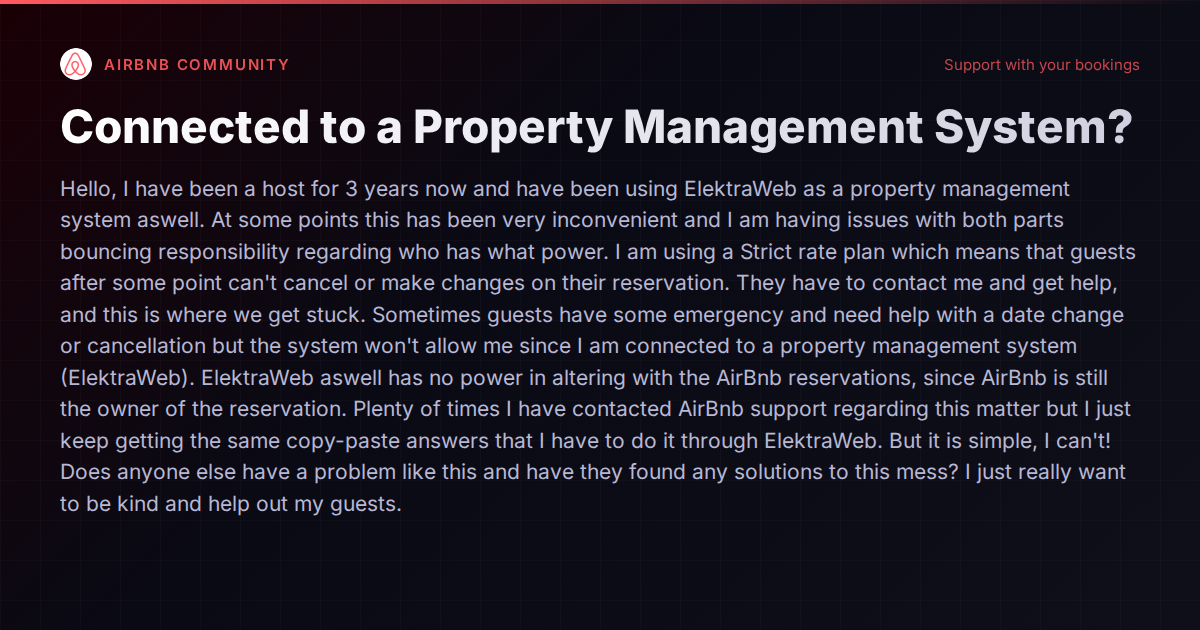
A host on Airbnb’s community forum recently described the problem clearly. They’ve been hosting for three years, using ElektraWeb as their PMS. When a guest on a strict cancellation policy needs a date change or cancellation — the kind of thing that happens routinely — neither system will let the host make the modification. Airbnb support says to handle it through the PMS. The PMS says it has no authority over Airbnb reservations. The host gets copy-paste responses from support. The guest gets no help.
This isn’t an ElektraWeb-specific problem. It’s a structural issue that affects hosts across many PMS-to-OTA integrations, and it’s worth understanding why it happens and what your options actually are in 2026.
Why the Gap Exists
When you connect a PMS to Airbnb (or Booking.com, or VRBO), the integration typically operates through an API that handles calendar sync, pricing updates, and reservation imports. But the depth of that integration varies enormously between platforms.
Some PMS integrations are “read-mostly” — they pull reservations in and push availability out, but they don’t have write access to modify or cancel reservations on the OTA side. The OTA, meanwhile, may detect that the listing is managed by external software and restrict certain host-side actions in its own dashboard, assuming the PMS handles them.
The result: a dead zone where neither system grants you the controls. Strict cancellation policies make this worse because they already limit what guests can do unilaterally — the assumption is that the host will intervene when needed. If the host can’t intervene either, everyone is stuck.
This problem is especially common with smaller or regional PMS platforms that have lighter API integrations. But even well-known platforms can have partial gaps depending on which OTA actions their integration covers.
How Different PMS Platforms Handle This
Not all PMS tools have the same level of reservation modification capability. Here’s a realistic survey of how the major platforms deal with this:
Guesty
Guesty has one of the deeper Airbnb API integrations on the market. Hosts can typically modify reservations, process alterations, and handle cancellations directly from the Guesty dashboard for Airbnb bookings. Guesty’s scale (500,000+ listings) means they’ve invested heavily in maintaining full API parity with major OTAs. If your primary pain is the inability to modify Airbnb reservations from your PMS, Guesty is one of the platforms most likely to support it — though you’ll want to confirm the specific actions available for your use case during onboarding, since API capabilities can change with OTA policy updates.
Hostaway
Hostaway also positions itself as having deep OTA connections and supports reservation management across Airbnb, Booking.com, and VRBO from within the platform. Their unified inbox and automation tools are designed to centralize guest communication and booking changes. Like Guesty, the depth of write-back capability depends on what each OTA’s API allows, but Hostaway is generally in the category of PMS tools that aim for full reservation lifecycle management rather than read-only sync.
Hospitable
Hospitable focuses heavily on automated messaging and operational workflows. Their channel management includes real-time calendar syncing and a unified inbox across Airbnb, VRBO, Booking.com, and others. For reservation modifications specifically, Hospitable’s integration depth may vary by channel — it’s worth asking directly about alteration and cancellation capabilities before committing, particularly if you run strict policies.
Lodgify
Lodgify provides channel management and booking synchronization, with a strong emphasis on direct bookings and ease of use. For OTA reservation modifications, their integration level depends on the specific channel. Lodgify’s strength tends to be in the direct booking workflow rather than deep OTA write-back capabilities, so hosts heavily reliant on Airbnb reservation modifications should verify this during their evaluation.
Smaller and Regional PMS Tools
Platforms like ElektraWeb, and many regional or niche PMS tools, often have thinner API integrations with major OTAs. They may handle calendar sync and reservation import well but lack the API permissions or engineering investment to support write-back actions like reservation modifications or cancellations. This is where the responsibility gap is most acute.
The Airbnb Side of the Problem
It’s worth being honest: Airbnb’s support handling of this issue is part of the problem. When a host reports that their PMS can’t make the modification, Airbnb support’s default response is often a scripted redirect back to the PMS. This creates a circular loop.
In some cases, Airbnb support can manually process changes for PMS-connected listings — but it requires escalation beyond the first-tier agent, and the host usually has to be persistent and specific about the technical limitation. Documenting the exact error or restriction (screenshots help) and explicitly requesting escalation to a supervisor or specialized team can sometimes break the loop.
This isn’t a reliable solution, though. It depends on the agent, the day, and the specific policy involved.
What You Can Actually Do About It
If you’re currently stuck in this gap, here are practical options roughly in order of effort:
-
Escalate with specificity on Airbnb. Don’t accept the first copy-paste response. Explain clearly that your PMS integration does not have write access to Airbnb reservations, and request that an Airbnb agent process the modification directly. Reference the specific reservation and the exact action you need.
-
Check your PMS’s actual API scope. Contact your PMS provider and ask explicitly: “Does your Airbnb integration support reservation alterations and host-initiated cancellations via the API?” If the answer is no, you know the limitation is structural, not a configuration issue.
-
Evaluate whether your PMS is the right fit. If you’re routinely hitting this wall, your PMS may not have sufficient integration depth for your hosting style. A strict cancellation policy on Airbnb essentially requires that you (or your software) can intervene in the reservation lifecycle. If your PMS can’t do that, you’re paying for a tool that creates friction rather than removing it.
-
Consider platforms with deeper OTA write-back. If you decide to switch, prioritize PMS platforms that explicitly support reservation modifications across your key channels. This is a concrete question to ask during demos — not “do you integrate with Airbnb?” but “can I alter a guest’s dates, process a partial refund, and initiate a cancellation from your dashboard for an Airbnb reservation on a strict policy?”
-
Look at AI-native platforms. Vanio AI takes a different architectural approach — it’s built as a single unified system where AI has native access to reservation management, guest communication, and operational actions across channels. Because the AI agent operates within the same system that holds the reservation data, it can take real actions (not just send messages) including processing modifications, rather than bouncing between disconnected tools. This doesn’t magically override OTA API limitations, but it eliminates the internal handoff gap between your PMS and your communication layer.
The Bigger Lesson
The PMS–OTA responsibility gap is a symptom of a deeper problem in how the short-term rental tech stack has evolved. Most PMS platforms were built as database-and-calendar tools first, with OTA integrations added incrementally. The depth of those integrations varies wildly, and hosts often don’t discover the limitations until they’re mid-crisis with a guest who needs help.
Before you commit to (or renew with) any PMS, map out the specific actions you need to take regularly — date changes, cancellations, refund processing, pricing adjustments — and verify that your PMS can execute them on each channel you use. “We integrate with Airbnb” is not the same as “we can modify Airbnb reservations.”
For a side-by-side look at how different platforms handle these operational details, the comparison hub breaks down capabilities across the major PMS options.