When Your PMS Stops Improving: How to Know It's Time to Switch
Trustpilot
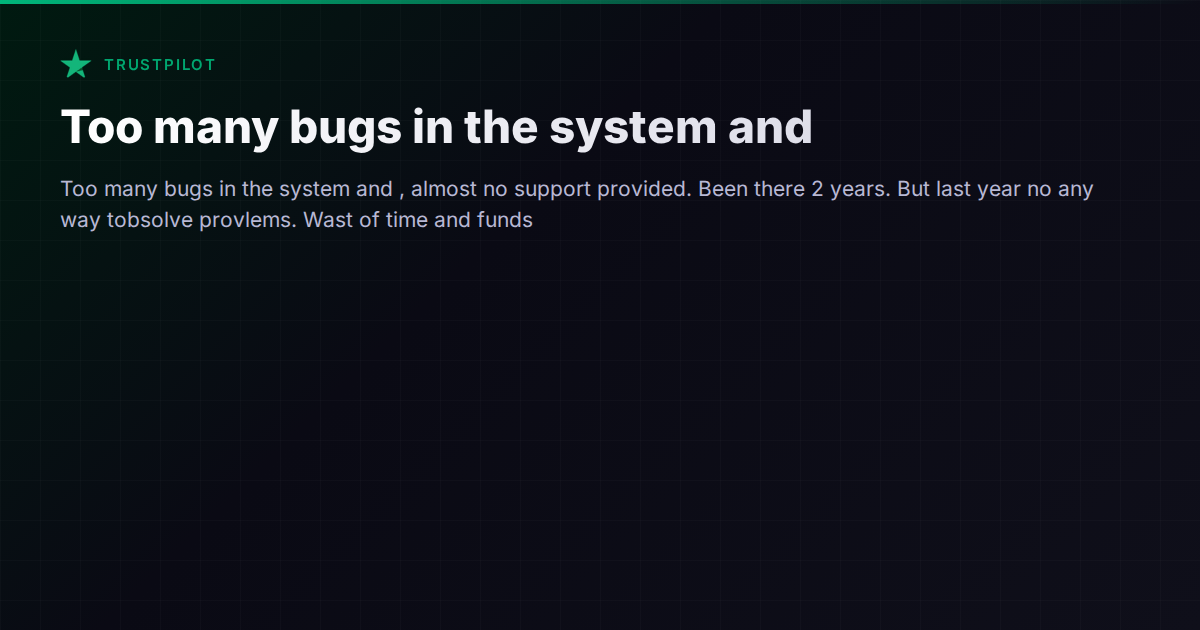
TL;DR: Host has been on Uplisting for 2 years and is fed up with persistent bugs and unresponsive support, calling it a waste of time and money.
Every short-term rental operator has a moment when the daily workarounds stop feeling temporary and start feeling permanent. A calendar sync that fails once a month. A messaging bug that eats replies during peak season. A support ticket that goes unanswered for two weeks, then three, then indefinitely.
A recent Trustpilot review of Uplisting captures the frustration concisely: a host who stayed on the platform for two years, initially satisfied, then watched the experience deteriorate — persistent bugs, near-zero support response, and ultimately the conclusion that continuing was “a waste of time and funds.” It’s a pattern that shows up across dozens of PMS platforms, not just Uplisting. The details change; the arc doesn’t.
The Slow Decay Pattern
PMS platforms rarely fall apart overnight. What typically happens is subtler and more damaging:
- Early momentum masks technical debt. The first year feels productive. Channels connect, bookings flow, automation templates fire on time. Small bugs exist but get fixed.
- Engineering focus shifts. The company chases new features (AI, direct booking, owner portals) while the existing codebase accumulates unresolved issues. Bug reports pile up.
- Support degrades under load. Growing customer counts strain the same-size support team. Response times stretch. Canned replies replace actual troubleshooting. Complex tickets get deprioritized.
- Operators absorb the cost. Hosts start building manual workarounds — spreadsheets to catch sync failures, alarm reminders to double-check things the PMS should handle automatically. The real cost isn’t the subscription; it’s the labor tax.
Uplisting isn’t alone here. Operators on forums and review sites report similar trajectories with platforms of all sizes. The core issue is structural: PMS companies face constant tension between acquiring new customers (which funds growth) and maintaining the product for existing ones (which doesn’t generate headlines).
What “Too Many Bugs” Actually Costs You
When a host says “too many bugs,” the instinct from outside is to wonder how bad it really is. But for an STR operation, even minor bugs compound fast:
- Calendar sync failures → double bookings → platform penalties, guest compensation, lost revenue
- Messaging glitches → missed guest inquiries → lower response rates → algorithmic ranking drops on Airbnb
- Automation misfires → wrong check-in instructions sent → guest lockouts → bad reviews
- Reporting errors → incorrect owner statements → trust erosion with property owners
The financial damage from a single double booking can exceed an entire year’s PMS subscription cost. Multiply that risk across a portfolio, and the tolerance for “known bugs” should be essentially zero.
How the Major Platforms Compare on Stability and Support
No platform is bug-free. But there are real differences in how companies handle the reliability question.
Guesty targets the enterprise end of the market and touts 99.99% uptime with a 250+ person R&D team and daily feature releases. For larger operators (50+ units), this investment in infrastructure tends to show. The trade-off: opaque pricing, and some operators report that the enterprise sales process itself can be slow and rigid. If you’re managing five listings, you’re probably not their priority.
Hostaway has built a reputation for strong OTA integrations — particularly their Airbnb and Vrbo connections, which tend to be stable. Their support quality gets mixed reviews: some operators praise fast resolution, others report the same ticket-queue stagnation described above. The lack of public pricing makes it hard to evaluate cost-to-quality upfront.
Hospitable (formerly Smartbnb) has a narrower product scope — messaging automation, channel sync, task management — but executes those pieces reliably for many operators. The focused feature set means less surface area for bugs. It won’t replace a full PMS for complex operations, but for hosts whose primary pain is communication automation, the stability trade-off can be favorable.
Lodgify leans heavily on onboarding support (they advertise a $700-value personalized onboarding included with subscription) and positions itself as approachable for less technical operators. The platform emphasizes ease of use. Operators with straightforward setups — direct bookings plus one or two OTA channels — often report a smooth experience, though complex multi-channel needs can expose limitations.
Uplisting itself occupies a middle ground: simpler than Guesty, more full-featured than Hospitable, with a direct booking engine and channel management. The product isn’t inherently flawed — the frustration pattern described in the review suggests a support and maintenance problem, not a fundamental architecture problem. Whether the company addresses this is an open question.
The Hidden Cost of Switching (and Why Operators Stay Too Long)
If you already know your PMS is underperforming, why haven’t you left? The honest answer is usually migration friction:
- Channel reconnection risk. Disconnecting and reconnecting Airbnb, Vrbo, and Booking.com accounts carries real risk of lost reviews, broken listing history, or brief availability gaps.
- Automation rebuilding. Every message template, pricing rule, and task workflow needs to be recreated on the new platform.
- Team retraining. Cleaners, co-hosts, and property owners all need to learn new systems.
- Data migration. Guest history, owner records, and financial data may not transfer cleanly.
These are legitimate concerns. But operators consistently underestimate the ongoing cost of staying on a broken platform and overestimate the one-time cost of switching. A well-executed migration takes 2-4 weeks of focused effort. Living with daily bugs costs you that much labor every quarter.
What to Evaluate Before You Move
If you’re in the “should I switch” phase, here’s a practical framework:
- Test support before you commit. Submit a pre-sales technical question. If the response takes 48+ hours or is generic, that’s your preview of post-sale support.
- Ask about their bug backlog. A company that’s transparent about known issues and publishes a product changelog is usually a healthier engineering organization than one that pretends everything works perfectly.
- Check uptime independently. Look for third-party status pages or ask for SLA commitments in writing.
- Run a parallel test. Most platforms offer free trials. Connect a single listing, run it for two weeks, and stress-test the specific workflows that break on your current platform.
- Talk to operators at your scale. A platform that’s great for 3 listings may crumble at 30, and vice versa.
For operators whose primary pain isn’t just bugs but operational overload — spending hours daily on guest messages, cleaning coordination, lock codes, and review responses — an AI-native platform like Vanio AI takes a different approach entirely. Rather than automating individual tasks through templates and rules, it uses a single AI agent with native access to every subsystem (reservations, messaging, locks, payments, tasks) to handle the full guest lifecycle autonomously. That architectural difference means fewer integration points where bugs can hide. It’s not the right fit for everyone — operators who want granular manual control over every message may find full autonomy uncomfortable — but for those drowning in operational labor on a buggy platform, it’s worth evaluating alongside the more traditional options.
The Bottom Line
A PMS that worked well a year ago and doesn’t today isn’t going to fix itself because you wait another six months. The operator who posted that Trustpilot review spent a year hoping things would improve. That year had a cost — not just in subscription fees, but in missed bookings, manual workarounds, and accumulated frustration.
The STR tool landscape is competitive enough that you don’t have to settle. Whether you move to a traditional PMS with better support infrastructure or rethink the stack entirely, the most expensive option is almost always the status quo.
For a structured comparison of the major platforms across features, pricing transparency, and support quality, the comparison hub is a good starting point.