When Your PMS Can't Tell a Booking from a Cancellation: Financial Reporting Gaps That Cost Real Money
Trustpilot
TL;DR: Host on Uplisting is frustrated by a poor mobile app and inaccurate financial reporting that can't distinguish actual bookings from cancellations, and is actively looking to switch if they can find something better.
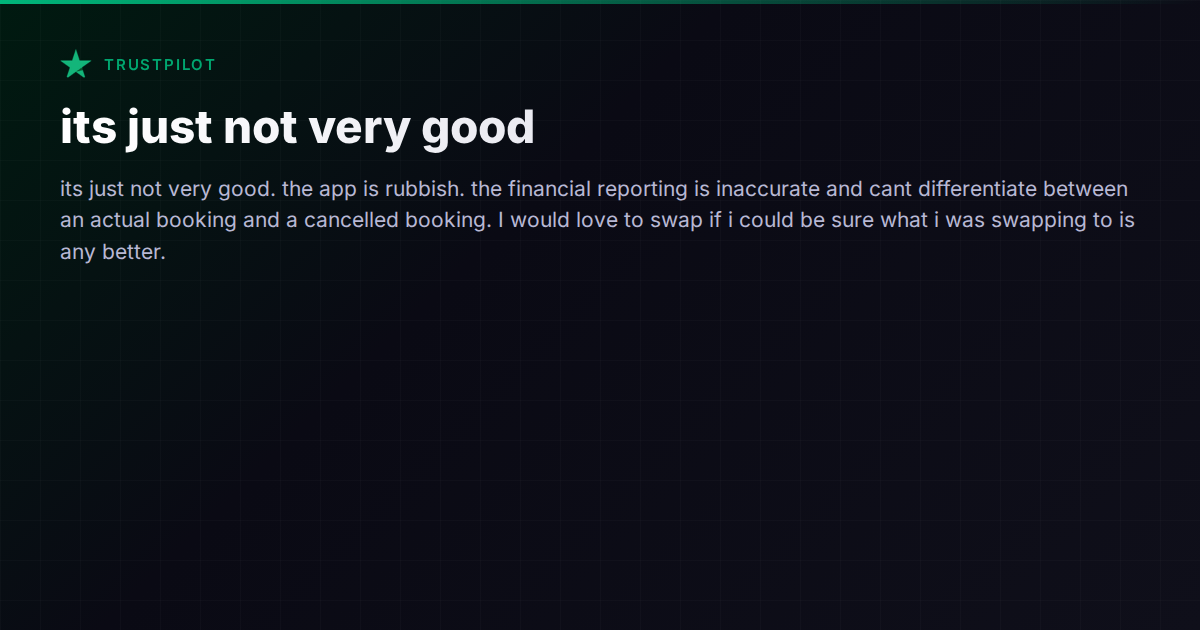
A host recently left a blunt two-star review of Uplisting on Trustpilot: “The financial reporting is inaccurate and can’t differentiate between an actual booking and a cancelled booking.” The mobile app was “rubbish.” And yet, despite clear frustration, they hadn’t switched — because they couldn’t be sure the next platform would be any better.
That last part is the most telling. It’s a sentiment you hear constantly in host communities: the devil you know versus the devil you don’t. And when the core issue is something as fundamental as accurate financial reporting, the stakes of picking wrong feel even higher.
Why Financial Reporting Accuracy Isn’t Optional
For a hobby host with two listings, eyeballing numbers in a spreadsheet might be fine. But the moment you’re managing five, ten, or fifty properties — especially on behalf of owners — your financial reports aren’t just dashboards. They’re the basis for owner payouts, tax filings, revenue projections, and operational decisions.
When a PMS conflates confirmed bookings with cancellations in its revenue figures, the downstream damage is real:
- Owner statements are wrong. If your system reports gross revenue that includes cancelled bookings, you’re either overpaying owners or spending hours manually reconciling.
- Tax reporting is off. Overstated revenue means overstated tax liability — or worse, an audit trail that doesn’t add up.
- Occupancy and ADR metrics are unreliable. If cancellations inflate your booking count, your performance metrics are fiction.
- Cash flow forecasting breaks. You can’t plan staffing, maintenance, or expansion when your projected income includes money that was never collected.
This isn’t a cosmetic problem. It’s a trust problem — both with your owners and with your own ability to make decisions based on data.
The Mobile App Question
The Trustpilot reviewer’s other complaint — a poor mobile app — is equally common across the industry. Property management increasingly happens on the go: approving messages between site visits, checking task completion from your car, reviewing a guest issue while you’re at dinner. A mobile experience that’s clunky, slow, or feature-incomplete means you’re tethered to your laptop for anything meaningful.
This is one of those areas where the gap between platforms is wide. Some tools treat mobile as an afterthought — a responsive web wrapper with limited functionality. Others invest in native apps with real feature parity. If you’re evaluating platforms, test the mobile experience with real scenarios before you commit. Screenshots on a marketing page tell you nothing.
How the Major Platforms Handle Financial Reporting
Let’s be specific about what the landscape looks like, because “switch to something better” is only useful advice if you know what “better” actually means in this context.
Guesty targets professional operators at scale and includes owner statements summarizing income, expenses, and net profit per property. It’s one of the more mature platforms for financial reporting, particularly for managers who need to generate polished owner-facing reports. The tradeoff: Guesty doesn’t publish pricing, and operators consistently report that it’s one of the more expensive options.
Hostaway also offers owner statements and a dedicated owner portal with 24/7 access. Their reporting is built around the property manager / owner relationship, with income, expense, and net profit breakdowns. Pricing is quote-based, so you’ll need to get on a call to understand cost.
Lodgify emphasizes ease of use and real-time synchronization. It’s a solid option for smaller operators who want something straightforward, though its financial reporting depth may not match what a 20+ property manager needs for detailed owner reconciliation.
Hospitable has an analytics module that covers occupancy, revenue, and taxes, with saveable dashboards. It’s more focused on the operational side — automated messaging, task management — than on deep financial reporting for multi-owner portfolios. If your primary pain is messaging automation and your reporting needs are moderate, it’s worth evaluating.
Uplisting itself (the platform the reviewer was using) occupies a middle ground — adequate for many hosts, but as this review suggests, with gaps that surface once you need reporting you can actually trust.
The Migration Fear Is Rational
The reviewer’s hesitation — “I would love to swap if I could be sure what I was swapping to is any better” — deserves to be taken seriously rather than dismissed. Platform migration is genuinely painful:
- Listing connections need to be re-established. One wrong step during migration and you’re dealing with double bookings or disconnected calendars.
- Historical data may not transfer. Your booking history, guest records, and financial records from the old platform might not import cleanly — or at all.
- Automations and templates need to be rebuilt. Every message template, pricing rule, and workflow you’ve configured is platform-specific.
- Staff need to be retrained. Your cleaners, co-hosts, and any team members are used to the current system.
The rational approach is to run a parallel trial where possible. Most platforms offer free trials — use them with real data, not just the demo property. Import a few listings, connect a channel or two, and specifically test the exact scenarios that are failing you today. In this case: create a booking, cancel it, and check whether the financial reports handle it correctly.
What to Prioritize When Evaluating a Switch
If you’re in a similar position — stuck on a platform with reporting you can’t trust — here’s what to actually test during your evaluation:
- Create and cancel a test booking. Check how it shows up in revenue reports, owner statements, and occupancy metrics. This is the single most relevant test for this specific pain.
- Run an owner statement. If you manage for owners, generate a sample payout report. Is it clear? Does it separate gross revenue, platform fees, cleaning fees, and net owner payout?
- Use the mobile app for a full day. Don’t just open it — try to respond to a message, check a task, review a booking, and look at a report. All from your phone.
- Ask about data migration. Will they import your historical bookings? Guest data? Financial records? Or are you starting from zero?
- Check the cancellation policy — for the PMS itself. Some platforms lock you into annual contracts. If the new tool turns out to have its own blind spots, you want to be able to leave.
Vanio AI takes a different architectural approach — it’s built as an AI-native platform where the AI agent has direct access to reservations, payments, and the full booking lifecycle in a single data layer. Because cancellations, confirmed bookings, and financial events all live in the same system, the reporting reflects actual booking states rather than aggregating everything into one bucket. It’s worth evaluating if you want both operational automation and financial clarity in one place, though as with any platform, test it against your specific scenarios.
The Bottom Line
Inaccurate financial reporting isn’t a minor annoyance — it’s a fundamental failure of the tool’s core job. A PMS that can’t distinguish between money you earned and money you didn’t isn’t managing your properties; it’s creating more work.
The fear of switching to something equally flawed is understandable. The antidote isn’t blind faith in a new platform — it’s methodical testing of the exact failures that are costing you today. Start with a cancellation test and an owner statement. If a platform can’t get those right during a trial, it won’t get them right at scale.
For a broader look at how the major platforms compare across features, pricing, and architecture, the comparison hub is a reasonable starting point.