When Your PMS Can't Sync: The Real Cost of Broken Calendar Connections and Missing Support
Trustpilot
TL;DR: Author is experiencing double bookings, broken Airbnb calendar sync, a confusing interface, and nonexistent support from Beds24, signaling readiness to switch platforms.
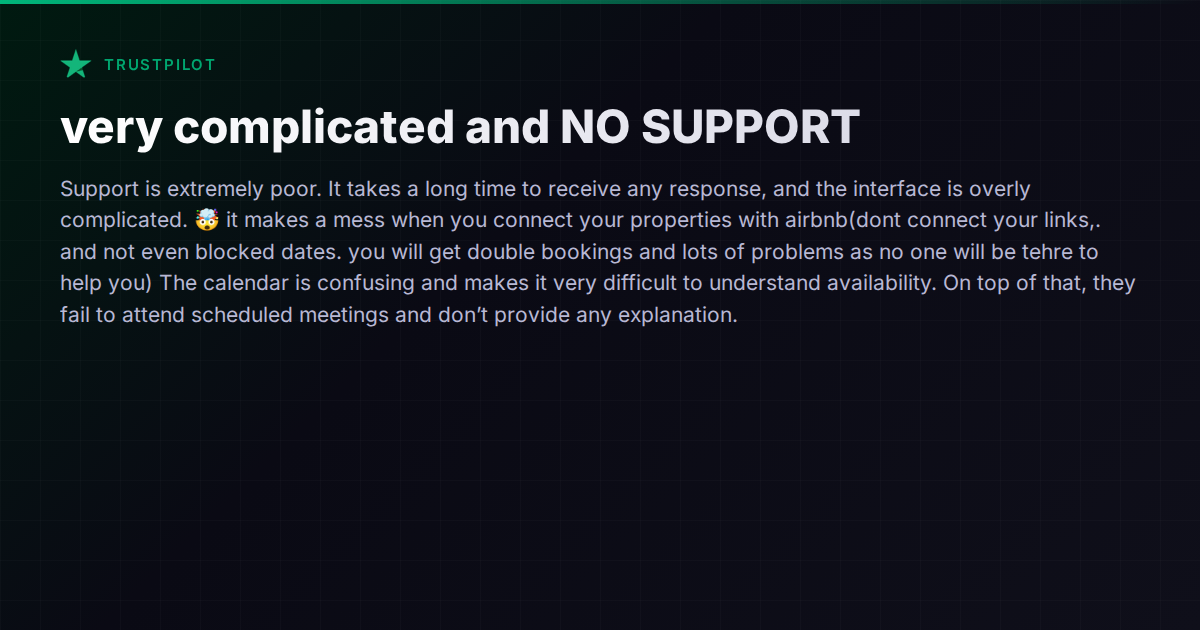
A recent Trustpilot review of Beds24 captures a frustration that’s far more common than it should be in 2025: connecting your Airbnb listings to a property management system, only to discover that blocked dates don’t sync, links don’t match up correctly, and double bookings start rolling in — with no one from support available to help untangle the mess.
The reviewer’s summary is blunt: “Support is extremely poor. It takes a long time to receive any response, and the interface is overly complicated.” They describe a calendar that’s confusing to read, missed support meetings with no explanation, and a system that actively creates problems when you connect your Airbnb properties.
If you’ve been in short-term rentals for any length of time, some version of this story probably sounds familiar.
The Double Booking Problem Is a Trust Destroyer
Double bookings aren’t just an inconvenience. They’re a cascading failure. You have to cancel on one guest, which tanks your cancellation rate on Airbnb (and potentially triggers Superhost demotion). The displaced guest leaves angry. You scramble to find alternative accommodation, often eating the cost. Your listing drops in search rankings. And if it happens more than once, you start losing confidence in your own systems — which is the worst outcome of all, because a host who doesn’t trust their tools starts manually checking everything, defeating the entire purpose of having a PMS.
The root cause is almost always the same: incomplete or delayed calendar synchronization between your PMS and your booking channels. When a reservation comes in on Airbnb, the PMS needs to instantly block those dates across Booking.com, VRBO, your direct booking site, and any other connected channel. “Instantly” here means seconds, not minutes. An iCal-based sync that polls every 15 or 30 minutes leaves a window where two platforms can accept the same dates.
Full API integrations — where the PMS has a direct, real-time connection to the channel — are the standard that most serious operators should demand. iCal should be treated as a fallback for niche channels, not as the primary sync mechanism for Airbnb or Booking.com.
The Interface Complexity Trap
Beds24 has a reputation in host communities for being powerful but deeply unintuitive. The platform offers extensive configurability, which appeals to technically-minded operators who want granular control. But for many hosts — especially those managing a handful of properties without a dedicated tech person — that flexibility translates to an interface where it’s genuinely hard to tell whether your calendar is synced correctly, whether your pricing overrides are applying, or whether a blocked date is actually blocked across all channels.
This isn’t a problem unique to Beds24. Several PMS platforms in the market were built “engineer-first” rather than “operator-first,” and they carry the legacy of complex interfaces that assume the user knows exactly what they’re doing. Guesty, for example, is powerful at scale but has drawn complaints about setup complexity for smaller operators. Lodgify has invested heavily in onboarding support precisely because the vacation rental PMS space has a reputation for steep learning curves.
The question isn’t whether a platform has advanced features — it’s whether a host can get their properties connected correctly on day one without needing a computer science degree or a dedicated onboarding specialist who actually shows up to meetings.
Support as Infrastructure, Not an Afterthought
The Beds24 reviewer’s complaint about missed meetings and slow responses points to a structural issue that goes beyond one bad support interaction. For many PMS platforms — especially those with lower price points — support is a cost center that gets scaled back as the user base grows. The math doesn’t work: if you’re charging $10-20 per month per listing, you can’t afford dedicated onboarding calls and responsive live support for every user.
This is why it’s worth evaluating how a PMS structures its support before you sign up, not after things go wrong:
- Self-serve documentation quality: Can you actually set up channel connections by following their docs, or do the docs assume knowledge you don’t have?
- Response time SLAs: Do they publish expected response times? Is there live chat, or only email ticketing?
- Onboarding process: Is there a guided setup, or are you dropped into a dashboard and left to figure it out?
- Community resources: Is there an active user community, YouTube walkthroughs, or third-party guides that fill the gaps?
Hostaway uses custom quote-based pricing, which typically bundles more hands-on onboarding for larger portfolios but leaves smaller operators uncertain about what they’ll actually get. Hospitable has built a reputation for more approachable automation that requires less initial setup, though it trades some configurability for that simplicity.
What to Look for When Your Current PMS Isn’t Working
If you’re in the situation the reviewer describes — properties connected, calendar not syncing, double bookings happening, support not responding — here’s a practical framework for evaluating alternatives:
1. Channel connection method matters. Ask specifically whether the platform uses full API integration with Airbnb, Booking.com, and VRBO, or whether it relies on iCal for any major channel. API means real-time. iCal means delayed.
2. Test the calendar before you migrate. Most PMS platforms offer a trial. Don’t just look at features during the trial — create a test property, connect it to one channel, make a booking, and verify that the blocked dates appear correctly everywhere within seconds.
3. Evaluate support before you need it. Send a pre-sales question and measure how long it takes to get a substantive response. If the sales process is slow, the post-sale support will be worse.
4. Consider whether AI can absorb the complexity. Newer platforms are using AI not just for guest messaging but for operational coordination — automatically checking that calendar sync is working, flagging potential conflicts before they become double bookings, and handling the routine decisions that would otherwise require you to navigate a complex interface. Vanio AI, for instance, takes the approach that the AI agent should have native access to the entire system — calendar, channel connections, smart locks, tasks — so it can catch and resolve issues across domains without the host needing to manually audit each subsystem. It’s a fundamentally different architecture than bolting an AI chatbot onto an existing PMS.
5. Migration cost is real but calculable. Switching PMS platforms takes effort — reconnecting channels, re-entering property details, re-building automations. But the cost of staying on a broken system is ongoing: double bookings, lost revenue, manual calendar babysitting, and stress. Run the numbers honestly.
The Uncomfortable Truth About PMS Selection
No platform is perfect. Every PMS has users who love it and users who are furious with it, often for the same product at the same time. What separates a workable tool from a liability is whether the platform can reliably handle the basics — calendar sync, channel connections, and support when things go wrong — without requiring the host to become an expert in the platform itself.
The Beds24 reviewer’s experience is a warning sign that many operators encounter too late: a platform that’s technically capable but practically unusable for their skill level, with support that can’t bridge the gap. If you’re evaluating PMS options or considering a switch, focus less on feature lists and more on the three things that actually determine whether you’ll have a good experience: sync reliability, interface clarity, and support responsiveness.
For a side-by-side look at how the major platforms compare on these dimensions, the comparison hub at /compare/ breaks down the landscape in more detail.