When Your PMS Gets Taxes Wrong: The Hidden Compliance Risk in Vacation Rental Software
Trustpilot
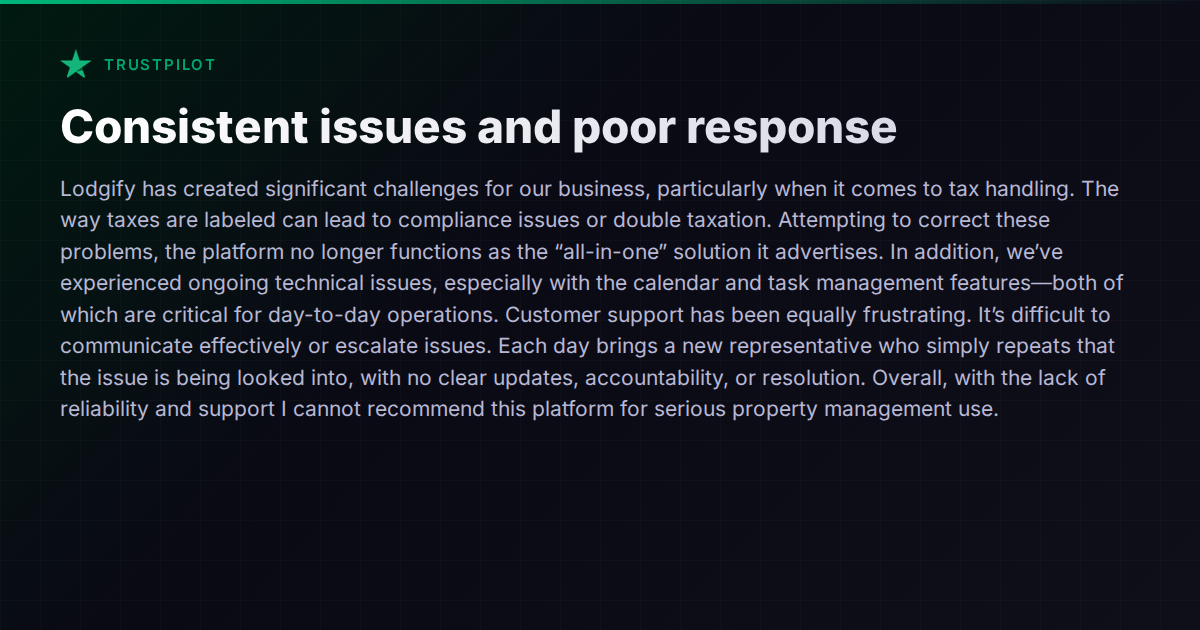
TL;DR: Host is experiencing tax handling compliance issues, broken calendar and task management features, and unresponsive support from Lodgify, making it unreliable for serious property management.
Most property managers evaluate PMS platforms on channel distribution, messaging automation, and calendar design. Tax handling rarely makes the shortlist — until it causes a real problem. But incorrect tax labeling, double taxation, or misconfigured remittance can create compliance headaches that dwarf any benefit from a slick calendar view.
A recent Trustpilot review from a host using Lodgify illustrates the issue clearly. The host reported that Lodgify’s tax labeling created compliance risks and potential double taxation. When they attempted to fix the configuration, other platform features broke — undermining Lodgify’s positioning as an all-in-one solution. Calendar and task management features also had ongoing issues. And support? A different representative every day, each one repeating that the issue was “being looked into” with no resolution.
This isn’t a one-off complaint. It’s a pattern that surfaces across multiple PMS platforms, and it’s worth understanding why.
Why Tax Handling Is Harder Than It Looks
Short-term rental taxes are a mess. Depending on your jurisdiction, you might owe state sales tax, county occupancy tax, city tourism tax, special district assessments, or some combination. The rates vary, the rules for what’s taxable differ (cleaning fees? service fees? damage deposits?), and the labeling on guest-facing invoices often has legal requirements.
Platforms like Airbnb handle tax collection and remittance in many jurisdictions, but not all. When Airbnb collects occupancy tax but your PMS also calculates and displays it on a direct booking invoice — or worse, on the same Airbnb booking — you get double taxation. The guest is overcharged, you’re potentially liable for the overage, and unwinding it means manual corrections and refunds.
The reverse is equally dangerous: your PMS doesn’t collect a required tax, you don’t notice for months, and you owe back taxes plus penalties to a local authority.
The “All-in-One” Trap
The Lodgify complaint highlights a dynamic that’s common across platforms marketing themselves as all-in-one: when one subsystem (taxes) is misconfigured or broken, fixing it can cascade into other subsystems (calendar, task management, guest-facing invoices). This happens because these platforms often evolved feature-by-feature over years, with each module built somewhat independently. Tax logic might live in a different layer than calendar logic, and the interactions between them aren’t always well-tested.
This isn’t unique to Lodgify. Operators on forums and review sites have reported similar cascading issues with other platforms. The “all-in-one” label sets expectations that everything works together seamlessly, but the reality is that some subsystems in any platform are more mature than others.
How Different Platforms Handle Taxes
Tax handling varies significantly across the PMS landscape, and it’s worth understanding the approaches before you commit.
Guesty offers tax configuration at the listing and account level, with support for multiple tax types and jurisdictions. For operators managing properties across different cities or states, Guesty’s enterprise focus means tax setup is generally more flexible — but the complexity of configuration means you’ll likely need their onboarding team to set it up correctly. Guesty doesn’t publicly disclose pricing, so you’ll need to factor in the cost of the platform itself.
Hostaway provides tax management tools within its PMS, including the ability to define multiple tax types per listing and control how taxes appear on invoices and owner statements. Their owner reporting features — including detailed income, expense, and tax breakdowns — are a strength for managers who need to provide transparent statements to property owners.
Hospitable takes a different approach depending on your booking source. For direct bookings, their Direct Premium tier includes built-in tax calculation, while Direct Basic leaves tax handling to the operator. For OTA bookings, tax handling follows whatever the channel and your PMS configuration dictate. Hospitable’s strength is messaging automation, not tax compliance, so operators with complex tax situations may find it limited.
Lodgify does offer tax configuration tools, but as the review in question suggests, the implementation can create labeling and compliance issues in practice. Lodgify’s focus on direct booking websites and ease of use is genuine, but operators with multi-jurisdiction tax obligations should test thoroughly before relying on it.
The Support Problem Is the Real Problem
The tax issue itself is fixable — in theory. The deeper problem in the original complaint is the support experience: a rotating cast of representatives, no ownership of the issue, no escalation path, and no timeline for resolution.
This is a structural problem at many PMS companies. Tier-1 support agents are trained on common questions, not edge cases. Tax configuration that creates compliance issues isn’t a common question — it’s a complex, jurisdiction-specific problem that requires someone who understands both the software’s tax engine and the operator’s local tax obligations. When there’s no escalation path to that person, you get the loop the reviewer described: “being looked into” indefinitely.
Before choosing any platform, ask specific questions about support:
- Can I get a dedicated account manager, or is support ticket-based only?
- What’s the escalation path for issues that frontline support can’t resolve?
- What’s the SLA for critical issues (broken calendar, incorrect tax calculation)?
- Can I talk to someone who understands tax configuration for my specific jurisdictions?
If the answers are vague, that’s your signal.
What to Actually Check Before You Commit
If you’re evaluating platforms — or considering a migration because your current platform is getting taxes wrong — here’s a practical checklist:
- Map your tax obligations first. Before touching any PMS, list every tax type you owe, the rate, what it applies to, and whether Airbnb/Booking.com already collects and remits it. This is your source of truth.
- Test tax configuration in a sandbox. Create a test booking on every channel you use and verify the guest-facing invoice shows the correct taxes — no more, no less. Check that the tax amount flows correctly into your reporting.
- Verify channel-specific behavior. Airbnb-collected taxes should not also be added by your PMS. VRBO and Booking.com handle taxes differently. Your PMS needs to account for these differences per channel, not apply a blanket tax rule.
- Check direct booking tax handling. If you take direct bookings, your PMS is the system of record for tax collection. Make sure it can handle your jurisdiction’s requirements, including how taxes are labeled on receipts.
- Test the support experience before you need it. Submit a moderately complex question during your trial period. See how long it takes, whether you get a real answer, and whether you can reach someone senior.
When AI Helps — and When It Doesn’t
AI-powered platforms can help with many operational headaches — guest messaging, task dispatch, lock code generation — but tax compliance is fundamentally a configuration and data-integrity problem. No amount of AI can fix a tax engine that labels taxes incorrectly or double-counts channel-collected taxes.
That said, platforms where AI has native access to the full data layer — reservations, payments, channel source, tax configuration — can at least flag anomalies. Vanio AI, for example, has its AI agent integrated across the entire system including payments and reservations, which means it can surface discrepancies between what a channel collected and what the platform is charging. But the tax rules themselves still need to be configured correctly by the operator.
The Bottom Line
Tax handling is one of those PMS features that’s invisible when it works and catastrophic when it doesn’t. The cost of getting it wrong isn’t just guest complaints — it’s potential legal liability, back taxes, and penalties from local authorities.
If your current platform is creating tax compliance issues, don’t wait for support to eventually fix it. Document the specific problem, test whether it’s a configuration issue or a platform limitation, and if it’s the latter, start evaluating alternatives with your tax-obligation map in hand.
For a side-by-side look at how different platforms handle core operational features, the comparison hub at /compare/ breaks down the major options. Tax handling is just one dimension — but it’s one that too many operators discover too late.