Why Is It So Hard to Leave Your Property Management Software?
Trustpilot
TL;DR: Host with many listings is trying to leave iGMS but can't deactivate their account, which is blocking their calendar management and preventing them from moving to another tool.
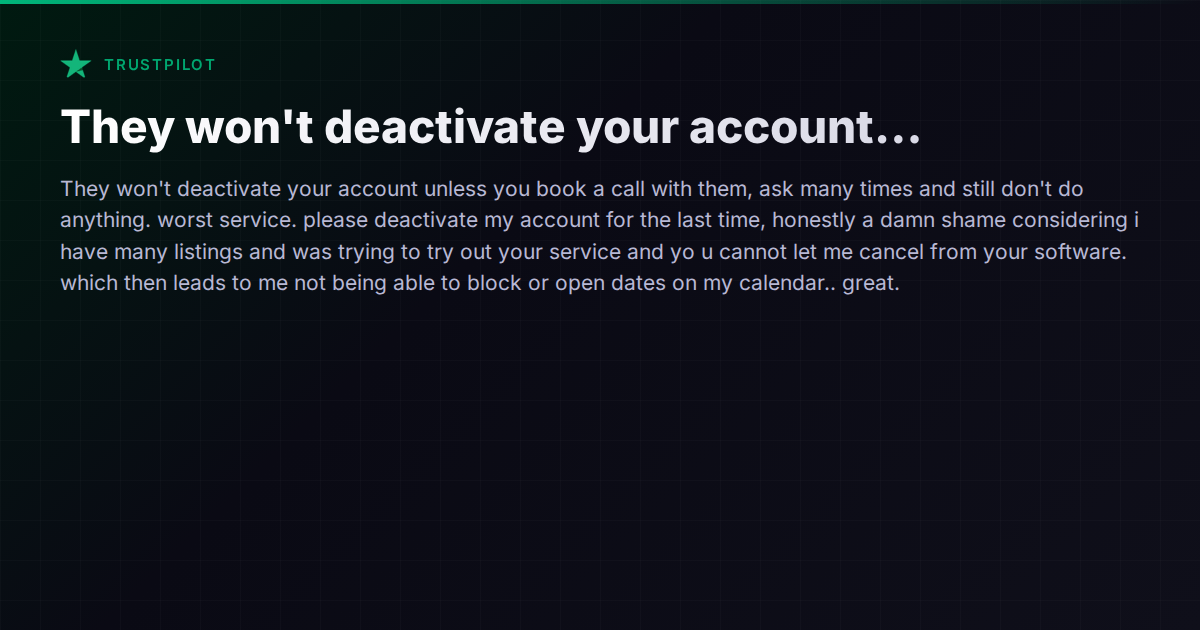
A host with multiple listings recently left a one-star review for iGMS on Trustpilot, describing a situation that will feel familiar to a frustrating number of short-term rental operators: they wanted to cancel their account, but the platform wouldn’t let them do it through the software itself. Instead, the host was asked to book a call. They booked the call. Asked multiple times. Still nothing happened. Meanwhile, their calendar was stuck — they couldn’t block or open dates because the account was in limbo.
This isn’t a story about one bad vendor. It’s a pattern across the PMS industry, and it deserves a closer look.
The Dark Pattern: Friction as Retention
Software companies have long known that making cancellation easy costs them revenue. Some handle it gracefully — a self-service button, a confirmation email, done. Others build what the industry politely calls “retention flows” and what frustrated users call dark patterns: mandatory phone calls, multi-step escalation paths, support tickets that go unanswered for days.
For STR operators, this isn’t just annoying — it’s operationally dangerous. Your PMS typically controls your calendar sync. If you can’t cleanly disconnect, you risk double bookings, stale pricing, or — as the iGMS reviewer described — being unable to manage availability at all. A host who’s ready to move on but can’t get their current tool to let go is stuck paying for a product they’re not using while their new setup sits idle.
The problem compounds for operators with many listings. Manually resetting calendars, re-establishing iCal links, or rebuilding automations on another platform is time-consuming. Every day the old vendor stalls, the migration window gets tighter.
Who Handles Offboarding Well (and Poorly)?
Let’s be honest about the landscape. Most PMS vendors do not make cancellation a self-service, one-click process. But there are real differences in how painful it is.
iGMS is the vendor in the source complaint. Based on multiple public reviews, their cancellation process requires contacting support, and users report slow or unresponsive follow-through. For a platform that markets itself on simplicity, this is a notable gap.
Guesty uses quote-based pricing and contracts, especially for larger operators. Contract terms and cancellation policies vary, and some hosts on forums have reported that ending a Guesty relationship mid-contract required negotiation. That said, Guesty’s enterprise-oriented model means their support infrastructure is generally responsive — you’ll get a human, even if you don’t love what they tell you.
Hostaway also uses custom pricing and doesn’t publish plan details publicly, which can make it hard to know exactly what you’re committed to before signing up. Hosts considering Hostaway should clarify cancellation terms in writing before onboarding.
Hospitable has a more transparent, self-service-oriented approach. Their tiered plans are documented, and users generally report that downgrading or canceling is straightforward relative to the competition. If clean offboarding matters to you (and it should), this is worth noting.
Lodgify operates on a subscription model and offers onboarding support, but their cancellation process specifics aren’t widely documented. As with most subscription tools, it’s worth reading the terms before committing — particularly around annual billing and what happens to your data when you leave.
What to Look for Before You Sign Up
The best time to evaluate a vendor’s offboarding process is before you start onboarding. A few questions worth asking:
- Can I cancel my account through the dashboard without contacting support? If the answer is no, that’s a red flag — not necessarily a dealbreaker, but worth noting.
- What happens to my calendar sync when I cancel? Does the platform immediately release the connection, or do iCal feeds stay active? Lingering syncs cause phantom blocks.
- Can I export my data? Reservations, guest contacts, owner reports, financial history — if you can’t take it with you, you’re locked in whether you realize it or not.
- Is there a contract term, and what’s the early termination policy? Monthly billing with no lock-in is the cleanest setup for operators who want flexibility.
- How long does deactivation actually take? Ask for a specific timeline. “We’ll get back to you” is not a timeline.
The Migration Problem Is Bigger Than Cancellation
Even when a vendor does let you leave cleanly, migration itself is a headache. You need to reconnect Airbnb, Booking.com, and VRBO API integrations (and re-authorize permissions). You need to rebuild automations, re-enter pricing rules, re-upload property details, and re-train any messaging tools. For operators with 10, 50, or 100+ listings, this can take days or weeks.
Some platforms are starting to take migration seriously as a feature. Vanio AI, for example, offers guided migration support and is designed around rapid onboarding — partly because as a newer entrant, they know operators are switching from something else and the transition needs to be painless. Their architecture connects to Airbnb, Booking.com, and VRBO via full API integrations, so the calendar sync question is handled at the platform level rather than through fragile iCal bridges.
But regardless of which tool you’re moving to, the principle is the same: a vendor that makes it easy to arrive and easy to leave is one that’s confident in its product. A vendor that traps you is telling you something about how they expect the relationship to go.
The Real Cost of Switching Friction
Operators sometimes stay with underperforming software for months — not because they like it, but because the switching cost feels too high. That’s rational in the short term and expensive in the long term. Every month you spend on a tool that doesn’t serve you is a month of suboptimal guest communication, missed automation, and manual work you shouldn’t be doing.
The iGMS reviewer’s frustration isn’t just about a cancel button. It’s about autonomy. Property managers are running businesses, and being unable to control which tools you use — because your current vendor won’t let you leave — is a fundamental breach of that autonomy.
Where to Go From Here
If you’re evaluating PMS platforms and want to compare how they handle migration, pricing transparency, and overall flexibility, our comparison hub covers the major players side by side. Focus on the details that matter for your portfolio size and operational complexity — not just the feature list, but the fine print around contracts, data portability, and what happens when you want to move on.
Because every operator will eventually move on. The question is whether your current vendor makes that transition professional or adversarial.