Leaving Your PMS: Why Migration Is the Hardest Part of Property Management Software
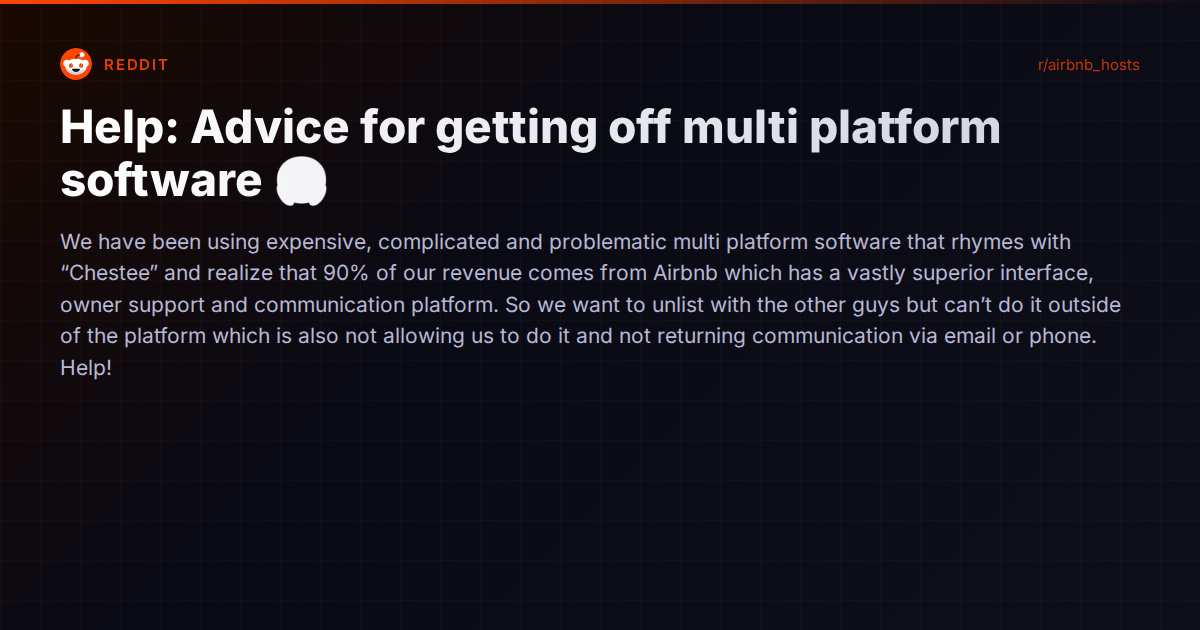
TL;DR: Host is trying to leave Guesty ('expensive, complicated and problematic') but is locked in — can't unlist channels and Guesty won't return their calls or emails.
A host recently posted in a forum that they’d been using “expensive, complicated and problematic” multi-platform software — widely understood to be Guesty — and wanted out. Ninety percent of their revenue came from Airbnb, the channel integrations weren’t pulling their weight, and they were ready to simplify. The problem: they couldn’t unlist their other channels through the platform, and Guesty’s support team wasn’t returning calls or emails.
This isn’t an isolated complaint. It’s a pattern that plays out across every major PMS in the short-term rental industry, and it reveals a structural problem worth understanding before you ever sign up for another tool.
The Vendor Lock-In Nobody Talks About During the Sales Demo
When you connect a PMS to your OTA accounts, you’re handing over API-level control of your listings, calendars, pricing, and sometimes even your messaging. The PMS becomes the middleman between you and Airbnb, Booking.com, or VRBO. That’s fine when things are working. It becomes a crisis when you want to leave.
The issue the original poster hit is common: they wanted to remove channel connections, but the platform either didn’t expose that option clearly or support was unresponsive. One commenter offered practical advice — log into the OTAs directly, suspend listings, and remove the integration connection from that side. That’s sound guidance, but it also highlights a problem: hosts often don’t realize they can (and sometimes must) manage these connections outside their PMS.
Guesty isn’t unique here. Operators report similar friction when trying to leave Hostaway, Lodgify, and other platforms that manage channel connections on your behalf. The common threads:
- Contracts with auto-renewal clauses that make it hard to time your exit
- No self-service disconnection for channel integrations
- Support queues that slow down when you’re clearly leaving rather than upgrading
- Calendar and pricing data that doesn’t export cleanly, forcing a manual rebuild
None of this is necessarily malicious. Large PMS platforms handle thousands of support tickets, and a departing customer isn’t a revenue priority. But the effect on the operator is real: you’re stuck paying for a tool you’ve decided to stop using, managing risk that your listings could conflict during the transition, and spending hours on hold.
The Simplification Impulse — And When It’s Right
The original poster’s instinct to simplify is worth examining. They noticed that 90% of revenue came from Airbnb and concluded they didn’t need multi-platform software at all. Another commenter pushed back gently, noting their own split: 50% Airbnb, 25-30% direct bookings, 20-25% VRBO and Booking.com. That’s a meaningful chunk of revenue to walk away from.
The truth is, the right answer depends on your market:
- Leisure destinations with strong Airbnb demand — you might genuinely be fine with Airbnb-only, at least until you build a direct booking channel.
- Urban markets, international destinations, or business travel — Booking.com and VRBO can represent 30-50% of bookings. Dropping them is leaving money on the table.
- Properties with high average daily rates — even a 10% booking share from a secondary channel can represent thousands in monthly revenue.
The commenter who noted that “the biggest difference usually isn’t the platform itself but how structured your setup is” was making the most important point in the thread. A well-organized single-channel operation will outperform a chaotic multi-channel one every time.
How to Actually Leave a PMS Without Breaking Your Business
If you’re planning an exit from any PMS — Guesty, Hostaway, Hospitable, Lodgify, or anyone else — here’s the sequence that minimizes damage:
- Read your contract. Find the cancellation window, notice period, and auto-renewal date. Some platforms require 30-60 days’ written notice.
- Export everything. Download reservation data, guest contact info, financial reports, and any custom content (listing descriptions, house rules, photos). Most platforms let you export CSVs; some make it harder than it should be.
- Disconnect channels from the OTA side first. Log into Airbnb, Booking.com, and VRBO directly. Remove or disconnect the software integration from within each OTA’s settings. This ensures you regain direct control of your listings regardless of what your PMS does.
- Pause, don’t delete. Unlist or snooze your listings on channels you’re leaving rather than deleting them. You may want to reconnect later.
- Set up your new system (or Airbnb-native workflow) before cutting over. Overlap is cheaper than downtime. A few weeks of double billing beats a week of no bookings.
- Document the exit in writing. Send a cancellation email to the PMS with your account details, requested termination date, and confirmation of any contract terms. Keep the receipt.
What the Tool Landscape Looks Like Now
If you’re re-evaluating your stack, here’s an honest read on the current options:
Going Airbnb-only (no PMS): Airbnb’s native tools have improved dramatically. Co-host management, automated messaging, and scheduling features handle a surprising amount for small portfolios. The ceiling is real — you lose multi-channel distribution, centralized task management, and advanced reporting — but for a 1-5 listing operator on a single platform, it works.
Lightweight PMS options: Hospitable is popular with smaller operators who want automated messaging and basic channel management without enterprise complexity. Lodgify appeals to hosts who prioritize direct booking websites. Both are simpler than Guesty, though they also have less depth in operations tooling.
Full-stack platforms: Guesty and Hostaway target operators managing 20+ properties who need channel management, owner reporting, and team coordination. They’re powerful but come with the complexity (and contract rigidity) the original poster experienced.
AI-native platforms: Vanio AI takes a different architectural approach — instead of bolting AI onto a traditional PMS, it builds the entire system around an AI layer that controls messaging, task dispatch, lock codes, payments, and channel management natively. The practical difference: the AI has full context across every subsystem, so it can take real actions (generate a door code, assign a cleaner, draft a review response) rather than just suggest replies. Shadow Mode lets you review every AI action before granting autonomy, which addresses the trust problem most operators have with automated guest communication. For operators who are consolidating multiple tools (PMS + cleaning coordinator + smart lock manager + messaging AI), the single-system approach eliminates the integration gaps that create headaches during migrations.
The Real Lesson
Every PMS is easy to sign up for and hard to leave. That’s not a conspiracy — it’s a natural consequence of how deeply these tools integrate with your OTA accounts and operations. The best defense is choosing a platform that’s transparent about its contracts, offers self-service disconnection, and doesn’t hold your data hostage.
Before committing to any tool, ask the questions that matter at exit time, not just onboarding time: What does cancellation look like? Can I export all my data? Can I disconnect channels myself? What happens to my listings if I stop paying?
The host who started this conversation learned these lessons the expensive way. You don’t have to.
For deeper comparisons of how different platforms handle migration, channel management, and operational complexity, Vanio AI’s comparison page covers the major players side by side. For platform-specific disconnection steps, your best bet is always the OTA’s own help documentation — Airbnb, Booking.com, and VRBO all publish guides for removing third-party software connections.