When Your PMS Gets the Pricing Wrong — and Won't Let You Leave
Trustpilot
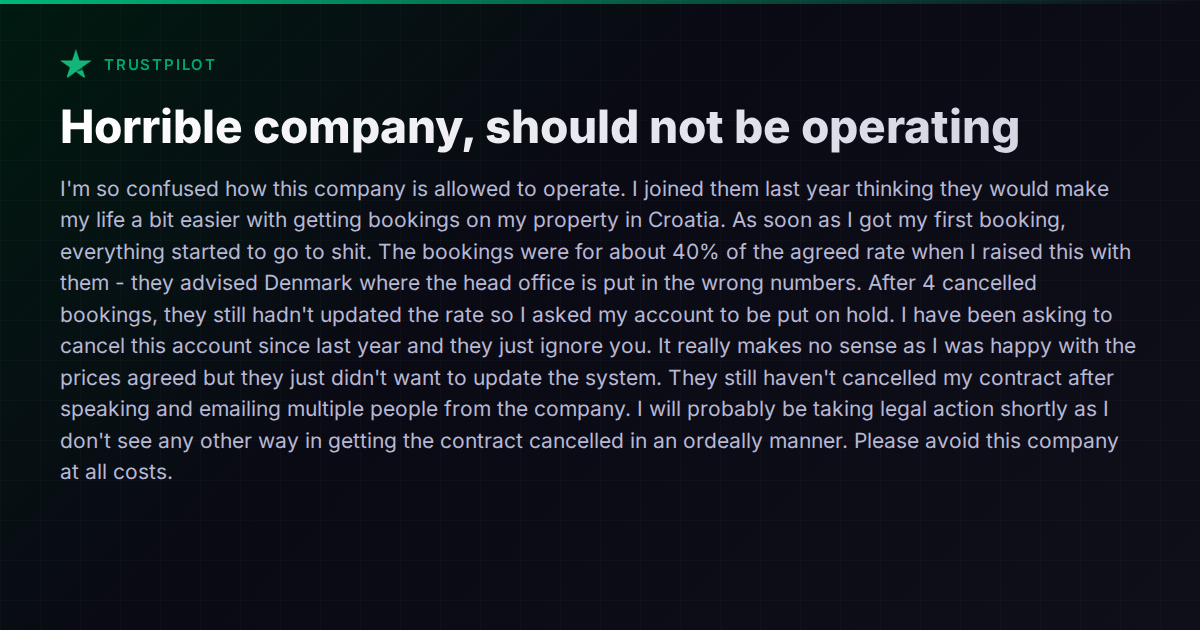
TL;DR: Host in Croatia joined Guesty expecting easier booking management but experienced persistent wrong pricing (40% of agreed rate), multiple cancelled bookings, and has been unable to cancel her contract for over a year despite repeated requests — now considering legal action.
A host managing a property in Croatia recently shared a story on Trustpilot that will sound familiar to anyone who’s been burned by a property management platform. She signed up with Guesty expecting streamlined booking management. Instead, her first booking came in at roughly 40% of the rate she’d agreed to. The headquarters had entered the wrong numbers. After four cancelled bookings and months of follow-up, the pricing still hadn’t been corrected. She asked to pause her account. Then she asked to cancel. That was over a year ago. At the time of her review in April 2026, she was considering legal action just to get out of the contract.
This isn’t an isolated incident. It’s a pattern that plays out across the PMS industry — and it exposes two systemic problems that operators of every size should understand before they commit to a platform.
The Pricing Error Problem
Getting your nightly rate wrong isn’t a minor inconvenience. In short-term rentals, a single underpriced booking can cost hundreds or thousands of dollars in lost revenue. When the error persists across multiple bookings because the platform is slow to fix it, the financial damage compounds fast.
Pricing errors in PMS platforms happen for several reasons:
- Manual data entry during onboarding. A support team member in one country enters rates for a property in another, sometimes misreading currency formats or regional pricing conventions.
- Channel-specific markup misconfigurations. A rate that looks correct in the PMS may get pushed to Airbnb, Booking.com, or VRBO with the wrong markup, cleaning fee, or tax handling.
- Sync lag. Some platforms batch-update pricing rather than pushing changes in real time. An operator fixes a rate in the dashboard but the old rate keeps appearing on OTAs for hours or days.
- Lack of rate verification workflows. Most PMS tools don’t have a built-in sanity check that flags when a pushed rate deviates significantly from the operator’s configured pricing.
The Croatian host’s case is especially frustrating because the error was identified immediately, reported repeatedly, and still not corrected after multiple bookings. That points to an operational breakdown inside the platform provider — not a technical limitation.
The Contract Lock-In Problem
The second issue — the inability to cancel — is arguably worse than the pricing error itself. A bad rate can be fixed. Being trapped in a contract with a provider that won’t fix it is a different category of problem.
Many traditional PMS platforms use annual contracts with auto-renewal clauses, cancellation windows, and minimum commitment periods. These structures made sense in an era when onboarding was expensive and platforms needed to recoup setup costs. In 2026, they increasingly feel like retention mechanisms disguised as business terms.
Here’s what operators commonly report across multiple platforms:
- Cancellation requests go unanswered. Email threads get lost. Support tickets are marked resolved without action. Account managers change and context disappears.
- Contractual fine print creates friction. Some contracts require written notice 30, 60, or even 90 days before a renewal date. Miss the window by a day and you’re locked in for another year.
- No self-service cancellation. If you can’t cancel from within your own dashboard, you’re at the mercy of someone else’s response time — and incentives.
Guesty, in particular, doesn’t publicly disclose its pricing or contract terms on its website. Prospective customers must request a custom quote, which often comes with annual commitments. This lack of upfront transparency makes it harder for operators to evaluate the true cost — and the true risk — before signing.
To be fair, Guesty is not the only PMS with these issues. Operators have reported similar contract frustrations with Hostaway and other platforms that rely on quote-based, annual agreements. The pattern is industry-wide.
What to Look for Before You Commit
If you’re evaluating PMS platforms in 2026, the Croatian host’s experience suggests a practical checklist:
1. Understand the cancellation terms before you sign. Ask explicitly: Can I cancel at any time? Is there a notice period? What happens if I cancel mid-contract? Get answers in writing, not verbal promises from a sales call.
2. Check whether pricing is transparent and self-serve. Platforms that publish their pricing openly — and let you manage your subscription without filing a support ticket — are signaling that they don’t rely on contract friction for retention. Hospitable, Lodgify, and Vanio AI all publish their pricing publicly. Vanio AI uses a per-reservation model ($5 per booking) with no annual lock-in, which structurally eliminates the contract trap — if the platform isn’t delivering value, you stop using it and stop paying.
3. Verify your rates before the first booking goes live. After onboarding, don’t just check your rates in the PMS dashboard. Go to Airbnb, Booking.com, and VRBO and search for your property as a guest would. Confirm that the rate, fees, and total price match your expectations. Do this for multiple date ranges.
4. Test the support response loop early. Before you have a real problem, submit a test support request. How fast do they respond? Do they actually resolve the issue, or do they acknowledge it and move on? A platform that takes three days to answer a non-urgent question will take three weeks on a critical pricing fix.
5. Look for rate safeguards. Some platforms include automated checks that flag when pushed rates deviate significantly from your base pricing. This isn’t a common feature, but it’s a reasonable expectation. If the platform can push rates to OTAs, it should be able to verify those rates match what you configured.
The Landscape in 2026
The PMS market has shifted meaningfully toward usage-based and month-to-month pricing models, but plenty of legacy providers still lean on annual contracts. Here’s a rough lay of the land:
- Guesty: Custom pricing, typically annual contracts. Strong feature set for enterprise-scale operators, but the onboarding and support experience varies widely based on account size and region.
- Hostaway: Also quote-based, no public pricing. Similar contract structure.
- Hospitable: Tiered plans with published pricing. Lower barrier to entry and exit, though the feature set is narrower — more focused on messaging automation and basic operations.
- Lodgify: Subscription-based with published pricing. Strongest on direct booking websites but lighter on operational automation.
- Vanio AI: Per-reservation pricing ($5/booking), no annual commitment. AI-native architecture with integrated operations, but newer to market with a smaller install base than the incumbents.
Each of these has genuine strengths. The right choice depends on your portfolio size, operational complexity, and — as this story illustrates — your tolerance for contract risk.
The Takeaway
A PMS that gets your pricing wrong and won’t let you leave is worse than no PMS at all. The Croatian host’s experience is a cautionary tale not because Guesty is uniquely bad — every platform has unhappy customers — but because it highlights a structural vulnerability that many operators don’t think about until they’re trapped by it.
Before you sign anything, ask yourself: if this platform stopped delivering value tomorrow, how quickly and painlessly could I walk away? If the answer is “not easily,” that’s information worth having before the first booking comes in.
For a broader comparison of how major PMS platforms stack up on pricing, contracts, and feature coverage, see the comparison hub.