What Happens When Your PMS Cancels Your Account Without Warning
Trustpilot
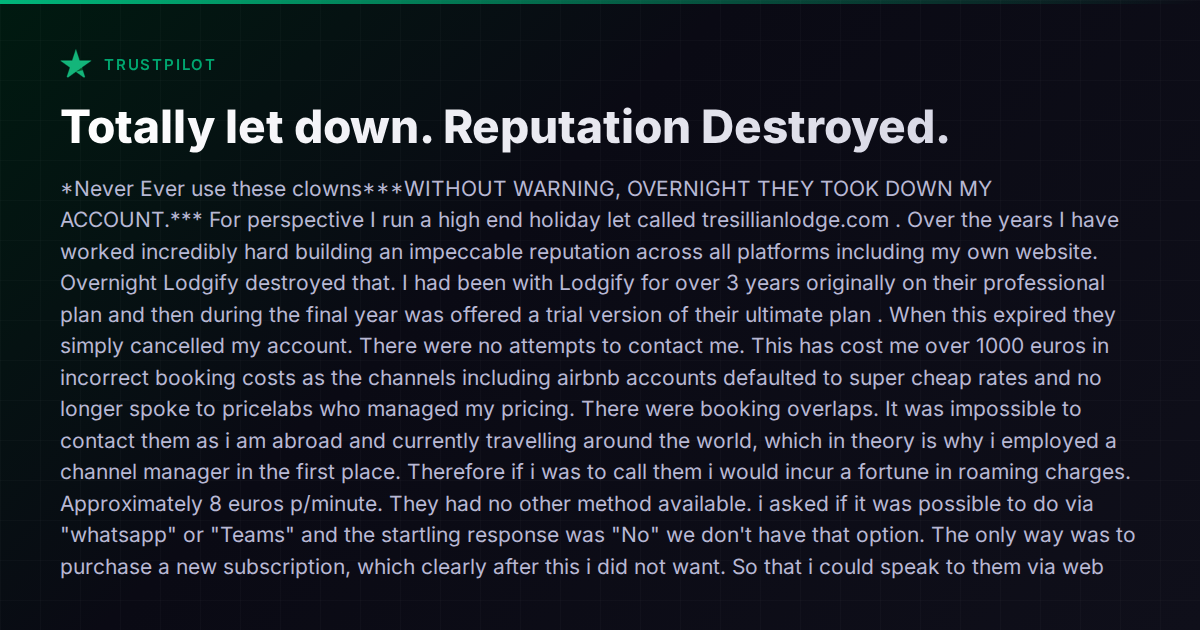
TL;DR: Host's Lodgify account was cancelled without warning when a trial expired, causing pricing defaults, booking overlaps, lost Superhost status, and over €1000 in damages — and support was inaccessible while traveling abroad.
Imagine you’re traveling abroad — perhaps the very reason you invested in a property management platform in the first place — and you wake up to discover your PMS account has been shut off. Your channel connections are severed. Your dynamic pricing tool is no longer syncing. Rates on Airbnb have defaulted to whatever was cached last — probably something wildly wrong. Bookings are overlapping. And the only support channel available requires an international phone call at €8 per minute.
This isn’t hypothetical. A UK-based host running a high-end holiday let recently described exactly this scenario in a Trustpilot review about Lodgify. After three years on the platform, a trial of their top-tier plan expired, and the account was simply cancelled. No email warning. No grace period. No attempt to downgrade to the previous paid plan. Just a hard cutoff — and over €1,000 in pricing errors, booking overlaps, and a potential loss of Airbnb Superhost status.
The details are painful, but the underlying pattern is far more common than it should be in 2026.
The Real Risk: Your Business Runs on a Single Point of Failure
Every short-term rental operator who uses a channel manager is making a bet: that the platform sitting between their listings and the booking channels will keep running reliably. When it works, it’s invisible. When it fails — or when it’s deliberately shut off — the consequences cascade fast.
Here’s what typically breaks when a PMS account goes dark:
- Calendar sync stops. Channels no longer talk to each other. Double bookings become likely within hours.
- Dynamic pricing disconnects. If you use PriceLabs, Wheelhouse, Beyond, or any external pricing tool, those tools lose their bridge to your listings. Rates may revert to stale defaults or disappear entirely.
- Channel API connections are severed. This is the part most hosts don’t realize until it’s too late: reconnecting to Airbnb, Vrbo, or Booking.com through a PMS isn’t instant. It can take hours or days, especially if the original connections were wiped rather than just paused.
- Guest communication breaks. Automated messages, check-in instructions, and review requests stop firing. Guests arrive with no access codes and no context.
The Lodgify case is a particularly sharp example because the host had done everything right operationally — professional plan, PriceLabs integration, multi-year track record — and the failure was entirely on the platform side.
Trial Expirations and Hard Cutoffs: A Pattern
Lodgify isn’t the only platform where trial-to-paid transitions have caused problems. Across host communities, operators have reported similar issues with various tools:
- Trial upgrades that expire without clear communication, dropping you back to a plan that doesn’t support your current configuration.
- Subscription lapses (expired credit card, billing address change) that immediately sever channel connections instead of providing a grace period.
- Account downgrades that silently disable features like API connections, leaving your listings in a broken state without any dashboard warning.
The core issue is that most PMS platforms treat account status as binary: active or inactive. There’s rarely a degraded state that keeps your channel connections alive while restricting new features. When the switch flips, everything goes at once.
The Support Problem Compounds Everything
What made the Lodgify situation especially damaging was the support model. The host was traveling internationally — exactly the use case a channel manager is supposed to support — and discovered that the only way to reach a human was via phone. No WhatsApp. No video call. No web chat unless you resubscribed first.
This is a design choice that reveals priorities. When support is gated behind an active subscription, the platform is optimizing for retention leverage, not customer outcomes. A host whose account was just cancelled is the person who needs support most urgently, and they’re the one who’s locked out of getting it.
This isn’t unique to Lodgify. Support accessibility varies widely across the PMS landscape:
- Guesty offers 24/7 support but pricing isn’t transparent, and some operators report slow response times for non-enterprise accounts.
- Hostaway provides email and chat support, but responsiveness has been a recurring complaint in host forums.
- Hospitable offers email-based support with generally positive reviews, though complex issues can take multiple exchanges to resolve.
- Lodgify emphasizes personalized onboarding, but as this case illustrates, post-sale support when things go wrong can be a different experience entirely.
The lesson: evaluate a PMS not just on how well it works when everything is fine, but on what happens when something breaks. Ask specifically: What is the grace period if my subscription lapses? What happens to my channel connections? Can I reach support without an active plan?
Protecting Yourself: Practical Steps
No matter which platform you use, there are steps you can take to reduce the blast radius of a sudden PMS failure:
- Set calendar reminders for every subscription renewal date. Don’t rely on the platform to notify you. Treat it like insurance — you check the renewal date yourself.
- Keep your channel credentials accessible. Know your Airbnb, Vrbo, and Booking.com login details and be prepared to manage listings directly if your PMS goes down.
- Document your pricing configuration externally. If you use PriceLabs or another dynamic pricing tool, keep a record of your base rates, minimum stays, and seasonal adjustments outside the PMS.
- Test support before you need it. Open a low-stakes support ticket and measure the response time, channel options, and quality. If it takes 48 hours to get a reply when nothing is wrong, imagine what happens during a crisis.
- Ask about data portability and connection persistence. Before signing up, ask the platform: if my subscription lapses, are my API connections paused or deleted? Can I export my reservation data? What’s the reconnection process?
Where the Industry Is Heading
The broader trend in property management software is toward platforms where the system itself is aware of operational continuity risks. Vanio AI, for example, takes an architecture-first approach where the AI agent has native access to channel connections, pricing, guest messaging, and smart locks in a single data layer — which means there’s no scenario where one subsystem silently disconnects while others keep running. The Operations Watchdog feature runs automated daily checks across messaging, access codes, cleaning, and payments, catching the kind of silent failures that cascade into booking overlaps and guest complaints.
That said, no platform is immune to subscription billing issues, and the most important protection is always your own diligence about renewal dates and fallback plans.
The Bottom Line
The Lodgify incident is a cautionary tale, but the underlying vulnerability applies to every PMS on the market. Your channel manager is the single point of failure for your entire rental business. When it goes dark — whether from a billing lapse, a trial expiration, or a platform outage — the damage is immediate, financial, and reputational.
Choose a platform based not just on features and price, but on how it handles failure states. Ask hard questions about grace periods, data persistence, and support accessibility. And always have a manual fallback plan, because the one time you’ll need it is the one time you won’t expect to.
For a deeper comparison of how different platforms handle these operational fundamentals, see our comparison hub.