When Your PMS Breaks Your Listings: The Hidden Risk of Cross-Platform Account Linking
Trustpilot
TL;DR: Author's Uplisting account broke twice in a month due to cross-platform account linking issues with AirDNA, destroying their messaging and dynamic pricing, and support refuses to acknowledge or repair the account.
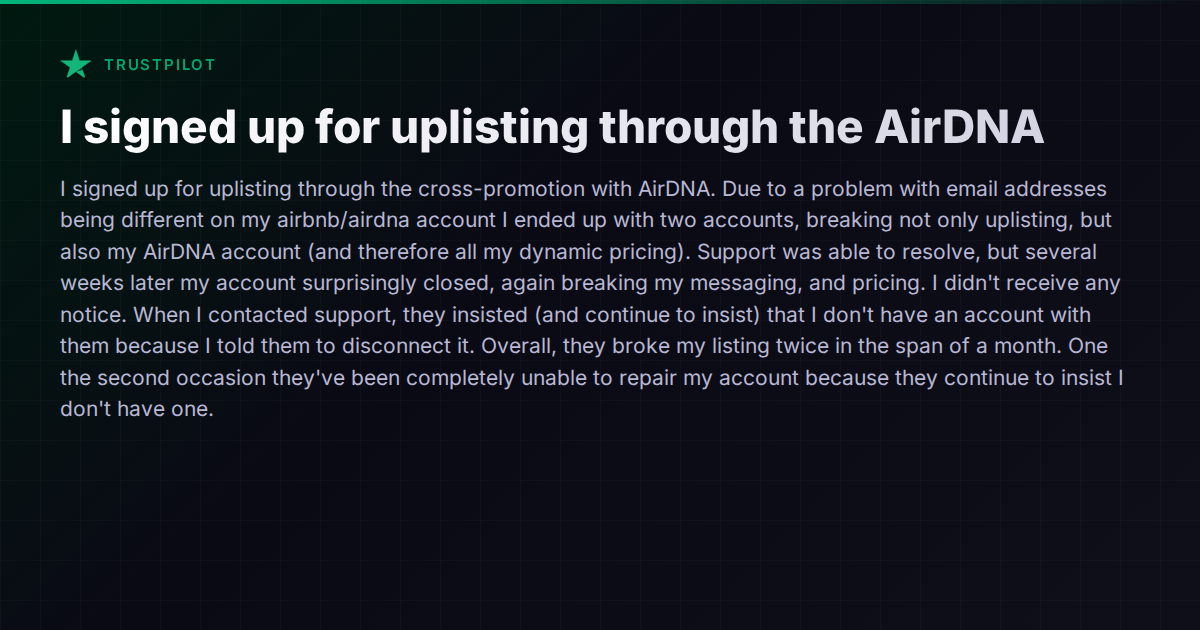
A host recently shared a nightmare scenario on Trustpilot: they signed up for Uplisting through a cross-promotion with AirDNA, ended up with duplicate accounts due to mismatched email addresses, and watched their messaging, dynamic pricing, and listing sync break — twice in one month. The second time, support insisted the account didn’t exist at all. No notice, no recovery path, no acknowledgment.
It’s a worst-case outcome, but the underlying problem is far more common than most operators realize. As the short-term rental tool stack grows more interconnected — PMS platforms partnering with pricing tools, channel managers linking to lock providers, direct booking engines feeding CRMs — the risk of one broken link cascading across your entire operation grows with every integration.
The Cascade Failure Pattern
Here’s what makes cross-platform account linking dangerous: it’s not just one system that breaks. A single account mismatch can propagate failures across every tool in the chain.
In the case above, a mismatched email between Airbnb and AirDNA created duplicate accounts in Uplisting, which then corrupted the AirDNA connection and, by extension, the dynamic pricing that depended on it. Guest messaging went down. Calendar sync went down. And when the host tried to get help the second time around, the support team couldn’t even locate the account.
This isn’t unique to Uplisting. Any PMS that relies on third-party integrations for critical functions — pricing, messaging, lock codes, payment processing — creates the same potential for cascade failure. The more tools in the chain, the more links that can snap.
Operators who’ve been through a PMS migration or tried to connect a new pricing engine mid-season know the anxiety. A single OAuth token expiring, an email mismatch, or a duplicate account record can silently disconnect your calendar sync for days before you notice the double bookings rolling in.
Why Support Often Can’t Help
The Trustpilot review highlights a particularly frustrating pattern: the vendor insisting the account doesn’t exist. This sounds absurd, but it’s a predictable consequence of how many platforms handle account identity.
When a cross-promotion creates an account automatically — as Uplisting did through AirDNA — the account’s identity is often tied to the partner’s SSO or referral token rather than the host’s direct login credentials. If that link breaks, the host can end up in a dead zone: the PMS says they have no account, the partner platform says the account was created, and neither side has the tooling to reconcile.
Most PMS support teams are trained to handle standard workflows: connect a channel, sync a calendar, troubleshoot a pricing rule. Cross-platform identity issues sit in the cracks between two support organizations, and neither has full visibility into the other’s system.
How the Major PMS Platforms Handle (or Don’t Handle) This
No platform is immune, but the risk varies depending on architecture.
Guesty integrates with a wide range of third-party tools — dynamic pricing (PriceLabs, Beyond Pricing, Wheelhouse), smart locks, accounting software, and more. The upside is flexibility. The downside is that more integration points mean more potential failure points. Guesty’s enterprise support is generally responsive for large portfolios, but smaller operators on lower tiers have reported longer resolution times for complex integration issues.
Hostaway takes a similar approach with a broad integration marketplace. Their unified inbox and channel manager are tightly coupled, which reduces some internal cascade risk, but pricing and operational tool connections still rely on third-party APIs. Hostaway’s quote-based pricing model suggests they invest more in onboarding and support for committed customers, which can help prevent setup errors — but doesn’t eliminate them.
Hospitable focuses heavily on messaging automation and channel sync, with pricing handled through integrations with tools like PriceLabs and Beyond Pricing. Their system is relatively streamlined, which reduces the surface area for account linking issues, but the tradeoff is fewer built-in features — you still need external tools for pricing, locks, and payments.
Lodgify emphasizes ease of use and includes a free one-on-one onboarding session, which is specifically designed to catch setup errors before they cascade. For operators who value guided setup over self-service flexibility, this matters. But Lodgify’s integration ecosystem is narrower than Guesty’s or Hostaway’s, which can be limiting for operators with complex stacks.
The Architecture Question: Integration vs. Consolidation
The fundamental tension here is between flexibility and fragility. A modular stack — PMS plus separate pricing tool plus separate lock provider plus separate messaging platform — gives you best-of-breed in each category but creates dozens of integration seams where things can break.
A consolidated platform that handles more functions natively reduces those seams. When your messaging, calendar, pricing overrides, lock codes, and task dispatch all live in one system, there’s no cross-platform account linking to fail. The tradeoff is that you’re betting on one vendor to be good enough at everything, rather than picking specialists.
Vanio AI takes this consolidation approach to its logical endpoint, building channel management, guest messaging, smart locks, task dispatch, payments, and pricing controls into a single system with one data layer. Because there’s no middleware between subsystems, there’s structurally no place for the kind of cross-platform identity failure described in the Trustpilot review. That doesn’t make it the right choice for every operator — if you’re deeply invested in a specific pricing engine or operational tool, a modular stack might still make sense — but it eliminates an entire category of failure mode.
Protecting Yourself Regardless of Platform
Whether you run a modular stack or a consolidated platform, there are practical steps to reduce cascade failure risk:
- Use the same email everywhere. Before connecting any new tool, verify that your email, name, and account identity match across every platform in the chain. Mismatches are the number-one cause of duplicate account issues.
- Document every integration. Keep a simple spreadsheet of what’s connected to what, which credentials are used, and when tokens were last refreshed. When something breaks, this cuts your diagnosis time in half.
- Test integrations in staging. If a PMS offers a sandbox or test mode, use it before connecting your live Airbnb or Booking.com account. Not all do, but those that offer it are worth the extra setup time.
- Export your data regularly. Reservation data, guest contacts, pricing rules, message templates — if your PMS account disappears tomorrow (as in the Trustpilot case), you need to be able to rebuild somewhere else without starting from zero.
- Avoid cross-promotion signups for critical tools. If a pricing tool offers a “sign up for this PMS through us” flow, consider signing up for the PMS directly instead. The convenience rarely justifies the identity-linking risk.
The Takeaway
The Trustpilot story is an extreme case, but the underlying risk — cascading failures from cross-platform account linking — affects every operator running more than one tool. The short-term rental industry has normalized five-tool stacks as the cost of doing business, but every additional integration is a potential point of failure that no single vendor’s support team can fully own.
Whether you address that by consolidating into fewer platforms, by being meticulous about account hygiene, or by maintaining manual fallback procedures for critical functions like pricing and messaging, the worst move is to assume it won’t happen to you. If you’re evaluating your current stack or considering a migration, the /compare/ page offers side-by-side breakdowns of how different platforms handle integration depth, built-in features, and operational consolidation.