When Your PMS Vendor Becomes Your Biggest Operational Risk
Trustpilot
TL;DR: Guesty's platform is not intuitive, support is unresponsive with month-long unresolved tickets, training is minimal, and the author explicitly says they would not choose Guesty again if given the chance.
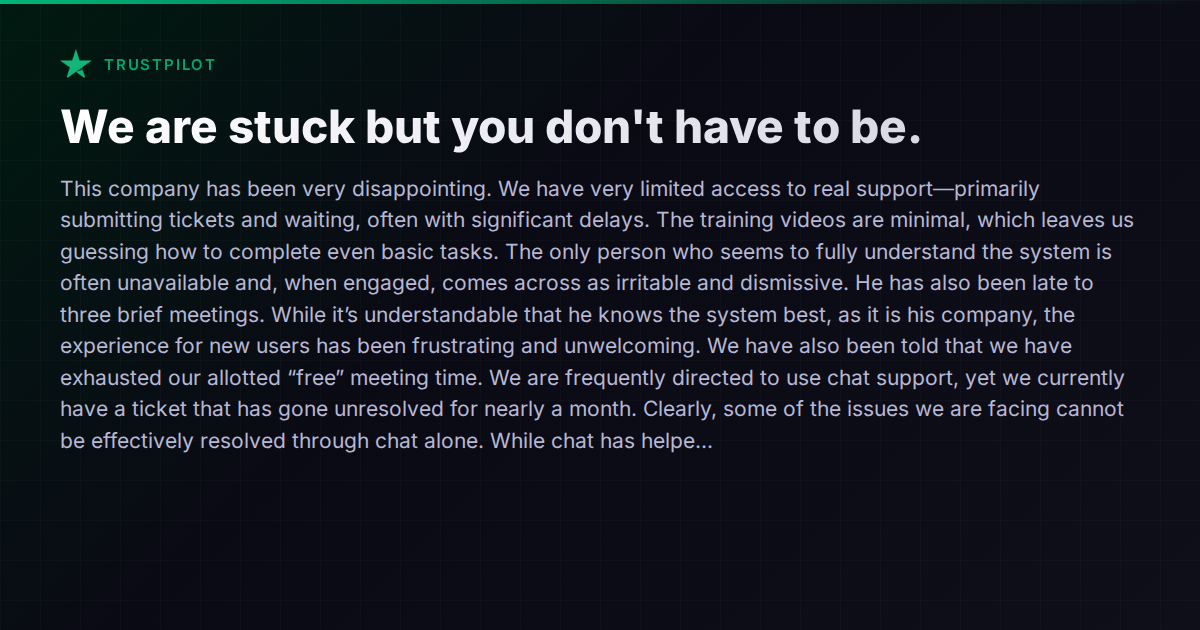
A property manager recently left a detailed Trustpilot review about their experience with Guesty that’s worth reading not for the anger, but for the specificity. Month-long unresolved support tickets. Training materials too thin to get new staff productive. A single point of contact who understood the system but was frequently unavailable and dismissive when engaged. Allotted “free” meeting time exhausted before the team was even functional. Non-accountant staff expected to understand debits and credits to complete basic tasks.
The review ends with a line that should concern any operator mid-migration: “We are stuck but you don’t have to be.”
This isn’t a unique story. It’s a pattern that plays out across the short-term rental industry, and it reveals something important about how PMS selection goes wrong.
The Onboarding Trap
Most property managers choose a PMS based on feature lists, demos, and sales conversations. These are all pre-sale experiences. What determines whether a platform actually works for your business happens after you sign: onboarding, training, migration, and the first few months of live operations.
This is where the gap between enterprise-marketed platforms and the actual support infrastructure becomes painfully visible. A platform can have a great channel manager, solid automation tools, and a polished dashboard — and still fail you completely if you can’t get help when something breaks or doesn’t make sense.
The Guesty review highlights several specific failure modes:
- Ticket-based support with no escalation path. When your only option is to submit a ticket and wait, urgent operational issues (a guest can’t check in, a channel isn’t syncing, a payment is stuck) become crises.
- Training that assumes expertise. Expecting property managers to understand accounting concepts like debits and credits without proper onboarding isn’t a feature gap — it’s a design philosophy gap.
- Metered onboarding time. Being told you’ve “exhausted your free meeting time” during implementation means the vendor has structurally separated the sale from the success. They got paid; whether you succeed is now your problem.
- Single-threaded knowledge. When one person is the only one who truly understands the system, every interaction becomes a bottleneck and a power dynamic.
These aren’t bugs. They’re business model choices.
What the Landscape Actually Looks Like
Let’s be fair about what’s available and where different platforms land on the support and usability spectrum.
Guesty targets mid-market to enterprise operators and manages over 500,000 listings. Their platform is genuinely deep — channel management, unified inbox, guest communication services, damage protection, and a newer AI copilot feature. But their pricing isn’t publicly disclosed, requiring a sales conversation, and reports of support quality vary widely. For operators with internal technical staff who can self-serve, Guesty’s depth is an asset. For teams that need hands-on help, the experience described in the review above isn’t an outlier based on what operators report across forums and review sites.
Hostaway occupies a similar mid-market space with strong OTA connections and a unified inbox. Their pricing also requires contacting sales, which makes comparison shopping harder. They offer owner portals and direct booking websites out of the box. Support experiences vary, but the platform generally gets better marks for usability than Guesty from operators in host communities, particularly for teams under 50 properties.
Hospitable (formerly Smartbnb) leans more heavily into automation-first design. Their AI guest messaging is genuinely good for routine communication, and the platform is more approachable for smaller operators. The trade-off is that it’s less feature-dense for complex portfolios. If your primary pain is guest communication automation and you’re running fewer than 20-30 properties, Hospitable’s learning curve is meaningfully lower.
Lodgify differentiates on onboarding — they offer a free onboarding experience (valued at $700 on their site) with one-on-one support from a dedicated specialist. For operators who’ve been burned by sink-or-swim implementations, this is a genuine selling point. The platform is more focused on direct bookings and website building than deep operational tooling, so it may not suit operators who need robust task management or cleaning coordination.
The Deeper Problem: Platform Complexity vs. Support Investment
Here’s the uncomfortable truth about the PMS market: the platforms that offer the most features are often the hardest to support. Every feature is a surface area for confusion, misconfiguration, and tickets. If a vendor doesn’t invest proportionally in support, documentation, and onboarding as they add features, complexity becomes a liability rather than an asset.
This is why the “all-in-one” pitch can be a double-edged sword. An all-in-one platform that you can’t fully implement is worse than a simpler platform you actually use. The review’s complaint about being “left to figure things out on our own” is the predictable outcome of selling a complex system without funding the human infrastructure to support it.
Some questions worth asking before you commit to any platform:
- What does onboarding actually include? Get specifics: how many hours, over what timeline, with whom. Is it metered?
- What happens after onboarding ends? Is ongoing support ticket-only? Is there live chat with actual humans? Phone support? What are published SLAs for ticket resolution?
- Can you talk to current customers at your scale? A platform that works for a 200-listing enterprise may be a poor fit for a 15-listing operation, and vice versa.
- How deep is the self-serve documentation? Browse the help center before you buy. If you can’t find clear answers to basic questions, that’s signal.
- What does migration look like? Moving off a PMS is painful. Moving off a PMS you never fully implemented is even more painful. Factor switching costs into your decision.
Where AI Changes the Equation (Somewhat)
One of the emerging shifts in this space is platforms where AI isn’t just a messaging feature but serves as an always-available interface to the system itself. Vanio AI takes this approach — building the AI as the core operating layer rather than bolting it onto an existing PMS. The practical implication for the support problem is that when your AI assistant has full context across reservations, tasks, locks, payments, and messaging, it can answer operational questions and take actions that would otherwise require a support ticket or a training session. Their Shadow Mode lets you verify AI behavior before trusting it to act autonomously, which addresses the reasonable fear of handing control to software you don’t yet understand.
This doesn’t eliminate the need for human support — no AI handles edge cases, billing disputes, or platform bugs. But it can meaningfully reduce the volume of “how do I do X” questions that clog ticket queues and frustrate operators during onboarding.
The Honest Summary
If you’re currently stuck on a platform with inadequate support, you’re facing a classic sunk-cost problem. The migration cost is real, but so is the ongoing cost of a system your team can’t use effectively.
Before choosing your next platform, weight support quality and onboarding depth at least as heavily as feature lists. The best feature set in the world is worthless if you can’t get it working — and can’t get help when it breaks.
Dig deeper: Guesty’s own help center, Hostaway’s knowledge base, Hospitable’s support docs, and Vanio AI’s documentation are all publicly browsable. Spend thirty minutes in each before your next demo. The quality of the docs tells you more about the company than the sales deck ever will.