When a Prettier Interface Isn't Worth the Operational Downgrade
Trustpilot
TL;DR: Author regrets switching to DUVE due to rigid workflows, broken guest access code delivery (unresolved for over a month), a WhatsApp number that was never activated despite being billed for 3 months, and poor support — and is actively looking for a more flexible, reliable alternative.
Every property manager has felt the pull. You see a demo with a sleek guest portal, modern typography, and a check-in flow that looks like it belongs in a boutique hotel app. You think: my guests deserve this. So you migrate — and then you spend the next three months chasing support tickets for features that worked fine on your old platform.
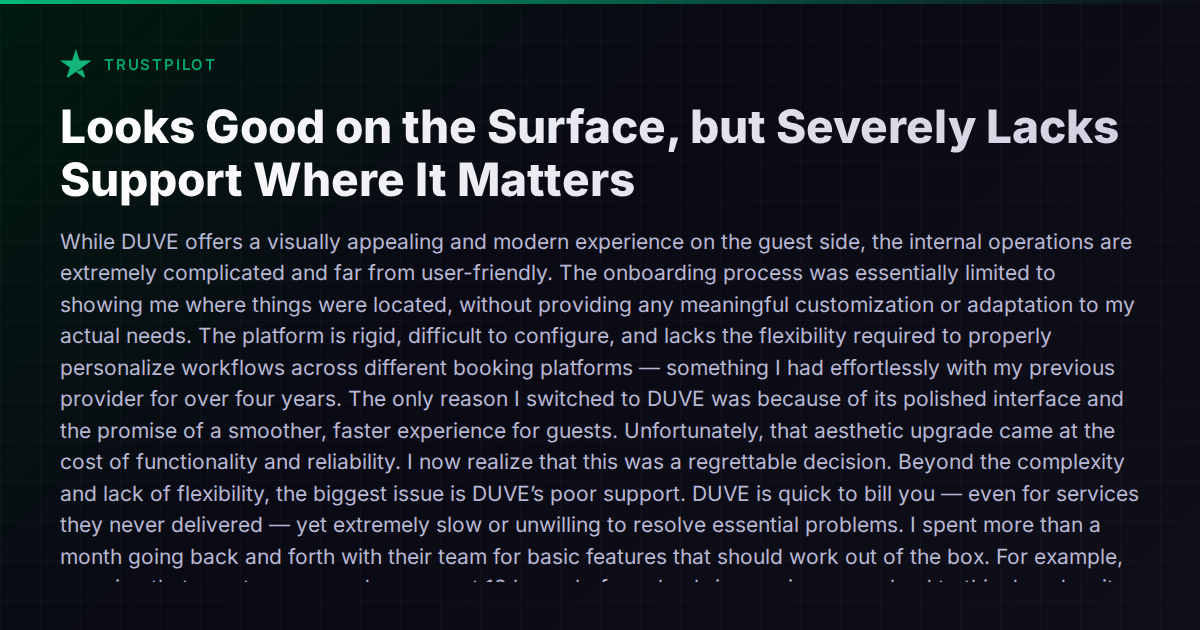
A recent Trustpilot review of Duve captures this pattern perfectly. The operator switched specifically for the polished guest-facing UI, only to find rigid internal workflows, an onboarding process that amounted to a product tour rather than real configuration help, guest access codes that never fired on schedule despite weeks of tickets, and a branded WhatsApp number that was billed for three months without ever being activated. The reviewer’s summary is blunt: “Instead of simplifying my operations, they added layers of complexity and ongoing issues that require constant follow-up.”
This isn’t just a Duve story. It’s a recurring pattern across the short-term rental software landscape, and it’s worth unpacking because the decision to migrate platforms is one of the highest-stakes moves an operator can make.
The “Pretty Demo” Trap
Guest-facing polish is genuinely important. A clean digital guidebook, a smooth check-in flow, and a well-designed upsell page can measurably improve guest satisfaction and ancillary revenue. The problem arises when a platform invests disproportionately in the presentation layer while the operational backbone — workflows, automations, channel-specific logic, lock code delivery, messaging integrations — remains brittle or inflexible.
Operators who’ve managed properties across Airbnb, Booking.com, and VRBO for years know that each channel has its own quirks: different messaging APIs, different cancellation policy structures, different data fields available at different times. A platform that looks beautiful in a single-channel demo can fall apart when you need conditional logic that behaves differently per channel, per property, per booking source. That’s exactly the kind of flexibility the Duve reviewer described losing.
What “Bad Onboarding” Actually Costs
The reviewer’s complaint about onboarding — “essentially limited to showing me where things were located” — is a red flag that shows up across multiple platforms, not just Duve. The difference between a product tour and real onboarding is enormous:
- Product tour: “Here’s where you set up automations. Here’s the messaging tab. Here’s the integrations page.”
- Real onboarding: “You manage 15 units across three channels with staggered check-in times and two cleaning teams. Let’s configure your workflows to match that reality.”
The cost of shallow onboarding compounds quickly. Every week you spend troubleshooting a misconfigured automation is a week of missed messages, confused guests, and manual workarounds. And because most PMS contracts lock you in for months, you’re paying full price during the entire remediation period.
Some platforms handle this better than others. Guesty assigns dedicated onboarding managers for larger accounts, though operators with smaller portfolios sometimes report being deprioritized. Hostaway offers guided setup but has drawn criticism from some users for onboarding timelines that stretch longer than expected. Lodgify advertises free one-on-one onboarding valued at $700, which suggests they’ve identified this as a competitive differentiator — though the depth of that onboarding varies by report. Hospitable leans more toward self-service with strong documentation, which works well for technically comfortable hosts but can leave others stranded.
The takeaway: before you sign, ask the vendor exactly how onboarding works for your specific setup — number of properties, channels, lock hardware, cleaning workflow. Ask for references from operators with a similar portfolio shape. A 30-minute demo call is not due diligence.
The Access Code Problem Is More Common Than It Should Be
The Duve reviewer’s unresolved issue — guest access codes not being sent 12 hours before check-in — sounds minor until you think about the guest experience it creates. A traveler lands at 10 PM, pulls up their check-in instructions, and finds no door code. They call the host. The host scrambles. The review suffers.
Reliable timed delivery of access codes depends on a chain of systems working together: the reservation data (correct check-in time, correct timezone), the lock integration (code generated and valid for the right window), and the messaging system (triggered at the right offset, delivered via the right channel). If any link in that chain is a separate vendor connected by webhook, failures are hard to diagnose because no single system owns the full picture.
This is one area where architectural choices genuinely matter. Platforms that handle reservations, lock codes, and guest messaging in a single system have an inherent advantage for this specific workflow because there’s no integration seam where data can get lost or delayed. Vanio AI is built this way — its AI agent generates lock codes, schedules delivery, and sends messages across channels from within the same data layer, which eliminates the class of bugs where a webhook fires but the receiving system doesn’t process it correctly. Hostaway and Guesty also offer lock integrations, though they typically rely on third-party lock platforms connected via API, which means the integration chain is longer and more points of failure exist.
Being Billed for Undelivered Services
The WhatsApp billing issue the reviewer describes — charged for three months for a branded WhatsApp number that was never activated — is a trust-destroying experience. It’s also surprisingly common across SaaS platforms that bundle add-on services with monthly fees that start at contract signing rather than at successful activation.
Before committing to any platform add-on (branded WhatsApp, SMS packages, premium support tiers), ask:
- When does billing start — at contract signing or at successful activation?
- What’s the SLA for activation, and what happens if it’s missed?
- Is there a credit or refund policy for services not delivered?
- Can you see activation status in your dashboard, or do you have to ask support?
Get answers in writing. If the vendor can’t give you a clear SLA for activating a paid feature, that’s a signal about how the rest of the relationship will go.
How to Evaluate Before You Migrate
The Duve reviewer’s core regret is familiar: they optimized for the wrong variable. Guest-facing aesthetics won the evaluation; operational depth lost. Here’s a more balanced framework for platform evaluation:
-
Run your actual workflows in the trial. Don’t just set up one listing. Configure your real check-in/check-out times, your real cleaning schedule, your real messaging sequences across all your channels. If the trial period isn’t long enough to do this, that’s data too.
-
Test the failure modes. What happens when a guest messages at 2 AM with a lock code issue? What happens when a cleaning task isn’t confirmed? How does the platform surface problems to you?
-
Talk to operators at your scale. A platform that works beautifully for 3 listings may collapse at 30. A platform built for 500-listing enterprises may be overkill and rigid for a 10-unit operator.
-
Evaluate support before you need it. Submit a technical question during your trial. Time the response. Assess whether the answer actually solves the problem or just links to a generic help article.
-
Check the contract terms. Monthly vs. annual. Cancellation notice period. Refund policy. Auto-renewal clauses. These details matter most when things go wrong.
The Bigger Picture
The short-term rental software market in 2026 is mature enough that no operator should have to tolerate broken access code delivery or months-long activation delays for paid features. The bar has been raised by platforms investing in tighter integrations, AI-driven operations, and architectures that reduce the number of seams where things break.
But maturity also means there are more options than ever, and switching costs are real. The best defense against a regrettable migration is rigorous evaluation upfront — not of the demo, but of the operational reality. Pretty interfaces are easy to build. Reliable operations across multiple channels, lock systems, and messaging platforms at 2 AM on a holiday weekend? That’s the hard part.
For a structured comparison of how different platforms handle these operational fundamentals — channel management, lock integrations, messaging automation, and onboarding depth — the comparison hub is a good starting point.