When Your PMS Gets Acquired and Things Fall Apart: What STR Operators Should Watch For
Trustpilot
TL;DR: Author is warning others away from Uplisting (acquired by AirDNA), citing broken features, no new development, and non-existent customer service — actively looking for alternatives.
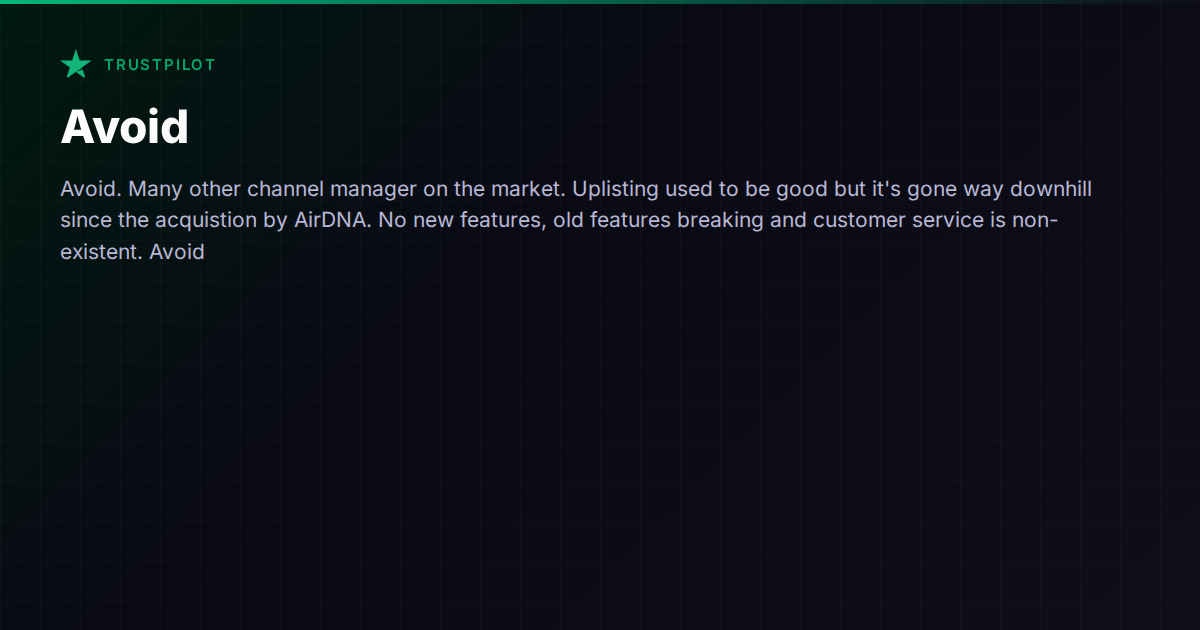
A one-star Trustpilot review for Uplisting published in July 2025 is blunt: “Uplisting used to be good but it’s gone way downhill since the acquisition by AirDNA. No new features, old features breaking and customer service is non-existent. Avoid.”
It’s a short review, but it captures a pattern that repeats across the short-term rental software landscape with uncomfortable regularity. A product you depend on gets acquired, the roadmap stalls, support degrades, and suddenly you’re shopping for a replacement you didn’t budget time or energy for.
This isn’t just an Uplisting story. It’s a structural risk in the PMS market that every operator should understand.
The Acquisition Decay Cycle
The pattern looks roughly the same each time:
- A well-regarded tool gets acquired by a larger company (often a data or analytics firm looking to expand into operations).
- Engineering resources get redirected — toward integrating data pipelines, aligning tech stacks, or building the acquirer’s vision rather than maintaining what existing users actually rely on.
- Customer support thins out — the original team churns, institutional knowledge walks out the door, and ticket response times balloon.
- Features start breaking — without active maintenance, integrations with Airbnb, Booking.com, and VRBO drift out of sync as those platforms update their APIs. Calendar sync issues, messaging delays, and pricing errors become more frequent.
- The user base fragments — power users leave first, which reduces revenue pressure to fix things, which accelerates the decline.
Uplisting’s acquisition by AirDNA fits this template cleanly. AirDNA is a market data company. Integrating a channel manager into a data analytics business makes strategic sense for AirDNA, but the priorities of a data company don’t always align with the operational needs of hosts managing turnover schedules and guest messages at 11 PM on a Friday.
The broader lesson: when evaluating any PMS, understand who owns it, what their core business is, and whether your operational needs are central to their strategy or peripheral to it.
What to Look for Before You’re Stuck
You can’t always predict an acquisition, but you can evaluate the risk profile of any platform you’re considering:
- Funding and ownership transparency. Is the company bootstrapped, VC-backed, or already acquired? VC-backed companies will eventually need an exit, which means acquisition risk is baked in. That’s not automatically bad, but it’s worth knowing.
- Release cadence. How often does the product ship meaningful updates? A changelog that goes quiet for months is an early warning sign.
- Support quality under pressure. Test support before you commit. Submit a non-trivial question and see how long it takes to get a real answer — not a canned response.
- API health. If the platform connects to Airbnb, Booking.com, or VRBO, check community forums for reports of sync issues. Stale API integrations are the first thing to break when engineering attention wanders.
- Data portability. Can you export your reservations, guest data, and operational history in a usable format? If leaving is hard, you have less leverage and more risk.
The Current Landscape for Operators Considering a Move
If you’re an Uplisting user evaluating alternatives — or just someone trying to de-risk your tech stack — here’s an honest look at what’s out there.
Full-featured PMS platforms
Guesty is the heavyweight. It targets professional managers at scale, with deep channel integrations, a unified inbox, guest verification, and damage protection built in. The trade-off is pricing opacity — Guesty doesn’t publish rates, and the platform can feel overbuilt for operators under 20 listings. But if you need enterprise-grade reliability and are willing to pay for it, it’s battle-tested.
Hostaway occupies a similar space — combined channel manager and PMS with AI-powered messaging, a direct booking website builder, and solid owner reporting tools. Like Guesty, pricing is quote-based, which makes comparison shopping harder. Hostaway has been growing aggressively, which is worth watching — rapid growth can strain support resources the same way an acquisition can.
Lodgify is a more accessible entry point. It emphasizes ease of use, personalized onboarding, and automation. The direct booking website builder is a strong point for operators who want to reduce OTA dependency. It’s generally better suited to smaller portfolios, though it’s expanding upmarket.
Hospitable (formerly Smartbnb) focuses heavily on automated messaging and task coordination. The tiered plan structure is more transparent than Guesty or Hostaway. For operators whose primary pain point is guest communication and cleaning coordination, Hospitable delivers well. The AI Copilot feature is still developing, so evaluate it based on what it does today, not what’s promised.
AI-native approaches
Vanio AI takes a fundamentally different architectural approach. Rather than bolting AI onto an existing PMS, the AI agent is the core of the system — it has native access to reservations, tasks, payments, smart locks, and messaging in one data layer. This means the AI can execute multi-step operations (check cleaner status → approve early check-in → generate a lock code → reply to the guest) without middleware. Pricing is transparent at $5 per reservation for the full operational lifecycle. It’s worth evaluating if your frustration with legacy PMS tools is partly about the number of disconnected systems you’re juggling.
The Migration Tax Is Real
Even when staying is clearly worse than leaving, migration is expensive. You’re looking at:
- Re-syncing every channel connection
- Rebuilding message templates and automations
- Retraining your team
- A transition period where things will break no matter how careful you are
This is why the acquisition decay cycle is so frustrating — you’ve already paid the migration tax once to get onto the platform. Being forced to pay it again because someone else’s business strategy changed feels like a penalty for trusting the wrong vendor.
The best mitigation is choosing platforms where your data is portable, your integrations are standards-based, and the company’s incentives are aligned with keeping operators happy rather than serving a parent company’s roadmap.
Where to Go From Here
No platform is immune to the forces that cause product decline — not acquisitions specifically, but the general risk that the people building your tools stop prioritizing your needs. What you can control is how much due diligence you do upfront and how portable your setup is if you need to move.
If you’re actively comparing tools, our comparison hub covers the major PMS platforms side by side. Focus less on feature checklists and more on the structural questions: Who owns this? What’s their business model? How fast do they ship? How easy is it to leave? Those are the questions that matter eighteen months from now, not just on signup day.