When Your PMS Can't Scale: Why Multi-Property Managers Outgrow Budget Tools
Trustpilot
TL;DR: Multi-property manager is actively leaving Smoobu after over a year due to terrible customer service, dysfunctional support, and a platform that doesn't scale beyond a few properties.
There’s a pattern that plays out hundreds of times a year in short-term rental management. A host starts with two or three properties, picks a platform that’s affordable and does the basics, and things work fine for a while. Then the portfolio grows. Five properties become ten. Ten become twenty. And the cracks that were invisible at two listings become structural failures at scale.
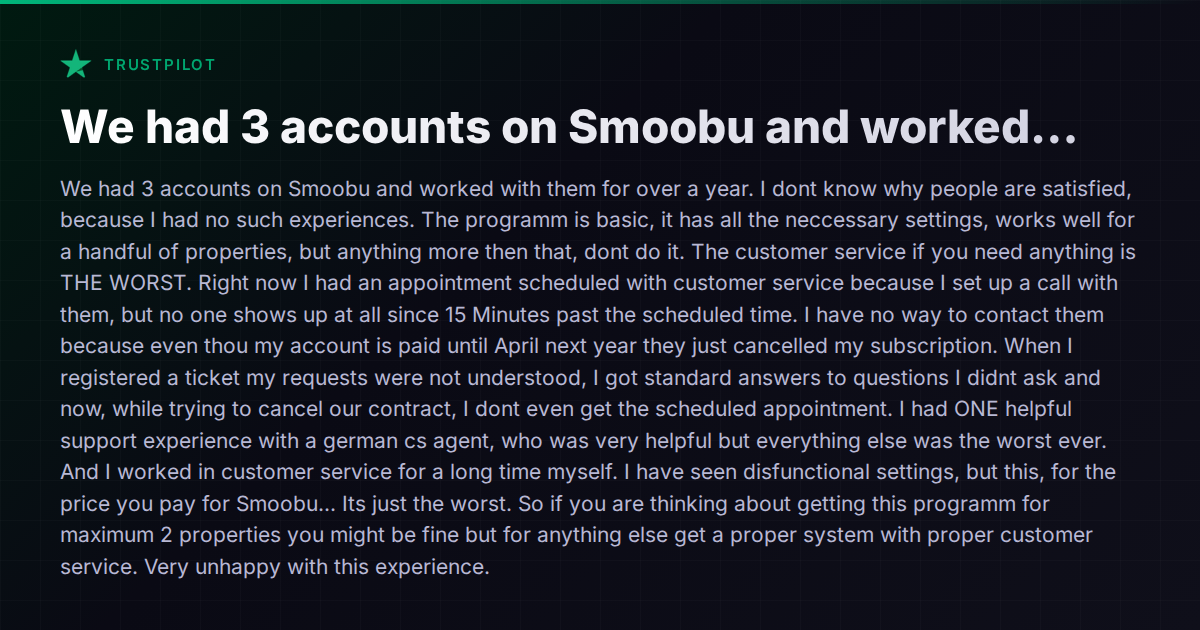
A property management company recently shared their experience on Trustpilot after running three accounts on Smoobu for over a year. Their verdict was blunt: the platform works for a handful of properties, but anything beyond that is asking for trouble. They described customer service as “the worst” — missed scheduled calls, ticket responses that answered questions nobody asked, and an inability to get help even while actively paying for the subscription. Their one positive support interaction in over a year was with a single helpful agent. Everything else was, in their words, dysfunctional.
This isn’t a story about one platform. It’s a story about a category of problem that hits growing operators hard — and about how to recognize the warning signs before you’re stuck.
The Budget PMS Trap
Budget property management platforms serve a real purpose. For a host with one or two vacation rentals, a tool that handles calendar sync, basic messaging templates, and channel distribution at a low monthly cost is genuinely all you need. The interface is simple because the problem is simple.
The trap springs when the portfolio grows but the platform doesn’t grow with it. Common symptoms include:
- Support degrades as you need it more. Small operators rarely contact support. Larger ones depend on it — for API issues, channel sync problems, bulk operations, and edge cases the software doesn’t handle well. If the support team is staffed for casual users, professional operators get left waiting.
- No multi-account or team management. Some budget tools were designed for solo hosts. When you need role-based access for cleaners, maintenance staff, and co-managers, the architecture simply isn’t there.
- Manual work that doesn’t scale. Copying settings across properties one by one. Handling guest messages individually instead of through automation. Managing pricing without bulk editing tools. These small inefficiencies compound as the portfolio grows.
- Integrations that are shallow. A channel manager that syncs calendar and price to Airbnb and Booking.com covers the basics. But when you need smart lock integration, automated task dispatch, payment processing, or a proper direct booking site, you discover the platform either doesn’t offer these features or relies on third-party connections that break.
The Smoobu situation described above hits several of these: basic functionality that works fine at small scale, support infrastructure that can’t handle professional-grade needs, and a growing sense that the cost savings aren’t worth the operational friction.
What “Proper” Looks Like at Scale
The operator’s parting advice was simple: “Get a proper system with proper customer service.” That raises the obvious question — what separates a platform that scales from one that doesn’t?
Support That Matches Your Operational Complexity
This is the most underrated factor in PMS selection. Every platform promises great support. What matters is the support model: Is it live chat only? Email-only with 48-hour SLAs? Do you get a dedicated account manager above a certain tier? Can you actually reach someone on the phone when a channel sync breaks at 11 PM on a Friday?
Guesty emphasizes 24/7 support and cites 99.99% uptime — positioning that targets operators who can’t afford downtime. Hostaway bundles support with its quote-based pricing, which typically means enterprise-tier accounts get better access. Lodgify highlights personalized one-on-one onboarding (valued at $700, included with subscription), which signals investment in getting new users up and running — though onboarding quality and ongoing support quality are two different things.
The honest truth: support quality varies by tier, by timing, and sometimes by luck. Read recent reviews, not just feature pages.
Operational Depth Beyond Messaging
A platform that works at 20+ properties needs to do more than send automated check-in messages. Look for:
- Task management with staff coordination — not just a to-do list, but assignment, tracking, and verification.
- Smart lock integration — generating and distributing unique access codes per reservation without manual intervention.
- Financial tools — owner statements, revenue splits, payment processing, and deposit handling.
- Unified communication — one inbox that captures Airbnb, Booking.com, VRBO, WhatsApp, email, and SMS without losing context.
Hospitable handles automated messaging and task management well, with a teammate portal that gives cleaning staff their own workspace. For operators who need deeper operational control — locks, payments, owner reporting — platforms like Guesty and Hostaway offer broader feature sets, though at significantly higher price points and with steeper learning curves.
Vanio AI takes a different architectural approach: the AI agent has native access to every subsystem (reservations, tasks, payments, locks, messaging) in a single data layer, which means it can coordinate across domains in one step — check cleaner status, approve an early check-in, generate a lock code, and message the guest without stitching together separate tools. The $5-per-reservation pricing model is straightforward to budget at scale. Whether that architecture fits your operation depends on how much autonomy you’re comfortable giving an AI system and whether your current workflow relies on specialized tools that a unified platform might not replicate.
How to Evaluate Before You’re Stuck
Migrating PMS platforms is painful. Calendar sync gaps cause double bookings. Automated messages stop firing. Staff lose access to task lists. The best time to pick the right platform is before you need to migrate, but the second-best time is now — before the next growth phase makes the switch even harder.
Here’s a practical evaluation framework:
- Test support before you buy. Send a pre-sales question that requires a thoughtful answer. If the response is a canned template, that’s what you’ll get when things break.
- Ask about contract flexibility. The Smoobu operator couldn’t get a response while trying to cancel. Ask explicitly: What’s the cancellation process? Is there a lock-in period? What happens to my data?
- Run your actual workflow. Don’t evaluate features in isolation. Walk through a real scenario: guest books on Booking.com → cleaning is assigned → guest asks for early check-in → lock code is generated → guest checks out → review is requested. How many manual steps does each platform require?
- Talk to operators at your target scale. A platform that works well for 5 listings may fall apart at 30. Find operators managing a portfolio size you’re growing toward, not the one you have today.
- Count your tools. If you’re using a PMS plus a separate messaging tool plus a separate lock manager plus a separate cleaning coordinator, that’s four potential points of failure and four subscriptions. Consider whether a more integrated platform — even at a higher per-listing cost — reduces total operational overhead.
The Honest Summary
Budget PMS platforms aren’t bad. They’re built for a specific use case — small portfolios with simple operations — and they serve that use case well. The problem is that growth sneaks up on you, and by the time you realize you’ve outgrown your tools, you’re deep in an ecosystem that’s expensive to leave.
If you’re managing more than a handful of properties and hitting walls with support responsiveness, feature depth, or operational automation, it’s worth surveying the landscape seriously. Guesty and Hostaway offer enterprise-grade feature sets but come with enterprise-grade complexity and pricing. Hospitable and Lodgify sit in the middle — more automation than a budget tool, less overhead than the enterprise tier. Vanio AI offers a unified AI-native approach that collapses the tool stack into one system.
None of these are universally “the best.” They’re trade-offs — features vs. simplicity, cost vs. capability, control vs. automation. The key is matching the tool to where your business is headed, not where it was when you signed up.
For side-by-side feature breakdowns, the comparison hub covers 25+ platforms and can help narrow the field based on your specific priorities.