When Your PMS Goes Dark: Availability Glitches and the Real Cost of Unresponsive Support
Trustpilot
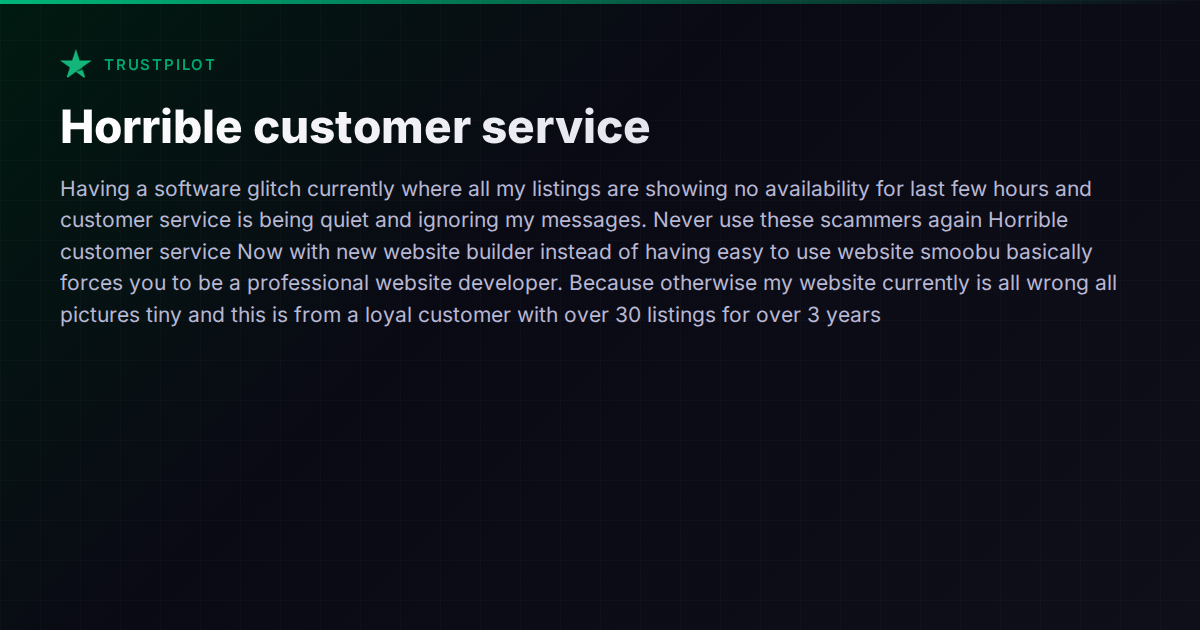
TL;DR: Guesty/Smoobu user with 30+ listings experiencing a software glitch wiping all availability for hours with unresponsive customer service, plus frustration with a new website builder that requires professional dev skills.
Imagine checking your phone and realizing that every one of your 30+ listings is showing zero availability. Not because you’re sold out — because your property management software has a glitch. You fire off a message to support. Then another. Nothing. Hours pass. Every minute your calendar shows “unavailable” is a booking you’ll never get back.
This is exactly what happened to a long-time Guesty customer (specifically on the Smoobu side of the Guesty family) in April 2026. A loyal operator with over 30 listings and three-plus years on the platform found themselves staring at blanked-out calendars with no response from support. To add insult to injury, a recent overhaul of the platform’s website builder had turned their direct booking site into a mess — tiny images, broken layouts — requiring what felt like professional web development skills to fix.
This isn’t a story about one bad day with one vendor. It’s about a structural risk that every short-term rental operator should understand and plan for.
The Availability Blackout: Why It Hurts More Than You Think
A calendar glitch that wipes your availability isn’t a minor inconvenience — it’s an active revenue killer. When your listings show “no availability” on Airbnb, Booking.com, or VRBO, you don’t just miss bookings for those hours. You lose search ranking momentum. OTA algorithms reward consistency, and gaps in availability or sudden de-listing signals can push you down in search results for days afterward.
For an operator with 30+ listings, even a few hours of downtime can mean thousands of dollars in lost bookings, particularly during high-demand periods. And the damage compounds: guests who searched for your area during that window found competitors instead, and they’re not coming back to check again.
This type of failure — a channel manager or PMS losing sync and showing incorrect availability — is not unique to any single platform. Operators across the industry have reported similar incidents with various tools. The real differentiator isn’t whether a platform ever has a glitch (they all do), but how quickly it’s detected, communicated, and resolved.
The Support Black Hole
What turns a bad situation into a catastrophic one is silence from support. When your revenue is actively bleeding, every minute without a response feels like an hour.
Guesty markets itself as offering 24/7 support backed by 99.99% uptime. For enterprise-tier customers, that may hold true. But the experience reported by smaller operators — even loyal ones managing 30+ listings — can be very different. Support responsiveness tends to scale with contract size in the PMS world, and this isn’t a problem limited to Guesty.
Hostaway uses quote-based pricing with no public tiers, which often means support priority is baked into your contract negotiation. Lodgify explicitly touts personalized onboarding and proactive support, but the depth of ongoing technical support depends on your plan. Hospitable has built a reputation for solid self-serve documentation and responsive support for mid-tier operators, though their product is more focused on automation than on being a full PMS.
The uncomfortable truth: if you’re paying a standard-tier rate and managing 30 listings, you’re often in a support no-man’s-land — too big to be a hobby host, too small to get enterprise-level attention. Before signing with any platform, ask explicitly: What is my guaranteed first-response SLA? What happens during a critical outage that affects my calendar? If the answer is vague, that’s your answer.
The Website Builder Trap
The second part of this operator’s frustration — a website builder overhaul that broke their direct booking site — highlights another common PMS pain point: forced migrations.
Platforms regularly ship redesigns, new builders, or “improved” interfaces. For the platform, it’s progress. For the operator who spent hours configuring their site to look right, it’s a wrecking ball. Tiny images, broken layouts, and a sudden requirement for CSS knowledge to fix what was previously drag-and-drop.
This is a genuine trade-off in the PMS space. Platforms that offer simple, constrained website builders (like Hospitable’s Direct Basic or Lodgify’s template-based approach) tend to be more stable through updates because there’s less to break. Platforms that offer more customization often create more fragile setups that are harder to maintain through version changes.
If direct bookings are a meaningful part of your revenue (and in 2026, they should be), you need to evaluate website builder stability as seriously as you evaluate channel management. Ask current users in host communities how recent updates have affected their sites. Look for platforms where the website builder is a core product, not an afterthought.
Building Resilience Into Your Stack
No platform is immune to outages or bad updates. The question is how you protect yourself.
Monitor your own listings. Don’t rely on your PMS to tell you something is wrong. Use a separate calendar check — even a simple iCal subscription in Google Calendar — to spot availability discrepancies before they cost you bookings.
Document your support interactions. When you’re in a crisis, having a paper trail of timestamps and messages gives you leverage for compensation claims and contract negotiations.
Evaluate switching costs honestly. The operator in this story has been on the platform for three years. That’s a lot of configured automations, saved templates, and muscle memory. But three years of loyalty doesn’t help when the platform is actively losing you money. Calculate what each hour of downtime actually costs, and weigh that against the pain of migration.
Consider platforms with proactive monitoring. Some newer platforms have built operational watchdog features that automatically detect anomalies — missing access codes, calendar sync failures, unresponsive channels — and alert you before you discover the problem through lost bookings. Vanio AI, for instance, runs a daily automated monitoring sweep across messaging, access codes, smart locks, cleaning, and payments, auto-fixing what it can and escalating what it can’t. That won’t prevent every outage, but it shortens the window between “something broke” and “someone knows.”
The Broader Lesson
The STR industry in 2026 has no shortage of PMS options. But the selection criteria most operators use — feature checklists, pricing comparisons, integration counts — miss the things that matter most when things go wrong. Support responsiveness during crises, platform stability through updates, and proactive monitoring are harder to evaluate from a pricing page but far more consequential to your bottom line.
If you’re currently evaluating platforms or reconsidering your current stack, spend less time comparing feature lists and more time talking to operators who’ve been through an outage with that vendor. Ask them how long it took to get a human on the line. Ask if a product update ever broke their site. The answers will tell you more than any demo ever will.
For a structured breakdown of how major PMS platforms compare on support, uptime, and operational reliability, the comparison hub at /compare/ covers 25+ tools side by side.