When Your PMS Has 'the Bones' but Can't Deliver: The Frustration of Almost-Good-Enough Software
Trustpilot
TL;DR: Host is frustrated with Smoobu's broken VRBO/Expedia sync, terrible booking engine UI, unreliable analytics, limited team access controls, and frequent glitches with rate/availability updates.
There’s a particular kind of frustration that comes with a property management system that’s almost there. Not the kind that’s obviously terrible from day one — you’d just cancel and move on. The painful ones are the platforms that clearly have potential, that get some things right, but keep falling short in ways that compound over time.
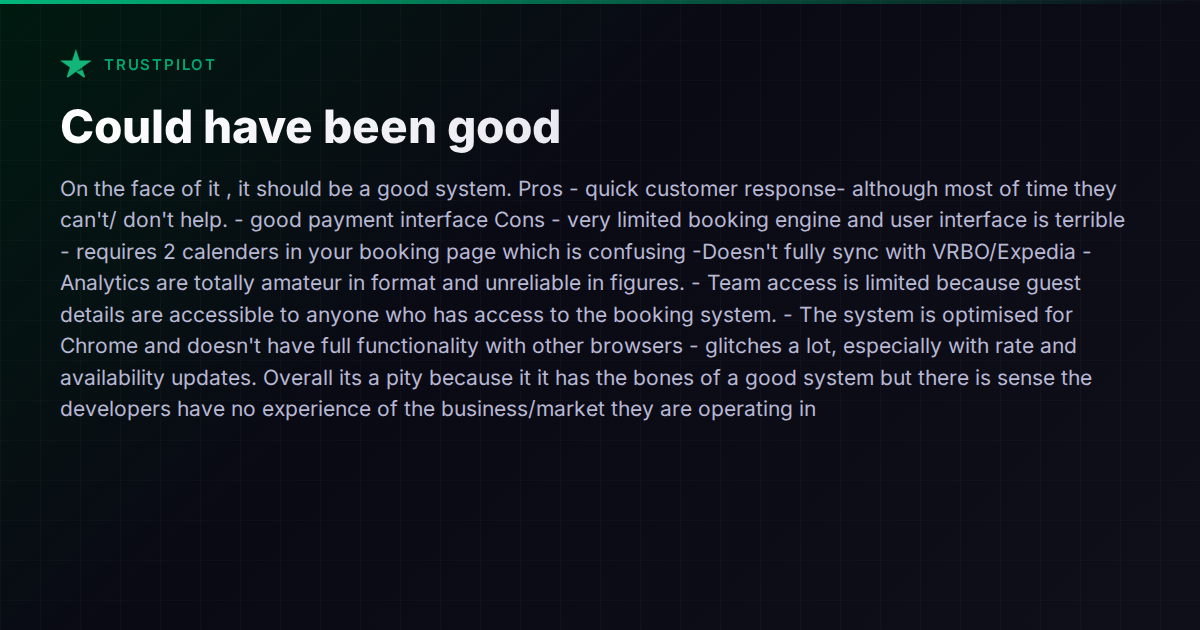
A recent Trustpilot review of Smoobu captures this perfectly. The reviewer gave the platform two stars, noting that “it has the bones of a good system” but adding a damning observation: “there is sense the developers have no experience of the business/market they are operating in.” The specific complaints — a confusing booking engine requiring two calendars, incomplete VRBO/Expedia sync, unreliable analytics, limited team access controls, browser-specific functionality, and frequent rate/availability glitches — paint a picture many STR operators will recognize from their own PMS experiences.
This isn’t just a Smoobu problem. It’s a pattern across the industry.
The Channel Sync Problem Nobody Has Fully Solved
Channel synchronization is the single most critical function of any PMS. If your rates and availability aren’t accurately reflected across Airbnb, VRBO, Booking.com, and your direct booking site, everything else the platform does is academic. Double bookings destroy guest trust and eat your time.
The Smoobu reviewer flagged that VRBO/Expedia sync doesn’t fully work, and that rate and availability updates glitch frequently. This is a known issue across many platforms — VRBO’s API has historically been more difficult to integrate with than Airbnb’s, and some PMS providers treat it as a second-class channel.
Hostaway and Guesty have invested heavily in their OTA connections and generally handle VRBO sync more reliably at scale, though neither is immune to occasional lag. Lodgify has made real-time syncing a core selling point, though experiences vary depending on the specific channel and property configuration. Hospitable also offers real-time calendar syncing across major OTAs and positions it as central to their product.
The honest truth: no PMS achieves perfect sync 100% of the time, because they’re at the mercy of each OTA’s API behavior. But there’s a meaningful difference between platforms that treat channel management as their primary engineering priority and those that treat it as a checkbox feature.
The Booking Engine UX Gap
Direct bookings are increasingly important as hosts try to reduce OTA commission dependency. But building a good booking engine — one that’s intuitive for guests, mobile-optimized, and doesn’t confuse people with duplicate calendars or clunky interfaces — is harder than it looks.
The Smoobu reviewer specifically called out the booking engine as “very limited” with a “terrible” user interface, including the puzzling requirement of two separate calendars on the booking page. For a guest trying to book directly, friction like this kills conversion rates.
This is an area where platforms diverge significantly. Lodgify has historically put real effort into its website builder and direct booking experience, offering templates that are designed to convert. Hostaway provides mobile-first direct booking website templates with built-in widgets for search, availability, and reviews. Vanio AI takes a different approach with branded, SEO-optimized direct booking sites that include real-time availability pulled from all connected channels, Stripe payment processing, and guest accounts — though the booking site is part of a broader all-in-one system rather than a standalone focus.
If direct bookings are your growth priority, the booking engine quality should be near the top of your evaluation criteria, not an afterthought.
Analytics: The Feature Everyone Claims, Few Get Right
The reviewer described Smoobu’s analytics as “totally amateur in format and unreliable in figures.” Unreliable numbers in your reporting aren’t just annoying — they’re dangerous. If you’re making pricing decisions, evaluating property performance, or preparing owner reports based on bad data, you’re operating blind.
Guesty has invested in analytics through their Copilot feature, which lets operators query performance data conversationally. Hostaway offers owner statements and a dedicated owner portal. But across the industry, analytics remains a weak point in many mid-market PMS platforms. The data often exists somewhere in the system but gets presented poorly, calculated inconsistently, or updated with delays that make real-time decision-making impossible.
Operators who need reliable portfolio analytics often end up exporting to spreadsheets anyway, which defeats the purpose of having integrated reporting.
Team Access Controls: The Security Problem
The reviewer raised a specific concern: “Team access is limited because guest details are accessible to anyone who has access to the booking system.” This is a real operational problem, especially as you scale.
A cleaning coordinator needs to see check-in/check-out times and property access details. They don’t need to see guest phone numbers, payment information, or booking financials. A maintenance worker needs to know which unit has an issue. They don’t need full reservation access.
Granular role-based access control is something the more mature platforms handle better. Guesty and Hostaway both offer role-based permissions, though the granularity varies. Vanio AI includes eight built-in roles (Admin, Manager, Cleaner, Maintenance, Inspector, Accountant, Partner, Custom) with per-property access control and unlimited team seats. But even among platforms that offer roles, the actual permission granularity can be disappointing — “admin” and “read-only” are not enough when you have a team of fifteen people with different responsibilities.
Before committing to a platform, ask specifically: can I restrict guest PII visibility by role? Can I limit financial data access? Can I assign team members to specific properties only?
Browser Compatibility in 2026
The reviewer noted that Smoobu is “optimised for Chrome and doesn’t have full functionality with other browsers.” In 2026, this should be a non-issue — cross-browser compatibility is baseline web development practice. If a platform doesn’t work properly in Safari, Firefox, or Edge, it signals under-investment in front-end engineering. Your cleaner on an iPhone shouldn’t be locked out because they’re using Safari.
This is also why native mobile apps matter. Operators who manage on the go — which is most of us — need a platform that works reliably on whatever device and browser they happen to pick up.
The Deeper Pattern: Built by Engineers, Not Operators
The reviewer’s sharpest observation was that the developers seem to lack experience in the business they’re building for. This is the root cause of many PMS frustrations. The features technically exist on paper, but the implementation reveals a fundamental misunderstanding of how STR operations actually work.
A booking engine that requires two calendars. Analytics that show numbers but get them wrong. Team access that’s all-or-nothing. These aren’t edge cases — they’re core operational needs that anyone running five or more properties would immediately identify.
When evaluating any PMS, dig past the feature list. Ask for a demo of the specific workflows you rely on daily. Try the direct booking experience as if you were a guest. Export a report and check the math. Invite a team member with restricted access and see what they can actually see.
Where to Go From Here
If you’re hitting the ceiling with your current platform, the good news is the market has matured considerably. The bad news is there’s no perfect option — every platform has trade-offs.
For operators prioritizing reliable channel sync and scale, Hostaway and Guesty are worth evaluating, though both come with enterprise-oriented pricing that may not suit smaller portfolios. For direct booking focus, Lodgify deserves a look. For operators who want to consolidate their entire stack — messaging, operations, locks, payments, and communication — into a single AI-driven system, Vanio AI takes a fundamentally different architectural approach worth exploring.
The key is knowing which problems matter most to your specific operation and testing ruthlessly before committing. Our comparison hub breaks down how these platforms stack up across specific feature categories, and the individual review pages linked above go deeper on each tool’s strengths and weaknesses.