When Your PMS Doesn't Actually Sync: The Hidden Cost of Manual Cross-Platform Updates
Trustpilot
TL;DR: Author is frustrated that iGMS lacks a functioning inbox, has a broken direct booking site, and requires manual changes across every platform individually — calling it 'not a PMS' after over a year of issues.
The whole point of a property management system is right there in the name: it manages things for you. So when a host discovers — sometimes months into a subscription — that their PMS requires them to manually replicate every listing change across Airbnb, VRBO, Booking.com, and their direct booking site, the frustration isn’t just about wasted time. It’s about a fundamental broken promise.
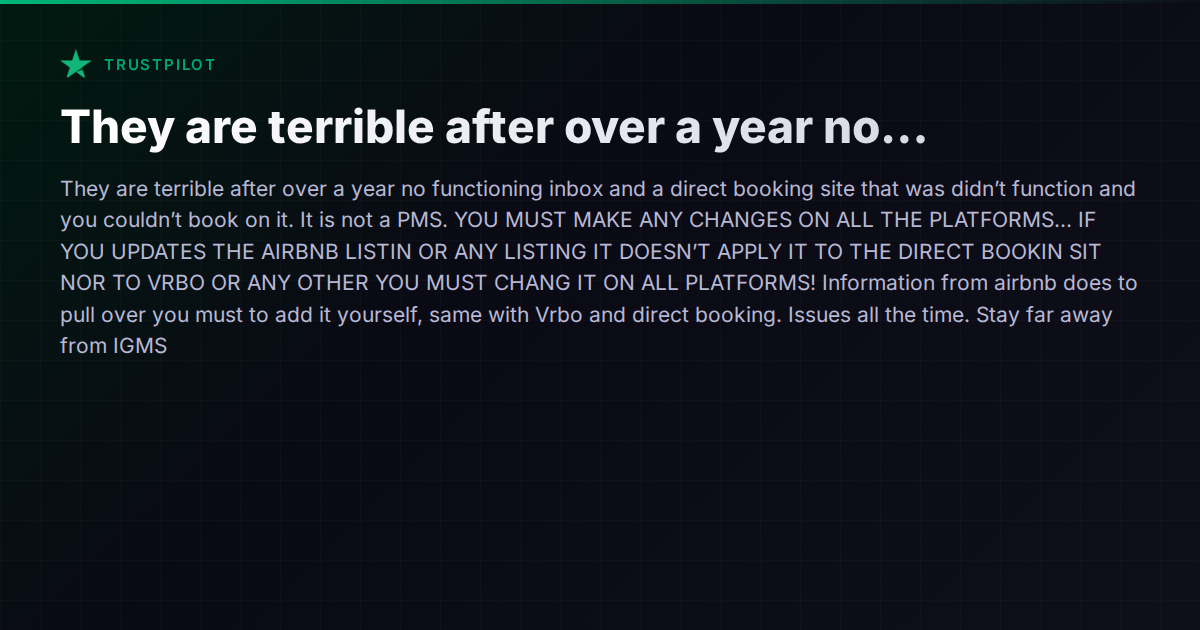
A recent Trustpilot review of iGMS captures this pain vividly. After more than a year on the platform, the host reported that listing updates made on one channel were never pushed to others. The direct booking site didn’t function. The inbox was broken. Their conclusion: “It is not a PMS.” The all-caps frustration in the review — “YOU MUST MAKE ANY CHANGES ON ALL THE PLATFORMS” — is the kind of thing that only comes from months of manual busywork that was supposed to be automated.
This isn’t just an iGMS problem. It’s a pattern across the PMS landscape, and understanding where it comes from can save you from repeating someone else’s expensive lesson.
What Cross-Platform Sync Actually Means (and Doesn’t)
When PMS vendors say “channel management,” most hosts hear “I update one place and it flows everywhere.” That’s the ideal, but the reality depends on what data actually syncs.
Almost every PMS on the market syncs calendar availability reliably. That’s table stakes — prevent double bookings. But the list of things that frequently don’t sync bidirectionally includes:
- Listing content (descriptions, titles, amenities, photos)
- House rules and policies
- Pricing rules and fee structures (especially cleaning fees, pet fees, and extra-guest charges)
- Check-in/check-out instructions
- Direct booking site content
The gap between “calendar sync” and “full listing sync” is where most of the frustration lives. A host sees that bookings flow correctly and assumes everything else does too. Then they update their Airbnb description, check their VRBO listing a week later, and find the old copy still live.
Why Direct Booking Sites Are the Weak Link
The iGMS review specifically calls out a non-functioning direct booking site. This is common across budget and mid-tier PMS platforms. Building a working direct booking engine requires:
- Real-time availability sync from all channels
- Secure payment processing
- A booking flow that actually converts
- Content that stays current with your OTA listings
- SEO fundamentals so the site actually gets traffic
Many PMS tools treat the direct booking site as an afterthought — a checkbox feature for the comparison page rather than a genuinely functional booking channel. The result is sites that look like they work but break at the payment step, display stale information, or simply don’t get indexed by search engines.
How the Major PMS Platforms Handle This
Not every platform struggles with syncing equally. Here’s an honest look at how the main contenders handle cross-platform content management:
Guesty offers robust channel management with two-way sync across major OTAs. At the enterprise tier, listing content changes can be pushed from a single source. But Guesty’s pricing is opaque (custom quotes only), and the platform is primarily designed for larger operators. Smaller hosts often find it over-engineered for their needs.
Hostaway provides centralized listing management and a direct booking website builder. The channel manager handles availability, pricing, and content sync across connected OTAs, and the direct booking site pulls from the same data. The trade-off: pricing is also quote-based, and onboarding can require significant time investment to configure properly — something multiple operators have flagged.
Lodgify leans heavily into the direct booking website as a core feature, offering template-based sites with real-time availability. It’s a reasonable choice for hosts whose primary goal is building a direct booking presence. Channel management covers the basics, though operators managing larger portfolios sometimes find the feature set limiting.
Hospitable focuses on messaging automation and task management first, with channel syncing and direct booking capabilities layered on top. Its Direct Premium tier includes tax handling, chargeback protection, and fraud screening — useful for hosts who want direct bookings without the operational headaches. Content sync across channels is functional but not its primary selling point.
iGMS (the subject of the original complaint) markets itself as a PMS but, based on consistent user reports, appears to function more like a calendar aggregator for some users. If listing changes require manual updates on every platform, the tool is essentially an iCal sync with a dashboard.
The Real Question: What Needs to Be Centralized?
Before evaluating any PMS, it helps to define what “sync” means to you. For some operators, calendar and pricing sync is sufficient — they manage listing content directly on each OTA and accept the manual overhead. For others, especially those scaling past five or ten properties, the inability to push a description change or photo update from one central location becomes a genuine operational bottleneck.
Ask these questions before committing:
- Does the platform sync listing content (descriptions, photos, amenities) or just availability? Get a specific answer for each channel you use.
- Is the direct booking site generated from your centralized listing data, or is it a separate system you maintain independently? If the latter, you’re maintaining two listings per property.
- Does the inbox actually aggregate messages from all channels? A broken or incomplete inbox means you’re still logging into each OTA separately — defeating the purpose.
- What happens when an OTA API changes? Platforms with smaller engineering teams sometimes fall behind on API updates, causing sync failures that persist for months.
When AI Enters the Picture
One emerging approach to this problem is platforms where AI doesn’t just sit on top of a PMS but is woven into the core architecture, with native access to listings, calendars, messaging, and operations. Vanio AI takes this approach — it’s built as a single system where guest communication, channel management, smart locks, task coordination, payments, and the direct booking site all share one data layer. When a listing detail changes, the AI and every downstream system (including the direct booking site and guest portal) see it immediately because there’s no integration seam to cross. For hosts burned by tools that claim to sync but actually require manual updates everywhere, the single-system architecture is specifically designed to eliminate that gap.
That said, Vanio AI is a newer entrant compared to established players like Guesty or Hostaway. Operators with complex legacy setups may want to evaluate migration complexity carefully.
The Takeaway
The frustration in that Trustpilot review isn’t unique — it’s a predictable outcome of choosing a PMS based on feature checkboxes rather than understanding how deeply those features are actually integrated. A tool can claim to support Airbnb, VRBO, Booking.com, and direct bookings while still requiring you to manually update each one independently.
The industry is moving toward genuinely centralized platforms where one change propagates everywhere, but not every tool is there yet. Before signing up for any PMS — especially one with an annual contract — ask for a live demo of the specific workflow: “I change my listing description here. Show me where it appears on each connected channel.” If the answer involves any manual steps, you know exactly what you’re buying.
For a side-by-side look at how different platforms handle sync, direct bookings, and operational automation, the comparison hub breaks down the specifics across more than two dozen tools.