When Your PMS Website Builder Wasn't Built for Multi-Property Portfolios
Trustpilot
TL;DR: Host managing multiple properties finds Smoobu's website editor limited to 10 pages, unable to properly present multiple properties or optimize SEO, and lacks automated partial invoicing (deposit + balance), requiring manual workarounds and extra domains.
Most property management platforms promise a built-in direct booking website. It’s a standard bullet point on every feature comparison chart. But once you move beyond a single listing and start trying to present a real portfolio — with dedicated pages for each property, proper SEO structure, and language-specific invoicing — the cracks start to show.
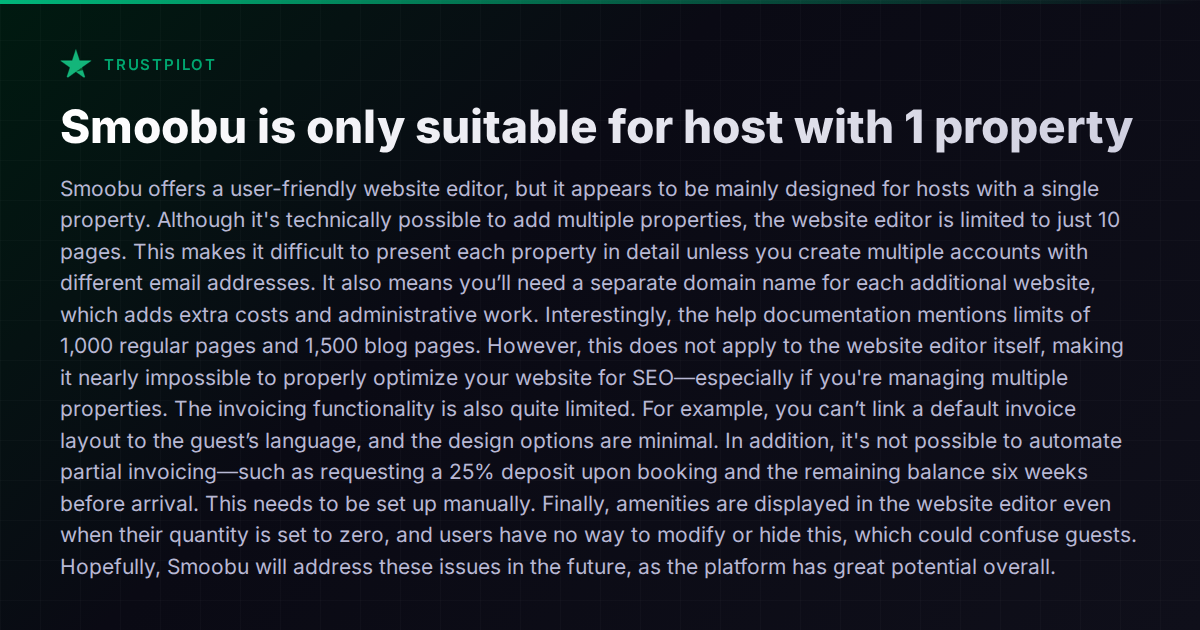
A recent Trustpilot review of Smoobu illustrates the problem well. The reviewer, managing multiple properties, discovered the platform’s website editor is capped at 10 pages. The help documentation references limits of 1,000 regular pages and 1,500 blog pages, but those limits don’t apply to the website editor itself. So while Smoobu technically supports multiple properties, there’s no practical way to give each listing its own detailed page, let alone build out location guides, blog content, or landing pages that search engines reward.
The workaround? Create separate accounts with different email addresses, each with its own domain. That means multiple subscriptions, fragmented management, and the kind of administrative overhead that a PMS is supposed to eliminate.
This isn’t a Smoobu-only issue. It’s a category-wide tension between “we have a website builder” and “our website builder can actually support a growing business.”
The Direct Booking Website Gap
Direct bookings are the holy grail for STR operators. No OTA commissions, full control of the guest relationship, and the ability to build a brand that outlasts algorithm changes. Every serious PMS knows this, which is why they all offer some form of website builder.
But there’s a spectrum:
- Template-based, limited page count: Good enough for a single listing or a small portfolio that doesn’t need SEO depth. You get a clean page, a booking widget, and that’s about it.
- More flexible but still constrained: You can create more pages, maybe add some blog content, but the builder lacks true SEO controls — no custom meta descriptions, no structured data, no control over URL structure.
- Full-featured, portfolio-scale: Dedicated pages per property, proper SEO optimization (server-rendered HTML, sitemaps, structured data), real-time availability from all channels, and a checkout flow that doesn’t feel like an afterthought.
Most PMS website builders fall into the first two categories. They’re marketing checkboxes, not serious direct booking tools. If you’re managing 10+ properties and want organic search traffic, you’ll likely outgrow them fast.
The Invoicing and Payment Automation Problem
The Smoobu review also flags a common pain point: the inability to automate split invoicing. The reviewer wanted a simple workflow — charge a 25% deposit at booking, collect the balance six weeks before arrival. Instead, it requires manual setup for each reservation.
This is more widespread than you’d think. Several platforms handle payments as a secondary concern, bolted on after the core booking engine was built. The result is rigid invoicing that doesn’t match how many European markets (and increasingly US markets) expect payment to work.
Here’s what multi-property operators typically need from payment automation:
- Configurable deposit schedules: Percentage or fixed amount at booking, with balance due at a configurable interval before check-in.
- Language-aware invoices: Guests booking from different countries should receive invoices in their language, with the correct VAT treatment.
- Security deposit handling: Pre-authorization holds that release automatically after checkout, not manual processes.
- Refund workflows: Partial and full refunds that sync back to the booking record and accounting.
When the PMS can’t do this natively, operators end up stitching together Stripe, manual spreadsheets, and separate invoicing software — exactly the kind of tool sprawl that makes AI-driven automation impossible.
How the Landscape Actually Stacks Up
Smoobu remains a solid entry point for hosts with one or two properties. The interface is clean, the channel manager works, and the price is accessible. But as the Trustpilot review makes clear, it hits a wall for operators who need a serious direct booking presence or automated financial workflows.
Lodgify has historically positioned its website builder as a core differentiator. It offers more design flexibility and supports multi-property sites with individual listing pages. If your primary frustration is with website limitations specifically, Lodgify deserves a look. However, operators scaling beyond 15-20 properties have reported that other parts of the platform — automation depth, API flexibility — start to feel constrained.
Hostaway provides expert-designed, mobile-first website templates with built-in widgets for search, availability, and booking. The direct booking site is more portfolio-oriented than Smoobu’s, and the platform’s broader feature set (automation, analytics, owner reporting) supports larger operations. Pricing is custom and quote-based, which means you’ll need to talk to sales to understand the total cost.
Guesty offers direct booking tools and targets enterprise-scale operators. If you’re managing 50+ properties, the platform’s depth in channel management and operational tooling is hard to match. But Guesty doesn’t publicly disclose pricing, and smaller operators often find the platform over-engineered for their needs.
Hospitable takes a tiered approach: Direct Basic is a DIY option (you handle taxes, chargebacks, guest screening), while Direct Premium includes tax calculation, chargeback protection, and damage coverage. It’s a thoughtful split, but the website builder itself is less customizable than Lodgify’s.
Vanio AI takes a different architectural approach. Its direct booking website is server-rendered with structured data and sitemaps for real SEO performance, supports custom domains, and pulls real-time availability from all connected channels. Payments run through Stripe Connect with configurable deposit schedules, security deposit pre-authorization, and automated balance collection. Because the AI agent has native access to the payment and booking systems — not via API bolted on top — it can handle split payments, refunds, and upsells within the same reasoning loop that manages guest communication. For operators whose frustration with Smoobu centers on both the website limitations and the payment automation gaps, it’s worth evaluating.
The Amenity Display Bug — Small Detail, Real Trust Issue
One more detail from the review worth noting: amenities with a quantity of zero still display on the Smoobu website. The host can’t hide or modify them. This is the kind of minor UI issue that erodes guest trust. A listing showing “0 x Swimming Pool” doesn’t just look unprofessional — it creates confusion and potentially misleading expectations.
It’s a reminder that direct booking websites need the same level of polish as OTA listings. Guests comparing your direct site to your Airbnb listing will notice inconsistencies. If the PMS website builder doesn’t give you full control over what’s displayed, it’s working against you.
What to Do If You’re Outgrowing Your Current Setup
Before jumping to a new platform, document exactly what’s blocking you:
- Is it just the website? If so, some operators keep their PMS for channel management and build a standalone WordPress or Webflow site with an embedded booking widget. It’s more work, but it decouples the SEO problem from the PMS choice.
- Is it payments and invoicing? Check whether your current PMS supports Stripe Connect or a comparable payment processor with the automation you need. Sometimes the feature exists but is buried in settings.
- Is it everything? If the website, payments, messaging automation, and operational tools are all hitting limits, a full platform migration makes more sense than patching individual gaps.
When evaluating alternatives, test the direct booking website with real listings before committing. Sign up for a trial, connect a test property, and see what the actual guest experience looks like. Check the page speed, look at the HTML source for SEO basics, and try the booking flow on mobile. The demo is always better than the production version — trust what you can build yourself during the trial.
For a broader comparison of how different platforms handle direct bookings, website builders, and payment automation, the comparison hub covers the major options side by side.