When Your PMS Support Disappears: Why Large Operators Walk Away from Budget Platforms
Trustpilot
TL;DR: Host managing 150+ properties left Avantio due to near-zero customer service and is actively seeking a competitor replacement.
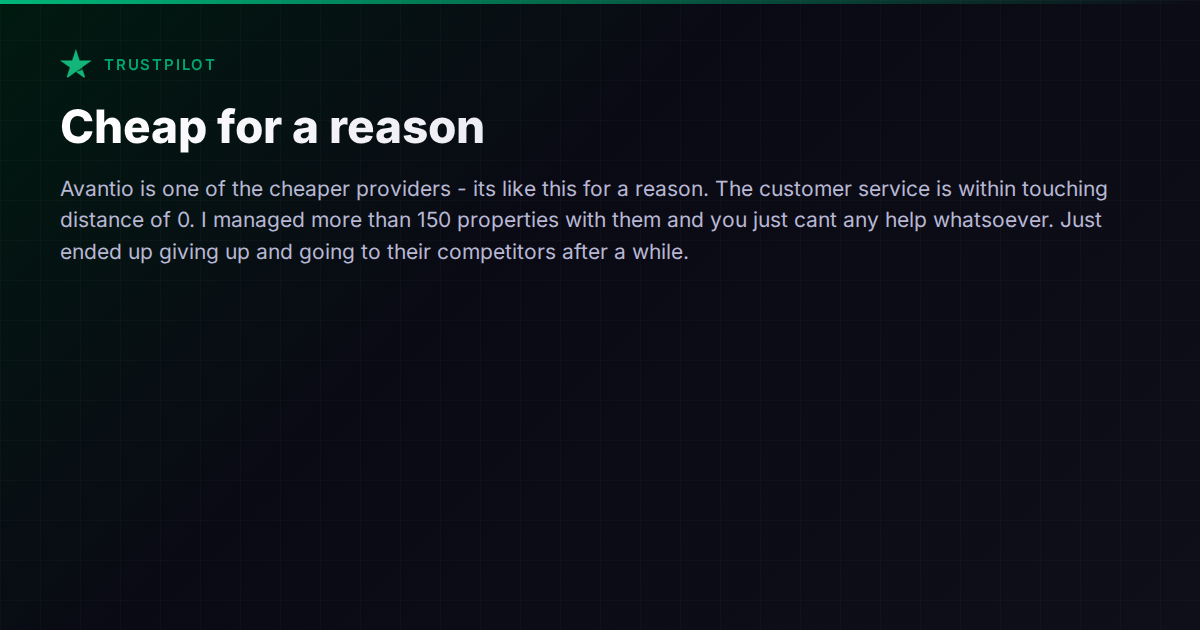
A property manager running 150+ listings recently left a one-star Trustpilot review for Avantio that distills a painful but common experience into a single line: “The customer service is within touching distance of 0. I managed more than 150 properties with them and you just can’t get any help whatsoever.”
The operator described Avantio as “one of the cheaper providers” and concluded it was “cheap for a reason.” After repeated attempts to get support, they gave up entirely and migrated to a competitor.
This is not a story about one platform. It’s a pattern that repeats across the PMS landscape — and it tends to hit hardest at the exact moment operators need support the most: when they’ve scaled past the threshold where manual workarounds stop working.
The Support Cliff at Scale
Small hosts often evaluate a PMS based on features and price. That’s reasonable when you’re running five listings — if something breaks, you can manually patch it. But at 50, 100, or 150+ properties, the calculus changes completely. Every unresolved support ticket translates into real revenue loss: a broken channel sync means double bookings, a pricing API glitch means underpriced weekends, a misconfigured automation means guests getting the wrong check-in instructions.
The frustrating reality is that support quality often degrades as your portfolio grows. You’d expect the opposite — larger accounts should get priority — but many PMS vendors staff support teams for their median customer, not their largest. If the median customer runs 10 listings, the support playbook is optimized for simple questions, not for debugging a multi-property automation that’s misfiring across three channels.
Budget platforms face this tension acutely. Lower price points mean thinner margins, which means fewer support staff per customer, which means longer queues and less specialized help. It’s not malice; it’s math.
Where the Major Players Land on Support
Support quality varies enormously across the PMS market, and it’s one of the hardest things to evaluate before you commit. Here’s a realistic survey:
Avantio has historically targeted the European vacation rental market with competitive pricing. However, multiple operators managing larger portfolios report support experiences similar to the one above — long response times, difficulty reaching someone who understands their specific configuration, and a sense that support resources haven’t scaled with the product’s customer base.
Guesty positions itself as the enterprise-grade option and claims 24/7 support backed by a large R&D team. For operators at the 100+ listing tier, Guesty typically assigns dedicated account managers. The trade-off is that Guesty doesn’t publicly disclose pricing, and operators consistently report that it’s among the most expensive options — you’re paying for that support infrastructure whether you use it or not.
Hostaway also uses quote-based pricing and targets professional managers. Support responsiveness is generally well-regarded by mid-size operators, though like any platform, experiences vary. The lack of transparent pricing makes it hard to know whether you’re getting value until you’re already in a sales conversation.
Hospitable tends to appeal to smaller operators who want strong automation out of the box. Their support is generally responsive for their target segment, but operators scaling past 50+ properties sometimes find the platform’s feature depth (and the support team’s ability to troubleshoot complex setups) starts to thin out.
Lodgify emphasizes personalized onboarding, including one-on-one setup support. That onboarding experience gets strong reviews, but ongoing support quality for scaled operations is less well-documented.
What to Actually Evaluate Before You Commit
If you’re shopping for a PMS — or preparing to migrate away from one — support quality should be near the top of your evaluation criteria, not an afterthought. Here’s how to pressure-test it:
- Ask for references at your scale. A PMS that’s excellent for 10-listing hosts may be terrible for 150-listing operators. Ask the vendor to connect you with a customer managing a similar portfolio size.
- Test support during the trial. Submit a non-trivial support ticket during your evaluation period. Not “how do I change my password” — something like “I need help configuring channel-specific pricing rules for 20 properties.” Measure response time and resolution quality.
- Ask about support tiers. Does the vendor offer dedicated account management? At what portfolio size? Is it included or an add-on fee?
- Check the exit path. If support fails, how hard is it to leave? Does the platform export your data cleanly? Are there contractual lock-ins? The operator in the original review “ended up giving up and going to their competitors” — that migration cost real time and money.
The Deeper Problem: Support as a Proxy
Poor support often signals something more fundamental. When operators at scale can’t get help, it usually means the platform wasn’t architected for their complexity. Simple products need less support. Complex platforms serving large operators need robust support and robust self-service tools — comprehensive documentation, reliable APIs, automation that doesn’t require hand-holding.
This is one reason some operators are exploring platforms where AI handles more of the operational surface area directly. If the system can autonomously manage guest messaging, generate lock codes, dispatch cleaning tasks, and handle routine exceptions, the operator’s dependency on vendor support decreases structurally. Vanio AI, for instance, is built around this premise — an AI agent with native access to every subsystem (reservations, tasks, payments, locks, communication) that handles the bulk of daily operations, reducing the number of situations where you’d need to file a support ticket in the first place. At $5 per reservation, the economics are transparent and the architecture eliminates some of the middleware complexity that generates support tickets.
That said, no platform eliminates the need for support entirely. Even the most automated system will occasionally need human intervention from the vendor side. The question is how often, and whether the vendor is resourced to handle it when it matters.
The Bottom Line
Budget PMS platforms can work well for small portfolios where the operator has the technical comfort to self-serve. But for managers running 100+ properties, “cheap” has a compounding cost. Every hour spent waiting on a support ticket is an hour not spent on revenue-generating work — and at scale, those hours add up fast.
Before you commit to any platform, evaluate support like you’d evaluate a hire: check references, run a working interview (the trial), and make sure the person (or team) can handle the complexity of your actual operation, not just the demo version.
For a side-by-side look at how major platforms compare across support, pricing transparency, and feature depth, the comparison hub at /compare/ breaks down the key differences.