When Your PMS Charges Fees on Cancelled Reservations and Ignores Your Bug Reports
Trustpilot
TL;DR: Host using Avaibook (Guesty) for almost a year details multiple concrete failures: buggy check-in form that cancels legally required rent contracts, payment system that charges fees on cancelled reservations and botches refunds, unfixed bugs reported over months, and promised integrations (ISTAT) never delivered — losing actual money and trust.
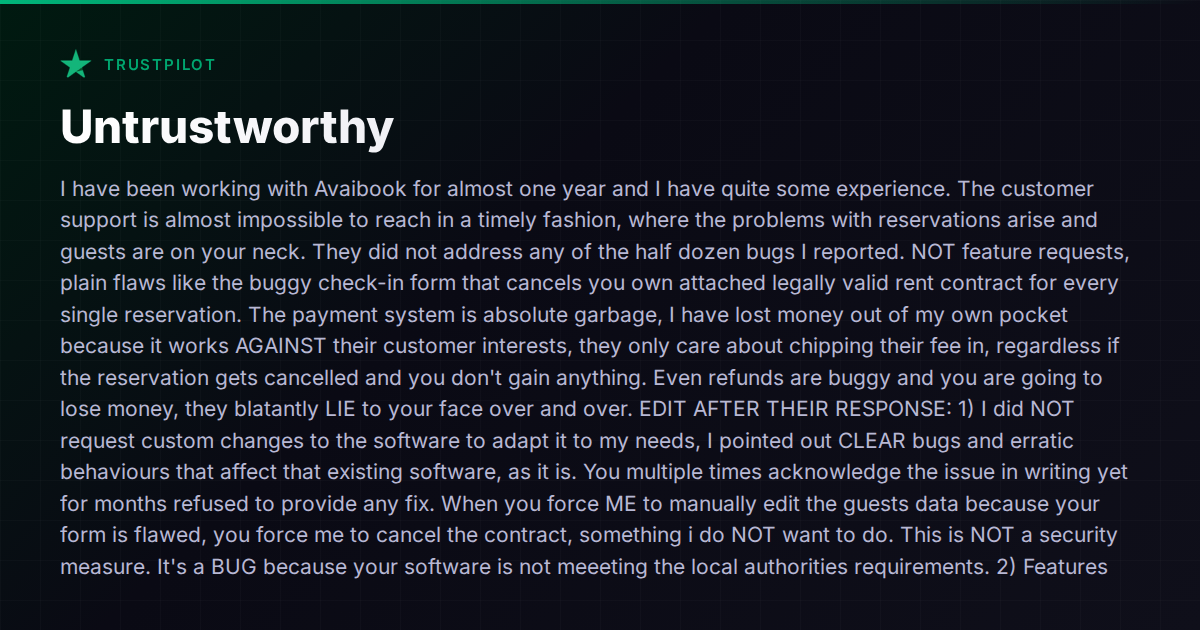
A host recently left a detailed one-star review on Trustpilot describing nearly a year of frustration with Avaibook, the vacation rental management tool that operates under the Guesty umbrella. The complaints were specific and concrete: a check-in form that cancels legally required rental contracts every time a host edits guest data, a payment system that charges platform fees on reservations that guests cancel (leaving the host to eat both the lost booking and the fee), buggy refund processes, and months of bug reports that went unaddressed despite written acknowledgment from support.
This isn’t an isolated experience. It’s a pattern that plays out across PMS platforms when a product scales faster than its support and engineering capacity can keep up.
The Three Failures That Actually Cost Hosts Money
The host’s complaints boil down to three categories that every short-term rental operator should evaluate before committing to any platform:
1. Bugs That Create Legal Liability
The host described a check-in form that, when edited, cancels the attached legally valid rent contract. In markets with strict local compliance requirements — Italy, Spain, Portugal, much of the EU — this isn’t a minor inconvenience. It’s a legal exposure. The host was forced to manually re-attach contracts for every reservation, and the platform reportedly acknowledged the issue in writing but didn’t ship a fix for months.
This is especially dangerous because hosts often don’t realize the contract has been silently removed until an inspection or dispute surfaces it. A PMS that introduces compliance risk through its own bugs is working against the operator it’s supposed to serve.
2. Fee Structures Misaligned With Host Interests
The host reported that Avaibook charged platform fees on reservations that were subsequently cancelled by guests. On top of that, the cancellation policy wasn’t linked to the incoming payment logic — so the payment system processed the platform’s cut regardless of whether the host received any revenue from the booking.
This is a design decision, not a bug. And it’s one that several PMS platforms make: they define “fee” as triggered by reservation creation rather than by completed stay or net revenue. For a host running tight margins on a small portfolio, a handful of cancellations where you still owe the platform can swing a month from profitable to loss-making.
Some platforms handle this differently. Hostaway and Lodgify use quote-based or subscription pricing that doesn’t fluctuate per-reservation in the same way, though each has its own trade-offs on minimum commitments and contract terms. Hospitable charges per-property rather than per-reservation, which sidesteps the cancellation-fee problem entirely but means you’re paying full price even during low-occupancy months. The right model depends on your booking volume, cancellation rate, and how seasonal your market is.
3. Support That Acknowledges Problems but Doesn’t Fix Them
The host reported filing half a dozen bug reports — not feature requests, but clear defects in existing functionality — and receiving no fixes over the course of almost a year. The platform’s public response to the review reframed the bugs as “custom change requests,” which the host rebutted point by point.
This is a pattern worth watching for during any PMS evaluation. Some platforms have responsive support for configuration questions (“how do I set up my listing?”) but a near-zero velocity on actual software defects. When evaluating a PMS, ask current users not just “Is support responsive?” but “Has support ever fixed an actual bug you reported, and how long did it take?”
Promised Features That Never Ship
The host also mentioned ISTAT integration — a regulatory reporting requirement for properties in Italy — that was publicly promised years ago and still hadn’t been delivered. This is common in PMS land: platforms announce regional compliance features to win customers in new markets, then deprioritize them once the customer is locked in.
If you operate in a market with specific regulatory requirements (tourist tax reporting, police registration, local authority integrations), verify that the feature exists in production today, not on a roadmap. Ask for a demo of the specific workflow. Check community forums for complaints about the feature being broken or incomplete. A roadmap promise with no delivery date is worth exactly nothing.
What to Look for When Evaluating (or Replacing) a PMS
If you’re experiencing problems like these — or trying to avoid them — here’s a practical checklist:
Fee alignment with your business model:
- Does the platform charge fees on cancelled reservations, or only on revenue you actually collect?
- Are refund scenarios handled cleanly, or do you end up paying fees on bookings that net you zero?
- Is there a minimum contract term, and what does early exit cost?
Bug and defect responsiveness:
- Ask existing users: how long does it take for acknowledged bugs to be fixed?
- Is there a public changelog or release log you can review for engineering velocity?
- Does the platform distinguish between feature requests and defect reports in its support process?
Compliance and regulatory fit:
- For your specific market, are the required integrations (ISTAT, police registration, tourist tax, contract generation) live and functional today?
- Can you test the workflow end-to-end in a trial, or only after signing a contract?
Data portability:
- If you need to leave, can you export your reservation history, guest data, and financial records in a standard format?
- How long does migration typically take, and does the platform cooperate or create friction?
The Broader Landscape in 2026
The PMS market has more options than ever, which is both a blessing and a curse. Legacy platforms like Guesty have broad feature sets and deep channel integrations, but their scale can mean slower support response and longer bug-fix cycles for smaller operators. Mid-market tools like Hospitable and Lodgify often provide more attentive support but may lack specific regional compliance features. Newer AI-native platforms like Vanio AI take a different architectural approach — building AI into the core of the system rather than bolting it on — which can reduce the number of tools you need and the surface area for integration bugs, but they’re newer entrants that may not yet cover every niche regulatory requirement.
The honest truth is that no platform is perfect for every operator in every market. The key is to match your specific operational pain points — cancellation fee policies, regulatory compliance needs, support responsiveness, AI automation depth — to the platform that handles those particular dimensions well.
Where to Dig Deeper
If you’re actively comparing platforms, our comparison hub covers head-to-head breakdowns across pricing, features, and architecture. For specific matchups, pages like Guesty vs Hostaway and Guesty vs Hospitable go into granular detail.
The most important thing: don’t trust marketing pages. Test the actual workflows that matter to your business during the trial period. File a test bug report and see how fast it gets acknowledged and resolved. Run a mock cancellation through the payment system and see who eats the fee. The answers to those questions will tell you more about your future with a platform than any feature comparison ever will.