When "Automated" Messaging Doesn't Actually Automate: A Common PMS Trap
Trustpilot
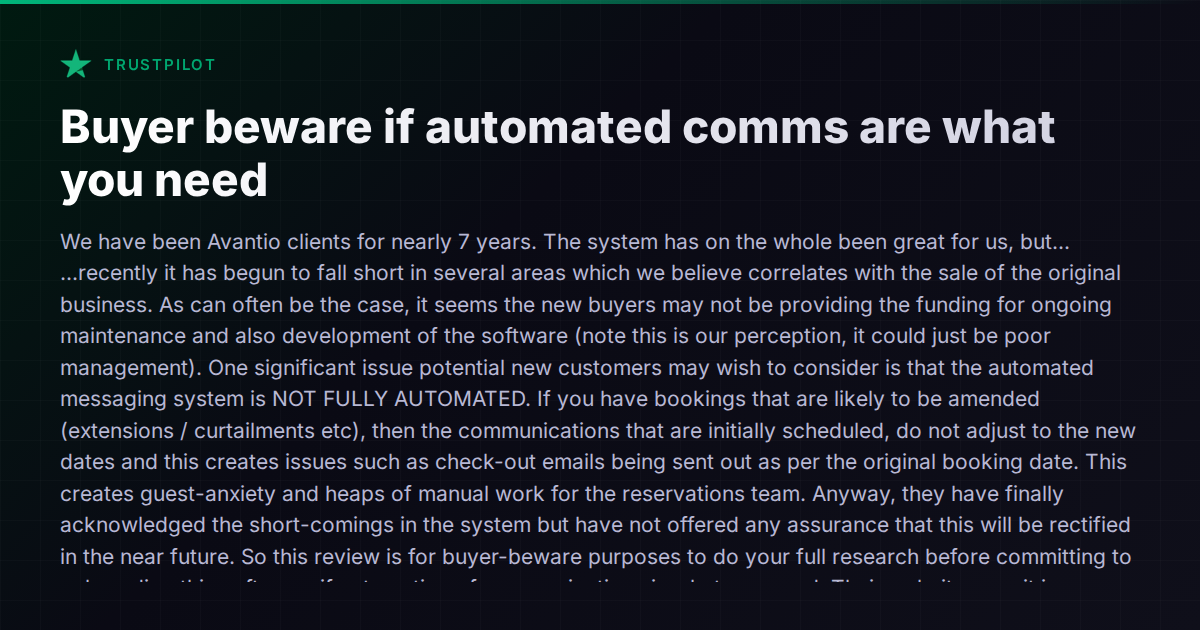
TL;DR: 7-year Avantio client frustrated that their 'automated' messaging system doesn't adjust to reservation amendments (extensions/curtailments), causing wrong check-out emails, guest anxiety, and heaps of manual work for the reservations team — and Avantio has no fix timeline.
Every property management platform promises automated guest communications. Scheduled messages for booking confirmations, check-in instructions, checkout reminders — it’s table stakes. But there’s a gap between “automated” and “actually automated” that only surfaces when real-world complexity hits. And one of the most common triggers is a simple reservation amendment.
The Problem: Messages That Don’t Follow the Booking
A long-time Avantio client recently shared a frustration on Trustpilot that many operators will recognize. After nearly seven years on the platform, they discovered that when a reservation is amended — an extended stay, an early departure, a date shift — the scheduled messages don’t adjust. The checkout email still fires on the original date. The check-in instructions reference the wrong day. The guest gets confused, panics, or calls. The reservations team scrambles to clean it up manually.
This isn’t an edge case. Reservation amendments happen constantly in short-term rentals. Guests extend by a night. They cut a trip short. OTAs push through modifications. Direct bookings get adjusted after a phone call. If your “automated” messaging only works for the initial booking snapshot and can’t dynamically recalculate when dates change, you don’t have automation — you have a mail merge that runs once.
The operator in question noted that Avantio acknowledged the shortcoming but offered no timeline for a fix. Their perception — which they were careful to frame as perception — was that the platform’s development had slowed after a change of ownership. Whether that’s the cause or not, the result is the same: a system that’s marketed as automated but requires significant manual intervention for common booking scenarios.
Why This Matters More Than It Sounds
For a host with five listings, catching a misfire isn’t a disaster. You notice the wrong checkout email, send a quick correction, move on. But for operators managing 20, 50, or 200+ properties, this kind of gap compounds fast:
- Guest anxiety: A checkout email arriving two days early makes guests think they’ve been double-booked or their reservation is wrong. They message. They call. They leave a mention in their review.
- Staff confusion: Cleaning teams get dispatched based on automated turnover signals. If those signals reference the wrong dates, you get cleaners showing up a day early or a day late.
- Erosion of trust in automation: Once the team learns they can’t trust the system, they start manually checking every message. The entire point of automation evaporates.
- Compounding errors: An amendment that triggers an incorrect checkout email might also send a wrong review request, or miscalculate a cleaning window, or generate the wrong lock code validity period.
The deeper issue isn’t the bug itself — it’s what it reveals about the architecture. If scheduled messages are stored as static events rather than dynamically derived from the reservation’s current state, fixing it isn’t a patch. It’s a rearchitecture.
How Different Platforms Handle This
Not every PMS gets this right, and the way they handle message scheduling reveals a lot about their underlying design. Here’s a fair look at the landscape:
Hostaway uses event-based automation triggers tied to reservation data. When a reservation is modified, the triggers should recalculate relative to the new dates. In practice, operators report that the system handles straightforward date changes well, but complex multi-modification scenarios can still require manual oversight.
Hospitable (formerly Smartbnb) built its reputation on automated messaging. Its scheduled messages are relative to check-in and check-out events rather than absolute dates, which means amendments should propagate correctly. For hosts whose primary need is reliable message automation, Hospitable remains a strong option — though it’s lighter on operational features like task management and payments compared to full PMS platforms.
Guesty offers automated messaging with template variables that pull live reservation data at send time, plus their ReplyAI layer for guest-facing responses. At scale, Guesty’s messaging generally handles amendments, but the platform’s pricing opacity and enterprise orientation may be overkill for smaller operators.
Lodgify provides automated emails with dynamic fields, though its automation engine is simpler than some competitors. It handles basic date changes but may require manual attention for more complex amendment scenarios.
The key question to ask any platform: When a reservation is modified after the initial booking, do scheduled messages automatically recalculate — or do they remain pinned to the original dates? If the sales team can’t give you a clear, immediate “yes, they recalculate,” that’s your answer.
What “Actually Automated” Looks Like
The best implementations share a few characteristics:
- Messages are event-relative, not date-absolute. “2 days before check-out” recalculates every time the check-out date changes.
- The automation engine subscribes to reservation state changes. A modification triggers a re-evaluation of all pending scheduled actions — messages, tasks, lock codes, cleaning dispatch.
- There’s a unified data layer. When the AI or automation engine sends a message, it pulls the current reservation data at send time, not cached data from booking creation.
- Cross-domain coordination. The best systems don’t just fix the message — they also update the cleaning schedule, regenerate the access code validity window, adjust the review request timing, and notify the guest portal. All from one reservation update event.
Vanio AI takes this further by design. Because it’s built as a single system where the AI agent has native access to reservations, tasks, smart locks, payments, and messaging on the same data layer, a reservation amendment automatically propagates across every downstream action. The AI doesn’t just reschedule a message template — it re-reasons about the entire guest lifecycle. If a checkout date moves, the lock code validity adjusts, the cleaning task reschedules, and any guest-facing message reflects the current reality. The $5-per-reservation model means this cross-domain coordination isn’t a premium add-on — it’s how the system works by default.
Due Diligence Before You Commit
The Avantio situation highlights a broader lesson: the gap between marketing claims and operational reality often only reveals itself months (or years) into using a platform. Here’s how to pressure-test before you sign:
- Ask for a live demo of an amendment scenario. Don’t just watch the happy path. Ask them to create a booking, schedule messages, then modify the dates. Watch what happens to the pending messages.
- Talk to current users at your scale. A platform that works for five listings may creak at fifty. Find operators managing a similar portfolio size and ask specifically about amendment handling.
- Check the automation audit trail. Can you see what messages were scheduled, when they were recalculated, and why? Visibility into the automation engine matters as much as the automation itself.
- Evaluate the architecture, not just the feature list. Is messaging a separate module bolted onto the PMS, or is it natively integrated with the reservation engine? Bolted-on modules are where amendment propagation failures live.
- Read the contract’s SLA carefully. If a core feature is broken and the vendor acknowledges it but offers no fix timeline, what are your options? Multi-year contracts with no performance guarantees are common in this space.
The Bottom Line
Automated messaging is only as good as its connection to live reservation data. If your platform treats scheduled messages as static calendar events rather than dynamic outputs of the current booking state, you’re going to spend your time fixing the system that was supposed to save your time.
This isn’t unique to Avantio — plenty of legacy PMS platforms have similar architectural limitations. The question is whether the platform you’re evaluating has solved this at the architecture level or papered over it at the feature level. The difference only shows up when a guest extends their stay by two nights and your checkout instructions go haywire.
For a broader look at how different platforms compare on messaging automation, operational coordination, and overall architecture, the comparison hub covers the major players side by side.