When Your PMS Makes You Work Harder, Not Smarter: The Hidden Costs of Automation That Doesn't Automate
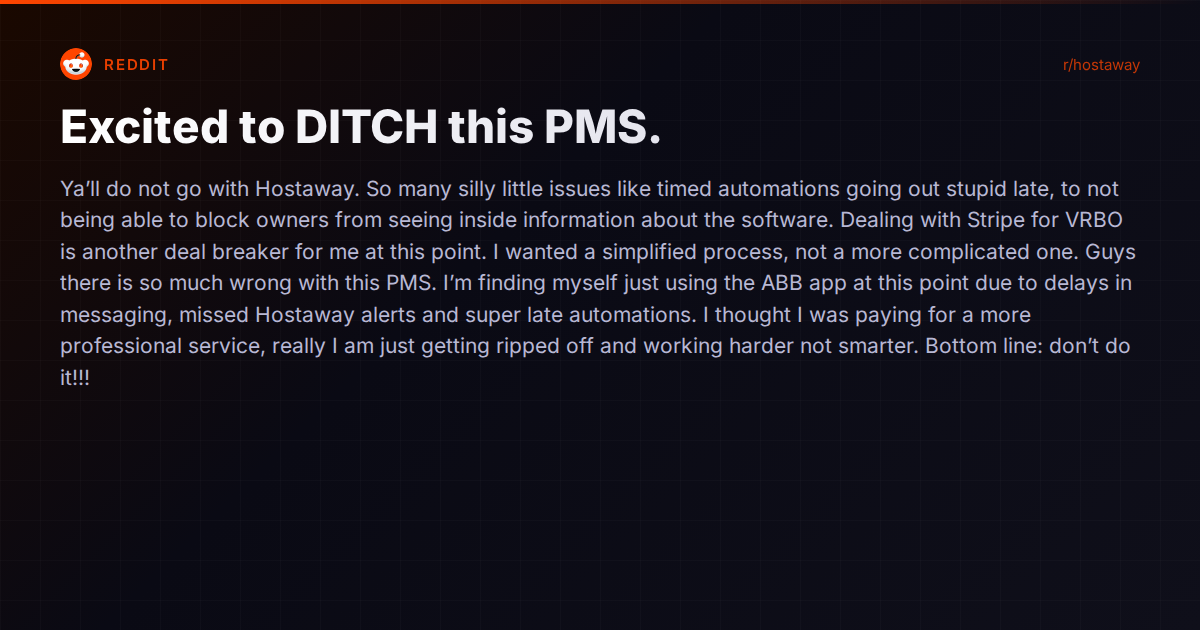
TL;DR: Frustrated Hostaway user experiencing late automations, delayed messaging, missed alerts, Stripe/VRBO payment headaches, and inability to control owner visibility — actively looking to switch PMS.
There’s a specific kind of frustration that only property managers know: you’re paying for a platform that’s supposed to automate your operations, and instead you find yourself logging into the OTA app directly because the PMS is slower, less reliable, or more confusing than doing things manually.
A recent thread in a host community captured this perfectly. A property manager running operations through Hostaway described a cascade of problems — timed automations firing late, delayed message delivery, missed alerts, complicated Stripe integration for VRBO payouts, and an inability to control what property owners could see inside the platform. Their conclusion: “I thought I was paying for a more professional service, really I am just getting ripped off and working harder not smarter.”
The post resonated. But what’s more interesting than the complaint itself is the nuanced conversation that followed — and what it reveals about the real trade-offs operators face when choosing (or leaving) a PMS.
The Automation Timing Problem Is More Common Than You Think
Late automations aren’t just annoying — they’re operationally destructive. If your check-in instructions go out three hours after a guest arrives, you’ve already lost. If a cleaning task dispatches late, your turnaround window shrinks or vanishes. If a review request fires at 2 AM instead of checkout afternoon, your response rate tanks.
This isn’t unique to any single platform. Automation timing reliability depends on queue architecture, API rate limits with OTAs, and how the platform handles webhook failures. Every PMS deals with these constraints. The question is how transparently they communicate delays and how robust their retry logic is.
What makes the original poster’s frustration instructive is the compounding effect: when you can’t trust that an automation will fire on time, you start manually monitoring everything the automation was supposed to handle. Now you’re paying for automation software and doing the work yourself.
Payment Processing: The Stripe-VRBO Pain Point
One of the sharpest pain points in the thread was VRBO payment handling through Stripe. Another commenter noted that Hostaway adds a 4% fee on top of standard Stripe credit card processing — a significant margin that compounds across hundreds of bookings.
This is worth understanding structurally. When a PMS acts as a payment intermediary (processing VRBO or direct bookings through their own Stripe Connect integration), there are multiple layers of fees: Stripe’s base processing rate, any platform surcharge, and potentially currency conversion. Some operators reported that VRBO payouts through Hostaway were immediate at booking rather than at check-in, creating cash flow timing issues they didn’t expect and couldn’t easily control.
Different platforms handle this differently. Guesty, for example, integrates with multiple payment processors and handles Booking.com virtual credit cards natively, but its pricing opacity (no public rates) makes fee comparison difficult until you’re deep in a sales conversation. Lodgify positions itself as simpler and more transparent, but its payment and channel integration depth may not satisfy operators managing portfolios across multiple OTAs. Hospitable takes a tiered approach to direct booking payments — a basic DIY option and a premium managed option — but VRBO payment handling specifics vary.
The lesson: before committing to any PMS, get explicit written answers on payment processing fees, payout timing controls, and whether you can use your own Stripe account versus the platform’s.
Owner Visibility Controls: A Property Manager’s Quiet Dealbreaker
The original poster flagged something that doesn’t make many feature comparison lists but matters enormously to professional property managers: the inability to block owners from seeing internal platform data.
If you manage properties on behalf of owners, you need granular control over what they see. Owners should see revenue, occupancy, and perhaps guest reviews. They should not see your internal communication templates, your cleaning costs, your markup structure, or your operational notes about their property’s quirks.
This is a maturity indicator for any PMS targeting the property management segment (as opposed to individual hosts). Platforms that grew up serving owner-operators often bolt on multi-owner support later, and the permission model shows the seams.
Guesty handles this relatively well with dedicated owner portals and configurable reporting — it’s built for the multi-owner management use case. Hostaway has an owner portal feature, but as the original poster suggests, the granularity of visibility controls may not meet every manager’s needs. It’s worth testing owner-facing views with dummy data during any trial period.
The “It Works Great for Me” Problem
One of the most telling comments in the thread came from an experienced operator who’d used Cloudbeds, Guesty, and Hostaway — and considered Hostaway the best of the three. They had automations running smoothly, rarely needed to send manual emails, and found tech support responsive. Their advice to the frustrated poster: if you’re running a simpler portfolio, consider something lighter like Lodgify.
Then came the edit: “I felt this way a month ago until I realized last week that Hostaway has been skimming 1% from all my bookings.”
This pattern — satisfaction followed by the discovery of hidden fees — is endemic to the PMS industry. It’s not always malicious; sometimes it’s a processing fee buried in terms of service, sometimes it’s a markup on payment processing that wasn’t clearly disclosed during onboarding. But it erodes trust in a way that’s hard to recover from.
Another commenter made a fair point: Hostaway’s strength kicks in once you’re managing multiple properties and need deeper integrations. For smaller or simpler setups, the overhead isn’t justified. This is honest advice. Not every tool is for every operator, and the mismatch between tool complexity and operational needs is one of the most common sources of PMS frustration.
What to Actually Evaluate Before Switching
If you’re considering a PMS migration — whether away from Hostaway or any other platform — here’s what the real-world complaints suggest you should stress-test:
- Automation timing: Ask for SLAs or at minimum, documentation on how automation queues work. Test with real reservations during your trial.
- Payment transparency: Get a complete written breakdown of every fee layer — platform fees, processing fees, surcharges, currency conversion. Ask whether you can bring your own Stripe account.
- Owner permissions: If you manage for owners, create a test owner account and verify exactly what they can and cannot see. Don’t trust a features page; verify in the product.
- Message delivery speed: Send test messages through the unified inbox and time how long they take to appear on the OTA platform. Do this at different times of day.
- Alert reliability: Set up notifications for test scenarios and verify they arrive promptly on your phone. If the platform’s alerts are unreliable, the unified inbox is pointless.
For operators whose primary pain is automation reliability and payment simplicity, the market has options across a wide spectrum. Hospitable leans into messaging automation as its core strength. Lodgify is genuinely simpler for smaller portfolios. Guesty targets larger operations with enterprise-grade (and enterprise-priced) infrastructure. Vanio AI takes a different architectural approach — building the PMS, channel manager, payment processing, and task management into a single system where AI operates natively across all subsystems, which structurally reduces the integration gaps where automations tend to fail. Its $5-per-reservation pricing model is transparent by design, and Stripe Connect is built in with VCC processing for Booking.com.
The Honest Trade-Off
No PMS is perfect. Every platform has operators who love it and operators who are counting the days until migration. The difference between a good fit and a bad one usually comes down to three things: the size and complexity of your portfolio, how transparent the platform is about fees and limitations, and whether the tool’s architecture matches how you actually operate.
The worst outcome isn’t choosing the wrong PMS — it’s staying with the wrong one because migration feels too painful. If your current platform is making you do more manual work than you did before you had it, that’s not a growing pain. That’s a signal.
Dig deeper: Hostaway’s documentation, Vanio AI’s comparison pages, and Hospitable’s feature overview are all worth reading before your next trial period.