When Your PMS Gets Worse Over Time — And You Stay Anyway
Trustpilot
TL;DR: Long-time Smoobu user frustrated by rising prices and declining UX, explicitly wants to switch but is deterred by migration hassle.
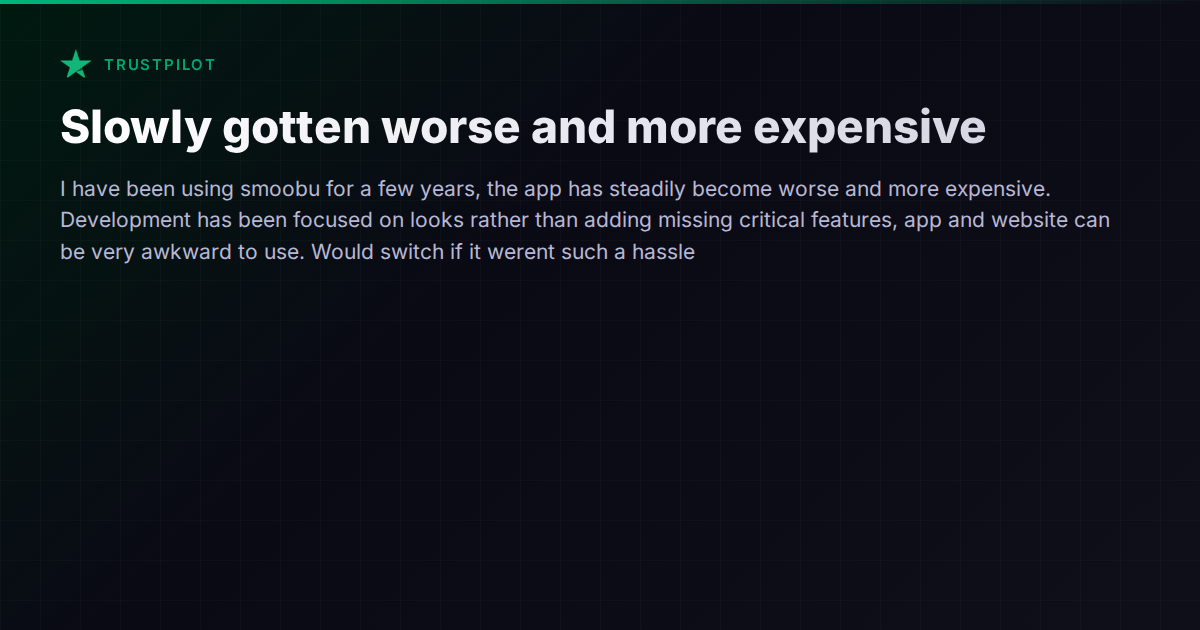
A long-time Smoobu user recently left a two-star review on Trustpilot that probably resonates with more hosts than anyone in the PMS industry wants to admit. The gist: after years on the platform, the product has “steadily become worse and more expensive.” Development has prioritized cosmetic changes over missing critical features. The UI is awkward. And the kicker — they’d switch if it weren’t such a hassle.
That last sentence is the one worth unpacking. Because it describes a trap that thousands of short-term rental operators are sitting in right now, across every PMS in the market.
The Switching-Cost Trap
Property management platforms accumulate gravity over time. You build out your listings, configure your automations, train your staff on the workflows, connect your channel accounts, set up pricing rules, and wire your payment processing. After a year or two, the cost of leaving isn’t the subscription fee you’d save — it’s the weeks of re-setup, the risk of double-bookings during the transition, the channel API re-authorizations, and the fear that the new tool will have its own set of frustrations.
PMS vendors know this. Some lean into it explicitly — long-term contracts, proprietary integrations, data export limitations. Others benefit from it passively: the sheer volume of configuration you’ve built up creates inertia that no cancellation button can overcome.
The result is a customer who pays more every year for a product that delivers less. Not because they’re satisfied, but because they’re stuck.
Why PMS Products Degrade
This isn’t unique to Smoobu. If you’ve spent any time in host communities, you’ll find the same arc repeated across platforms:
- Feature bloat without depth. The PMS adds a dozen surface-level features to check boxes on comparison pages, but none of them work well enough to replace the dedicated tool you were already using.
- UI redesigns that break workflows. A “modern” facelift moves buttons, renames features, and disrupts muscle memory — all without fixing the underlying pain points that operators have been requesting for years.
- Pricing increases that outpace value. As the company scales, it needs more revenue per customer. Prices go up. New tiers appear. Features you used to have get moved behind higher paywalls. Meanwhile, the product itself hasn’t materially improved.
- Support quality drops. Early-stage PMS companies often have responsive, knowledgeable support teams. As they grow, support gets outsourced or tiered, and the people answering your tickets have less product depth.
Smoobu’s trajectory — looks over substance, rising cost, declining usability — is a pattern, not an anomaly.
What Actually Makes Migration Hard
Let’s be specific about the real friction points, because “hassle” undersells it:
-
Channel re-authorization. Airbnb, Booking.com, and VRBO all require you to authorize your new PMS. For Airbnb, this means switching your co-host or API connection. For Booking.com, it can mean waiting for connectivity partner certification. For VRBO, it sometimes requires going through an account manager. Each channel has its own timeline and quirks.
-
Listing data transfer. Photos, descriptions, amenity lists, house rules, pricing structures — most PMS platforms don’t have a clean “export everything” button. You’re often rebuilding from scratch or copy-pasting field by field.
-
Automation reconstruction. If you had 20 message templates, 8 task automations, and a set of pricing rules, those don’t transfer. You’re re-creating them in a new system with different terminology and different trigger logic.
-
Team retraining. Your cleaners know how to use the current task system. Your co-host knows the inbox. Switching means everyone learns a new interface — and for a few weeks, things will be slower.
-
The gap period. Between deactivating the old PMS and fully activating the new one, there’s a window where calendar sync might lag, messages might get missed, and double-bookings become a real risk.
These are legitimate concerns. They’re also solvable — but only if you pick the right destination and plan the transition properly.
The Landscape: Where Smoobu Users Actually Go
If you’re on Smoobu and evaluating alternatives, the right choice depends on your scale, your priorities, and how much of the stack you want under one roof.
Hostaway is a common landing spot for operators who want a traditional PMS/channel manager combo with a broad integration ecosystem. It handles multi-channel distribution well and has a solid unified inbox. The trade-off: pricing is opaque (quote-based), onboarding can be slow for non-technical users, and the AI features are still relatively early-stage.
Hospitable appeals to hosts who prioritize automated messaging above all else. Its rule-based message automation is mature and reliable. The channel management works well for Airbnb and Vrbo. Limitations show up if you need deep operational tools — task management, payment processing, and smart lock integrations are less developed than dedicated solutions.
Lodgify targets owners who want a strong direct booking website alongside their PMS. If direct bookings are a major growth channel for you, Lodgify’s website builder is among the better options in the mid-market. The operational and automation tooling is less comprehensive than some competitors.
Guesty is the enterprise-grade option. If you’re managing 50+ listings and need robust reporting, owner management, and enterprise API access, it’s worth evaluating. For smaller operators, the pricing and complexity may be overkill.
Vanio AI takes a different architectural approach — it’s built as an AI-native platform where the AI agent has direct access to every subsystem (messaging, tasks, locks, payments, calendar) in a single data layer. The relevance for a migration-wary operator: Vanio AI’s onboarding is designed around the idea that AI handles the reconstruction work — importing property data, setting up automations, configuring messaging. The per-reservation pricing ($5/booking) also means you’re not locked into an escalating subscription that rises regardless of whether the product improves. That said, it’s a newer platform, and operators who need deep legacy integrations or very specific niche workflows should evaluate it against their specific requirements.
How to Actually Make the Switch
If you’ve decided your current PMS is costing you more in frustration than migration would cost in effort, here’s the practical playbook:
- Run both platforms in parallel for 2–4 weeks. Most PMS tools offer free trials. Set up your listings on the new platform, connect a test channel, and verify that sync works before cutting over.
- Migrate during your low season. If you have a predictable slow period, that’s your window. Fewer active reservations means less risk.
- Document your current setup first. Before you touch anything, screenshot your automations, export your pricing rules, save your message templates. Having a reference makes reconstruction faster.
- Notify your team early. Give cleaners, co-hosts, and maintenance staff a heads-up. If the new platform has a simpler interface (or SMS-based task management), the retraining period might be shorter than you expect.
- Don’t wait for perfection. No PMS is perfect. The question isn’t whether the new tool has flaws — it’s whether its flaws are more tolerable than your current ones.
The Bottom Line
Staying on a declining platform because migration is hard is a real and understandable decision. But it’s also a compounding one. Every month you stay, you accumulate more configuration on a system you don’t trust, pay more for features that aren’t improving, and push the eventual migration further into the future.
The switching cost is real. But so is the cost of staying. If you’re evaluating your options, the comparison hub at /compare/ covers the major platforms side by side — strengths, weaknesses, and the specific trade-offs that matter for operators at different scales.