What Happens When Your Property Management Company Goes Under — And How to Protect Yourself
Trustpilot
TL;DR: Author warns that their property management company (linked to Guesty/Houst) has gone into administration, payments for January and February are lost, and advises hosts to move properties away urgently.
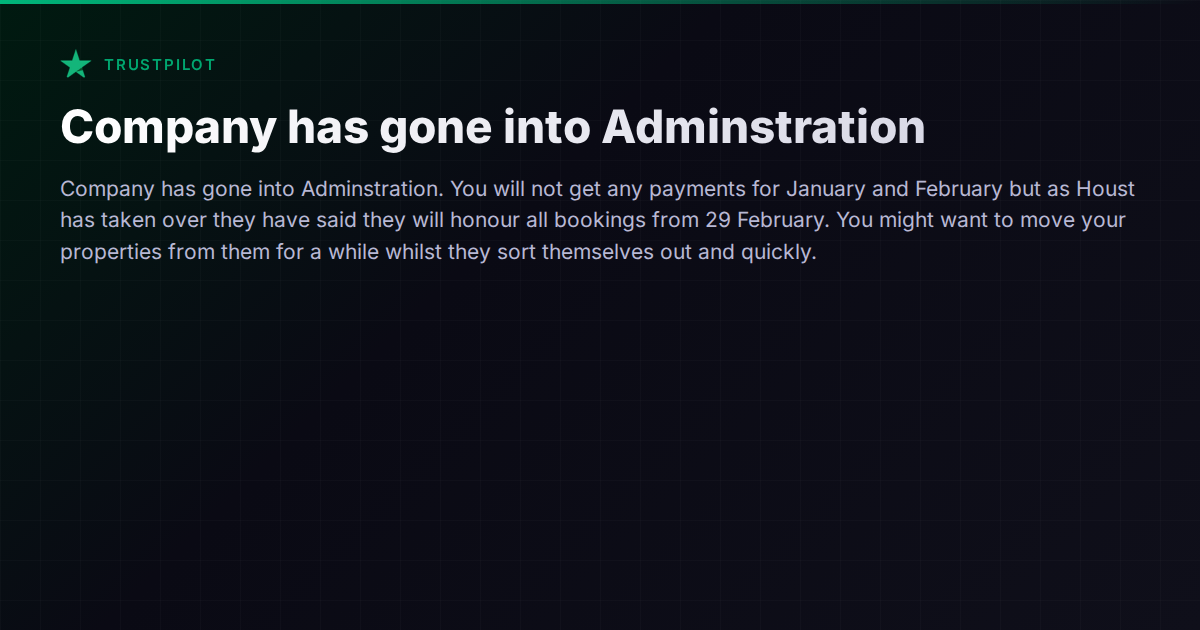
A host recently shared a warning on Trustpilot: their property management company had gone into administration. Payments for January and February were lost. A new entity — Houst — stepped in to honor bookings going forward, but the host’s advice was blunt: move your properties out, fast, while they sort themselves out.
This isn’t a one-off horror story. It’s a structural risk that every short-term rental owner faces, and in 2026 it’s worth understanding how to spot the warning signs, protect your revenue, and — if you need to — migrate your listings quickly.
The Structural Risk Nobody Talks About
When you hand your property to a management company, you’re trusting them with guest payments, booking calendars, listing ownership (or at least admin access), and your reputation. If that company enters administration, receivership, or simply shuts down, several things can happen simultaneously:
- Payments in the pipeline disappear. Guest payments that were collected but not yet remitted to owners become part of the company’s debtor pool. You may never see that money.
- Bookings become orphaned. Guests have confirmations for stays at your property, but the entity responsible for fulfilling them no longer exists — or is in limbo.
- Listing access gets tangled. If the management company holds the primary account on Airbnb, Booking.com, or VRBO, you may not be able to reclaim your listing quickly. Some platforms require formal verification to transfer listing ownership.
- Reviews and history vanish. Listings built under the management company’s account carry their review history. Migrating to a new account means starting from zero on some platforms.
The Trustpilot post that inspired this article illustrates the pattern perfectly: two months of payments gone, a scramble to migrate, and a new operator stepping in to honor existing bookings — but with no guarantee of continuity for the property owner.
Warning Signs to Watch For
Property management companies rarely collapse overnight. There are almost always signals:
- Late payments. If your monthly owner payout is consistently delayed — even by a few days — take it seriously. This is the most reliable early indicator of cash-flow problems.
- Staff turnover. Losing your account manager once is normal. Losing three in six months means the company is bleeding talent.
- Reduced responsiveness. Emails that used to get same-day replies now take a week. Support tickets go unanswered.
- Contractual changes. Sudden changes to commission structures, payment terms, or cancellation policies can indicate the company is trying to restructure on the fly.
- Negative online chatter. Hosts talk. If you see clusters of complaints on review sites or host communities about the same company, pay attention.
None of these individually means your management company is about to fold. But two or three together should trigger a contingency plan.
The Migration Problem
Even if you see the warning signs, moving properties isn’t trivial. This is where many owners get stuck:
- Calendar sync gaps. If your existing management company controls the OTA calendar, pulling your listing risks double bookings during the transition.
- Booking continuity. Guests with upcoming reservations need to be contacted. Who handles check-in? Who provides access codes? Who answers their messages?
- Platform re-verification. Airbnb, Booking.com, and VRBO each have different processes for transferring listing ownership. Some require the outgoing party to initiate the transfer — difficult if they’re in administration.
- Data portability. Guest contact information, pricing history, review archives, and operational playbooks may all live inside the management company’s systems.
This is why the original poster’s advice — “move your properties quickly” — is easier said than done. The hosts who navigate these situations best are the ones who maintained some level of direct control all along.
How to Protect Yourself Going Forward
Maintain Direct Platform Accounts
Never let a management company be the sole owner of your OTA listings. On Airbnb, you can grant co-host access without giving up ownership. On Booking.com, ensure the property is registered under your legal entity. This single step is the difference between a painful migration and a catastrophic one.
Keep Your Own PMS or At Least Your Own Calendar
Even if you use a management company, having your own property management software gives you a parallel record of bookings, guest data, and pricing. Several platforms make this practical:
- Lodgify is popular among owner-operators who want to maintain a direct booking website alongside their OTA presence. It’s straightforward to set up and keeps you in control of your calendar.
- Hostaway and Guesty are aimed at larger operators and management companies, but individual owners can use them too. Be aware that Guesty’s pricing isn’t publicly disclosed, which itself can be a risk factor — make sure you understand what you’re locked into.
- Hospitable focuses heavily on automation for hosts who self-manage. If you’re considering taking back direct control of your properties, it’s worth evaluating.
- Vanio AI takes a different approach as an AI-native platform where the AI agent handles guest communication, operations, lock codes, and cleaning coordination across the full guest lifecycle. Its $5-per-reservation pricing model means you’re not locked into expensive monthly subscriptions during a transition — you only pay when bookings actually come in, which matters when you’re migrating properties and revenue is uncertain.
Diversify Your Booking Channels
Don’t let all your revenue flow through a single management company’s preferred channel. Maintain your own direct booking capability — even a basic one — so you have a fallback if your management company’s OTA accounts go dark.
Escrow or Separate Trust Accounts
In some jurisdictions, property management companies are required to hold guest payments in trust accounts separate from their operating funds. Check whether your management company does this. If they don’t, your payments are comingled with their operating expenses — and if they go under, you’re an unsecured creditor.
Review Your Contract’s Exit Clauses
Before you sign with any management company, understand:
- How much notice is required to terminate?
- Who owns the listing and its reviews upon termination?
- What happens to bookings already confirmed when you leave?
- Are there liquidated damages or early-termination fees?
If the contract doesn’t address these clearly, that itself is a red flag.
The Uncomfortable Truth
Property management companies fail for the same reasons any business fails: thin margins, over-expansion, poor cash management, market downturns. The STR industry’s rapid growth over the past few years has attracted operators of varying quality, and the correction is already happening in 2026.
The hosts who come through these situations with the least damage are the ones who treated their management company as a service provider, not a co-owner. They kept their own platform accounts, maintained visibility into their calendars and financials, and had a plan for what happens if the relationship ends abruptly.
If you’re currently happy with your management company, that’s great. But take an hour this week to verify you could move your properties if you had to. The time to build a lifeboat is before the ship starts sinking.
For a broader comparison of the PMS tools available if you’re considering self-management or a platform switch, our comparison hub covers the major options side by side.