When Your Property Manager Goes Under — and Takes Your Rental Income With Them
Trustpilot
TL;DR: Host relied on rental income to pay their mortgage and experienced unprofessional customer service, poor cleaning standards, exorbitant maintenance charges, and ultimately lost owed rental income when their management company (Guesty-affiliated) went into administration.
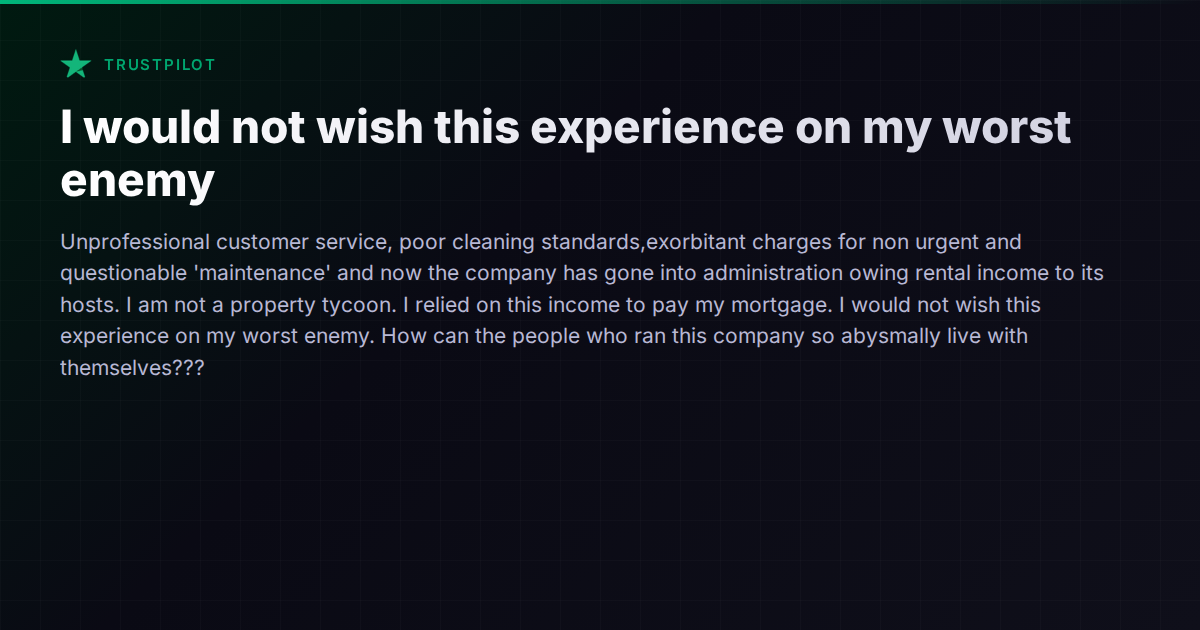
One host on Trustpilot summarized the nightmare scenario in a single sentence: the company managing their rental had gone into administration — and it still owed them income they depended on to pay the mortgage. Before the collapse, the warning signs were already there: unprofessional customer service, poor cleaning standards, and exorbitant charges for questionable maintenance work.
This isn’t an isolated story. In 2026, the short-term rental industry is mature enough to have its own recurring failure modes, and one of the most devastating is the financial collapse of a management company or platform intermediary that sits between hosts and their money. It’s worth understanding how this happens, what the warning signs look like, and how your choice of tooling and operational structure can either insulate you from — or expose you to — this kind of risk.
The Pattern: Intermediary Risk in Property Management
When a property manager or platform collects guest payments on your behalf and then remits your share on a delay, they are functioning as a financial intermediary. That delay — whether it’s 30 days, 60 days, or “whenever they get around to it” — creates a float. In healthy companies, that float is a manageable accounting item. In struggling ones, it becomes a temptation: use today’s incoming payments to cover yesterday’s obligations. When the music stops, hosts are left holding IOUs from a company that no longer exists.
This pattern has played out across the industry — not just with one platform, but across dozens of local and regional management companies that over-expanded, under-delivered on cleaning and maintenance, and then folded when cash flow turned negative. Hosts who relied on that income for mortgage payments or living expenses are hit hardest.
The Operational Warning Signs
The host’s complaint touches on three classic pre-collapse indicators:
1. Declining service quality. Poor cleaning standards are usually the first visible symptom. When a management company is under financial pressure, cleaning and maintenance budgets are the easiest line items to cut. Cleaners get paid less (or late), standards slip, guests complain, reviews drop, bookings decrease — a vicious cycle.
2. Opaque or inflated charges. “Exorbitant charges for non-urgent and questionable maintenance” is a red flag that shows up repeatedly in host complaints across forums and review sites. When a management company starts billing for work that seems unnecessary or overpriced, it may be padding revenue to cover shortfalls elsewhere.
3. Unresponsive or unprofessional support. Customer service degrades when a company is hemorrhaging staff or cutting costs. If your manager suddenly takes days to respond, rotates through contact people, or gives you contradictory information, those aren’t growing pains — they’re contraction pains.
Operators who recognize these patterns early have a chance to pull their properties before the worst happens. Those who don’t may find themselves in the position of the host above: owed money by a company that no longer has any to give.
Structural Protection: Who Holds the Money?
The single most important structural question in short-term rental operations is: who collects and holds the guest payment, and when does it reach the host’s account?
-
OTA-direct payouts (Airbnb, Booking.com, VRBO): When you list directly on an OTA and the platform pays you directly, your exposure to a management company’s solvency is limited. The OTA sends money to your bank account regardless of what’s happening with your software vendor.
-
Management company collection: When a management company collects payments on your behalf — especially for direct bookings or when they operate as the listed entity — your income sits in their accounts until they remit it. This is where the risk concentrates.
-
Stripe Connect and split payments: Some modern platforms use Stripe Connect or similar payment infrastructure where guest payments are split automatically at the point of transaction. The host’s share goes directly to the host’s Stripe account; the platform or manager takes their fee. This eliminates the float risk entirely, because the management company never holds your money.
If you’re evaluating any property management platform or service, ask this question before anything else: does my money ever sit in your bank account? If yes, for how long, and what protections exist if you become insolvent?
How the Tool Landscape Addresses This
Most PMS platforms are software-only — they help you manage operations but don’t collect or hold guest payments. However, the line blurs when platforms offer payment processing, direct booking engines, or full-service management.
Guesty operates as a comprehensive PMS with channel management, direct booking capabilities, and integrated payment processing. For hosts using Guesty as pure software — managing their own OTA listings and receiving payouts directly from Airbnb or Booking.com — the platform’s financial health doesn’t directly affect their rental income. The risk described in the Trustpilot review likely relates to a Guesty-affiliated management service where the company was collecting and disbursing payments, not Guesty’s SaaS product itself. This distinction matters: the software and the management service carry very different risk profiles.
Hostaway and Lodgify similarly provide PMS and channel management tools. When used as software to manage OTA listings, the host receives payouts directly from the OTA. The risk profile changes if you route direct bookings through any platform’s payment system — in those cases, understand the fund flow.
Hospitable offers a Direct Premium tier with built-in payment processing, chargeback protection, and damage coverage. Hosts using their Direct Basic option handle payments themselves, maintaining full control over the money.
Vanio AI uses Stripe Connect for payment processing, which means guest payments for direct bookings are split at the point of transaction — the host’s share goes directly to the host’s connected Stripe account. This is a structural decision that eliminates the intermediary float risk entirely. The platform never holds host funds.
Protecting Yourself: A Practical Checklist
Regardless of which platform or management structure you use, here’s how to minimize your exposure:
- Keep OTA payouts going to your own bank account. Don’t let a management company become the listed entity on your Airbnb or Booking.com listings unless you fully trust their financial health.
- Insist on Stripe Connect or equivalent split-payment architecture for direct bookings. If a platform collects guest payments, your share should be routed to your account automatically, not held in theirs.
- Monitor your payout schedule. If payouts start arriving late — even by a few days — investigate immediately. Late payments are the clearest signal of cash flow problems.
- Diversify your booking channels. Don’t route 100% of your revenue through a single intermediary. Spread across OTAs and direct bookings so that no single point of failure can cut off all your income.
- Maintain direct access to your listings. If your management company controls your OTA accounts, you may not be able to reclaim your listings quickly if they fold. Keep admin access to your own accounts.
- Read the contract termination clause. Understand what happens to pending payouts if either party terminates the agreement. Some contracts have language that allows the manager to withhold funds during a “settlement period” that can stretch for months.
The Bigger Picture
The host’s review is a reminder that in short-term rental operations, your choice of operational structure is a financial risk decision — not just a convenience decision. The difference between “my software vendor went out of business and I switched to a new one over the weekend” and “my management company went into administration and I lost months of rental income” is entirely about where the money flows.
In 2026, there’s no excuse for a host’s rental income to be held hostage by a management company’s solvency. The payment infrastructure exists to make intermediary risk optional. Use it.
For a broader comparison of how different platforms handle payments, operations, and the structural questions that matter most, the comparison hub breaks down these differences across more than 25 tools.