What Actually Breaks When You Scale Past Five Short-Term Rentals
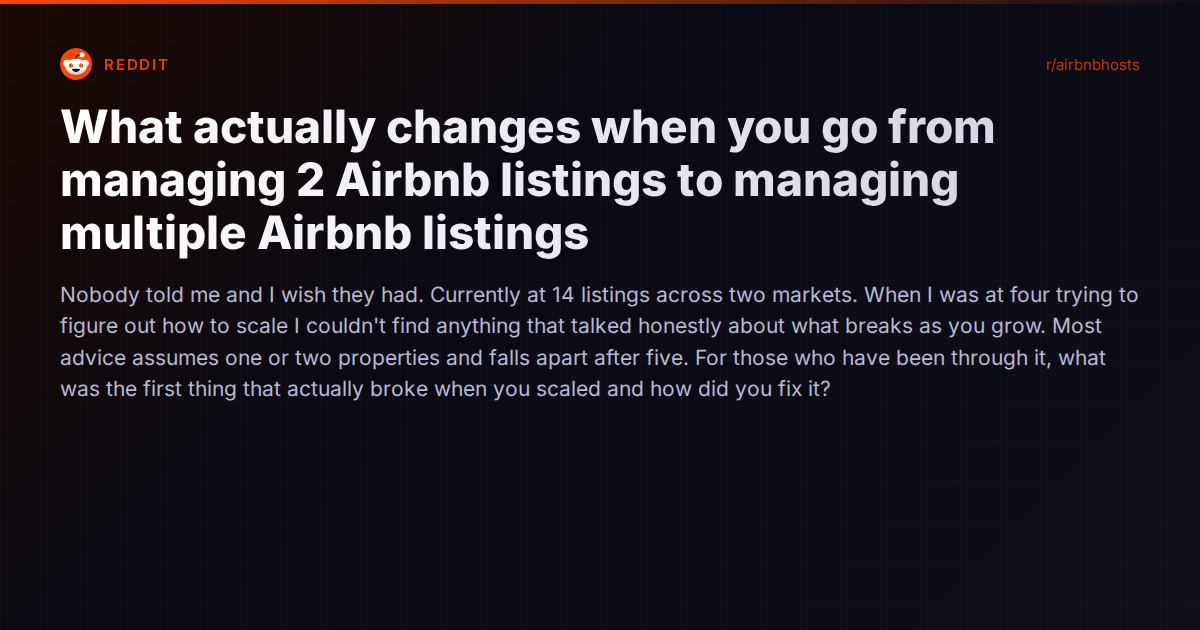
TL;DR: Host at 14 listings across two markets is asking what operationally breaks when scaling past 5 properties and how to fix it.
There’s a particular phase in short-term rental management that nobody warns you about. You’ve figured out one or two properties. You’ve got your cleaning rhythm, your pricing intuition, your personal rapport with every guest. Then you add a third, a fourth, a fifth — and somewhere around property six or seven, things start breaking in ways you didn’t anticipate.
A recent thread on Reddit captured this perfectly. A host at 14 listings across two markets asked the community what actually breaks when you scale, and the responses were remarkably consistent. The failures aren’t where most people expect them.
The context problem comes first
Almost every experienced operator in the thread pointed to the same thing: the collapse of contextual awareness.
At two or three properties, you know which guest is arriving tomorrow, which one had a parking question, which unit has the finicky dishwasher. As one commenter put it: “At 3, I could keep everything in my head. At 9, I started to wonder what kind of dishwasher unit #7 had before I could troubleshoot with them.”
Another host described it more bluntly: “At ten you’re pulling up the reservation mid-reply just to remember which property they’re at, and the message quality starts depending on what kind of day you’re having.”
This isn’t a time problem. It’s an information retrieval problem. You’re not slow — you’re reconstructing context from scratch on every interaction. One host nailed the diagnosis: “I kept thinking I needed more time to respond properly. What I actually needed was a system that already knew everything so I wasn’t reconstructing context from scratch every time.”
This distinction matters because the solution for “not enough time” is hiring staff, while the solution for “not enough context” is better systems. Throw a VA at the problem without the right infrastructure and you’ve just moved the context gap to someone with even less institutional knowledge than you.
Communication quality degrades before anything else
Multiple operators confirmed that communication is the first thing that breaks — not pricing, not logistics, not cleaning coordination. The volume is manageable; the inconsistency isn’t.
At two properties, every message is thoughtful and specific. At eight, you’re sending three or four simultaneous conversations, and the quality of each one depends on your mental bandwidth at that moment. Worse, you don’t realize you’ve dropped something until it surfaces in a review.
This is particularly insidious because messaging quality directly drives review scores, and review scores directly drive revenue. The degradation is gradual enough that you attribute the dip to seasonality or bad luck rather than to the fact that your 11pm reply to a check-in question was a half-distracted two-liner.
Turnovers become a quality control problem
The second consistent failure point is cleaning and turnover coordination. At small scale, you can inspect every unit yourself or maintain a close enough relationship with your cleaner that standards stay high. Past five or six units, especially across markets, quality control becomes probabilistic rather than certain.
The thread identified the specific failure modes: cleaners missing items on the checklist, timing gaps between checkout and the next check-in, and the absence of verification that work was actually done to standard. The fixes people cited were all systematic: checklists, photo verification, backup cleaners, and inspection protocols.
Documentation: the unglamorous fix that actually works
One of the more practical observations in the thread came from a host who scaled from 3 to 10, then deliberately contracted back to 6. Their advice was straightforward: before you scale, you need comprehensive documentation for every property. Amenity details, frequent issues, troubleshooting steps, access instructions, quirks.
This is the foundation that makes everything else work — whether you’re handing off to a VA, onboarding a co-host, or feeding information into an automated messaging system. Without it, every person (or tool) touching a property is operating with incomplete information.
How the tool landscape addresses this
The scaling pain points described in this thread — context collapse, communication inconsistency, turnover quality control — map directly to the categories that property management software is supposed to solve. But the solutions vary meaningfully in approach.
PMS + channel manager as foundation
Platforms like Guesty, Hostaway, and Lodgify all provide the basic infrastructure: a unified calendar, a channel manager to prevent double bookings, and a centralized inbox so you’re not switching between Airbnb, Booking.com, and VRBO tabs. This is table stakes for anyone past three or four properties. If you’re still managing from individual platform dashboards at six units, you’re making the context problem worse than it needs to be.
Guesty in particular targets larger operators (they claim 500,000+ listings on the platform) and offers managed communication services where their team handles guest messaging on your behalf — a direct solution to the “my message quality depends on what kind of day I’m having” problem, though at a cost that may not make sense below 15-20 units.
Hostaway’s unified inbox consolidates messages from Airbnb, Vrbo, Booking.com, email, SMS, and WhatsApp, with template support and SLA tracking. Solid for systematizing communication without full automation.
AI messaging to solve context reconstruction
The more interesting development is AI-powered messaging that actually reads reservation data, property details, and conversation history before generating a response. This directly addresses the core complaint: the host shouldn’t need to reconstruct context because the system already has it.
Hospitable has built its reputation here, with AI that handles routine questions in the host’s voice across channels. Their approach is specifically designed for the scenario where you’ve got four simultaneous conversations and can’t give each one full attention. The AI handles the predictable ones; you handle the exceptions.
Vanio AI takes this further architecturally by unifying messaging, property knowledge, task management, smart locks, and payments in a single system, so the AI doesn’t just know the conversation history — it can look up the lock code, check the cleaning status, or verify a payment without the host mediating. The practical difference is that when a guest asks “what’s the WiFi password” at 11pm, the system doesn’t just template a response; it pulls the actual password for that specific unit. When someone reports a maintenance issue, it can create the task and notify the right person. Their Shadow Mode lets you review every AI draft before it sends, which addresses the reasonable fear of an AI saying something wrong to a guest.
One commenter mentioned using HostAI (a standalone AI messaging tool) and noted that the per-property configuration made responses feel personal rather than generic. This is a real consideration: any AI tool is only as good as the property-specific data you feed it.
Turnover coordination
For the cleaning quality control problem, dedicated tools like Turno (formerly TurnoverBnB) and Breezeway specialize in cleaner scheduling, photo verification, and inspection workflows. They’re proven and focused.
The trade-off is that standalone cleaning tools don’t share context with your messaging system. Your AI doesn’t know whether the cleaning was actually completed when a guest asks if their unit is ready. Platforms that integrate operations and messaging — Vanio AI being one, Guesty being another at higher price points — can close that loop.
The real scaling decision
The thread surfaced a truth that doesn’t get discussed enough: scaling isn’t primarily a workload problem. It’s a systems problem. The operators who scale successfully aren’t the ones who work harder or hire faster. They’re the ones who build (or buy) systems that preserve context and enforce consistency regardless of how many properties are in the portfolio.
The honest trade-offs:
- Doing it manually works until about five units if you’re disciplined, but your message quality and personal bandwidth will be the constraint.
- A traditional PMS (Hostaway, Lodgify, Guesty) gives you the centralized infrastructure but still requires you or your team to be the intelligence layer.
- AI-augmented messaging (Hospitable, Vanio AI, standalone tools like HostAI) addresses the context reconstruction problem directly but requires upfront configuration and ongoing training to match your voice and standards.
- Full-stack AI platforms (Vanio AI) attempt to collapse the entire tool chain so the AI has maximum context, but you’re betting on a single vendor for everything.
- Hiring staff solves bandwidth but not context — unless you pair it with documentation and systems that give your team the information they need.
There’s no single right answer. But if you’re at four or five properties wondering what breaks next, the answer from everyone who’s been through it is the same: your ability to hold context breaks first, and everything downstream — message quality, review scores, turnover consistency — follows.
Start with documentation. Then pick the system that keeps that documentation accessible to whoever (or whatever) is doing the work.