Choosing a PMS for 150+ Short-Term Rental Listings: What Actually Matters at Scale
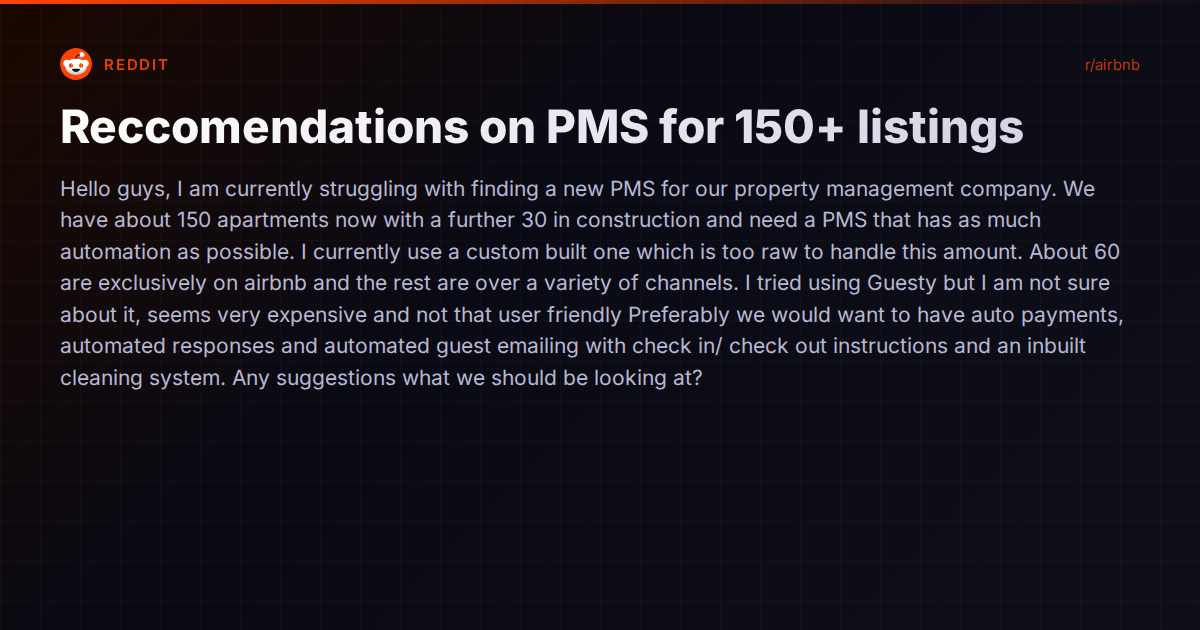
TL;DR: Property manager with 150+ listings across multiple channels is outgrowing a custom PMS and finds Guesty too expensive and not user-friendly, seeking maximum automation for payments, guest messaging, and cleaning.
There’s a well-known inflection point in short-term rental management. Somewhere between 50 and 150 listings, the duct-tape systems that got you this far — spreadsheets, a custom-built tool, a couple of channel-specific dashboards — start falling apart. You’re not a small host anymore, but you’re not an enterprise either. You’re in the messy middle, and the PMS decision you make here will either accelerate your next 100 listings or become the bottleneck that stalls them.
A property manager recently described this exact position on Reddit: 150 apartments live, 30 more under construction, a custom-built PMS that was “too raw” to keep up, and a specific set of requirements — automated payments, automated guest messaging (check-in/check-out instructions), and an integrated cleaning system. They’d evaluated Guesty and found it expensive and not particularly user-friendly. The comment thread offered a scattershot of alternatives: iGMS, Little Hotelier, Uplisting, Cloudbeds, MyVR. Each recommendation came from a different angle, and none directly addressed the core question: what should a 150+ unit operator actually prioritize?
That’s the question worth unpacking.
The Real Requirements at 150+ Listings
At this scale, your needs aren’t just “more features.” They’re structural:
- Multi-channel distribution with reliable sync. If 60 of your 150 listings are Airbnb-only but the other 90 span Booking.com, VRBO, and possibly direct bookings, you need a channel manager that handles two-way calendar, pricing, and availability sync without creating double bookings. This isn’t optional — it’s existential.
- Automated guest communication that actually works. Pre-arrival instructions, check-in details, house rules, mid-stay check-ins, review requests. At 150 units with staggered check-in/check-out times, you cannot do this manually. You need message automation that’s channel-aware and reservation-aware.
- Payment processing and reconciliation. Collecting guest payments, handling security deposits, paying out owners, paying cleaners. At scale, this is an accounting nightmare if your PMS doesn’t handle it natively.
- Cleaning and task coordination. Auto-generating turnover tasks from checkouts, dispatching to cleaning teams, getting confirmation that the job is done. At 150+ units, this is a daily logistics operation, not an afterthought.
- Owner reporting. If you’re managing on behalf of property owners (which is typical at this unit count), they want monthly statements: revenue, expenses, net payouts. A PMS that can’t generate these forces you into a parallel spreadsheet operation.
The original poster listed most of these explicitly. What they may not have fully articulated — because it only becomes obvious after you’ve lived with a tool for a year — is how much the integration between these functions matters. A PMS that handles messaging but outsources cleaning to Turno and payments to a separate Stripe setup and owner reports to a spreadsheet isn’t really solving the problem. It’s distributing it across more login screens.
The Landscape, Honestly
Let’s walk through the major options that a 150+ unit operator would realistically evaluate today.
Guesty
Guesty is the name that comes up most often for operators at this scale, and for good reason. It’s genuinely built for professional property managers running large portfolios. It offers a full channel manager, unified inbox, task automation, payment processing, owner reporting, and a direct booking engine. The AI features (Copilot for data queries, ReplyAI for messaging) are real additions, not vaporware.
The downsides are also real. Multiple operators have described Guesty’s pricing as the highest in the market, and the platform doesn’t publish its rates publicly — you need to go through a sales process. At 150+ listings, this can mean a substantial monthly commitment. The user-friendliness concern raised by the original poster is echoed by others; Guesty is feature-rich, but the interface can feel heavyweight, especially during onboarding. If your budget supports it and you need enterprise-grade support, Guesty is a legitimate choice. But “expensive and not that user-friendly” is a consistent refrain, not an isolated opinion.
Hostaway
Hostaway is probably Guesty’s closest direct competitor for mid-to-large portfolios. It combines a channel manager, PMS, unified inbox, automation tools, and a direct booking website builder. The AI-powered messaging is present, though less deeply documented than some competitors. Owner statements and a dedicated owner portal are included, which matters at scale. Like Guesty, pricing isn’t public — you’ll need to request a quote. Hostaway tends to position itself as more accessible than Guesty, but “more accessible” is relative. Operators at 150+ units should demo both and compare the actual per-listing cost at their volume.
Hospitable
Hospitable (formerly Smartbnb) has strong roots in automated guest messaging — that was its original core product. It’s expanded into channel management, task coordination, direct bookings, and smart device management. The AI messaging is mature and well-regarded. For operators whose primary pain is guest communication automation, Hospitable is worth serious evaluation.
The question at 150+ units is whether Hospitable’s operational tools (task management, payment processing, owner reporting) are as mature as its messaging layer. It’s evolving rapidly — the Copilot feature is expanding, and the platform is clearly moving toward being a full PMS — but operators at this scale should verify that the cleaning coordination and financial reporting meet their specific needs before committing.
Lodgify
Lodgify focuses on direct bookings and website building as a core differentiator, alongside channel management and booking automation. It offers a more affordable entry point and emphasizes hands-on onboarding support. For a 150-unit operator, Lodgify’s strength is in the direct booking funnel. Its operational automation (cleaning, payments, owner reporting) is less prominently featured, so operators with complex multi-owner portfolios should evaluate those specific capabilities carefully.
Cloudbeds, Little Hotelier, and Others
Several commenters suggested tools from the hotel/hospitality side — Cloudbeds, Little Hotelier (SiteMinder), eZee. These are legitimate platforms, especially if your properties feel more like aparthotels than scattered vacation rentals. Cloudbeds in particular handles multi-channel distribution well and has Airbnb API integration. The trade-off is that these tools are built around hotel operating models (front desk, room types, rate plans) rather than vacation rental workflows (per-property uniqueness, turnover cleaning, owner management). They can work, but expect to adapt your operations to fit their paradigm rather than the other way around.
Vanio AI
Vanio AI takes a different architectural approach: rather than bolting AI onto an existing PMS, the AI is the operating layer across the entire system — messaging, task dispatch, smart lock management, payments, and owner reporting all share the same data layer. This means the AI can, for example, auto-generate a lock code, dispatch a cleaner, send check-in instructions, and process a payment without requiring separate integrations.
For a 150+ unit operator, the relevant features are the unified inbox across 10+ channels, SMS-based task dispatch to cleaners (no app required — cleaners reply by text), automated payment processing via Stripe Connect, and automated owner reports. The Shadow Mode lets you review every AI-generated message before it sends, transitioning to full autonomy only when you’re confident. Pricing is transparent: a per-listing base fee plus $5 per active reservation, with volume discounts at scale.
The honest caveat: Vanio AI is newer to the market than Guesty or Hostaway. Operators who need a platform with a long track record at 500+ units may want to see more case studies at that scale. The BeyondBnB deployment (500+ properties) is the most cited reference.
What to Actually Do
If you’re at 150 listings and growing, here’s a practical decision framework:
- List your non-negotiables. For most operators at this scale, those are: reliable multi-channel sync, automated messaging, cleaning coordination, payment processing, and owner reporting. If a tool doesn’t do all five natively, you’re back to stitching together multiple systems.
- Get real pricing at your volume. “Request a quote” means wildly different numbers for different operators. Get line-item costs from at least three platforms at your actual listing count.
- Test the cleaning workflow. This is where most platforms feel weakest in demos. Ask: how does a checkout create a cleaning task? How does the cleaner get notified? How do I know it’s done? Can I see photos? If the answer involves a third-party integration, factor in that cost and complexity.
- Evaluate the AI with your actual data. Every platform claims AI automation. Load your real properties, your real FAQs, your real guest scenarios. See what the AI handles autonomously and what still requires human intervention.
- Check the migration path. Moving 150 listings off a custom PMS is non-trivial. Ask each vendor specifically about their migration support, timeline, and whether they’ll help import your existing data.
There’s no single “best PMS” for 150+ listings — only the best fit for your specific channel mix, operational model, budget, and growth trajectory. The tools have gotten meaningfully better in the last few years, but the decision still requires hands-on evaluation with your own data. Don’t trust feature comparison charts. Trust what the system does when you load your actual properties and walk through a real guest lifecycle from booking to checkout.