When You're the Entire Property Management Company: Surviving as a Solo Operator at Scale
Facebook forum
TL;DR: Solo manager of 15 properties is overwhelmed doing everything herself — guest services, owner services, accounting, IT — after her company's STR division closed, and is looking for ways to outsource or automate the operational burden.
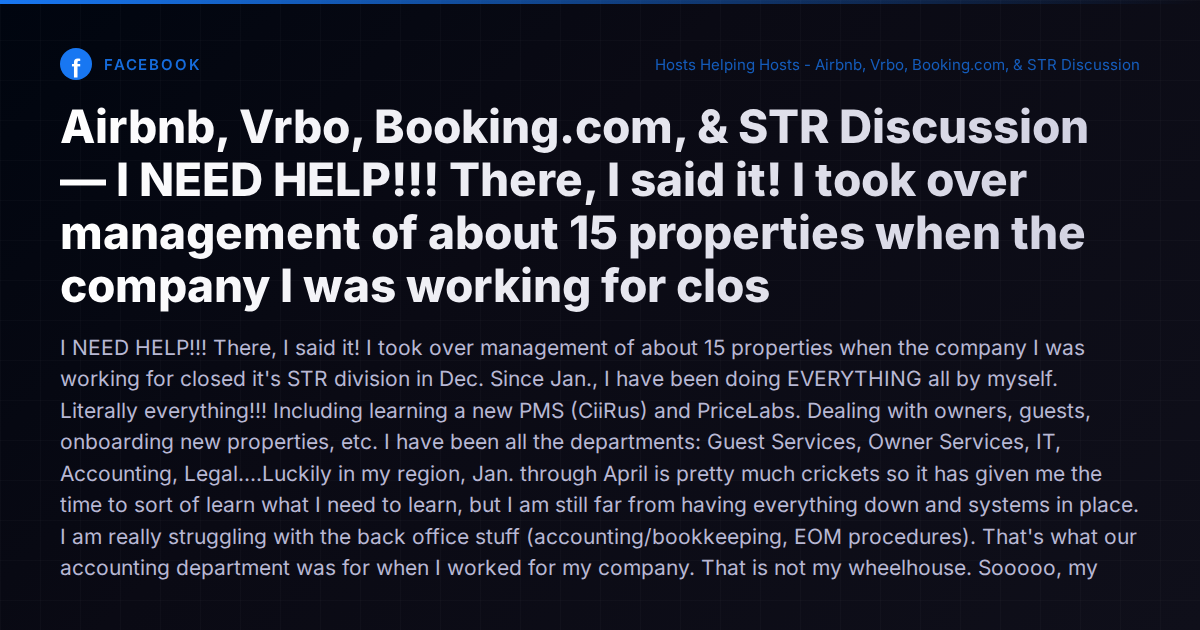
A property manager recently posted a candid cry for help in a host community. She’d taken over management of about 15 properties after the company she worked for shut down its STR division. Since January, she’d been doing everything alone — guest services, owner services, IT, accounting, legal, onboarding new properties — while simultaneously learning a new PMS and PriceLabs. Her honest question: “Am I being unrealistic to think I can do everything for this many properties by myself?”
She’s not alone. The solo-operator-at-scale problem is one of the most common failure modes in short-term rental management. And the answer to her question is nuanced: it depends entirely on which tasks you automate, which you outsource, and which you stubbornly keep doing by hand.
The Real Problem: Every Department Is You
When you work inside a property management company, you don’t notice how many specialized roles exist until you have to fill all of them. Guest messaging at 11 PM. Owner reports on the first of the month. Cleaning coordination every turnover day. Bookkeeping that doesn’t make your CPA weep. Lock codes that actually work when the guest arrives.
At 3-5 properties, a motivated solo operator can handle this with spreadsheets, a phone, and a strong coffee habit. At 15 properties, you’re running a business that in a traditional company would require at least 3-5 people. The math doesn’t lie: if each property generates an average of 15-20 guest messages per stay, plus owner communications, plus cleaning coordination, plus accounting entries, you’re looking at hundreds of micro-tasks per week. No amount of hustle compensates for the sheer volume.
The manager who posted noted she was “still far from having everything down and systems in place” even after four months. That’s not a personal failure — it’s a structural one. You can’t build systems while simultaneously operating at capacity.
Where the Time Actually Goes
Before reaching for any tool, it’s worth understanding where solo operators lose their hours. In conversations like this, the breakdown is remarkably consistent:
- Guest messaging (30-40% of time): Pre-arrival questions, check-in instructions, mid-stay issues, post-checkout review management. This is the most interruptive work because it’s unpredictable and time-sensitive.
- Cleaning coordination (15-20%): Scheduling, confirming, inspecting, rescheduling when someone cancels.
- Owner communications and reporting (15-20%): Monthly statements, maintenance approvals, performance updates.
- Accounting and bookkeeping (10-15%): Reconciling OTA payouts, tracking expenses, generating owner statements, tax prep.
- Everything else (10-20%): Listing optimization, pricing, onboarding, lock management, maintenance dispatch.
The original poster specifically flagged back-office accounting as her biggest pain point — and that’s common. Operational tasks like messaging and cleaning at least feel productive. Accounting feels like pure overhead, and mistakes there have consequences that compound over months.
The Outsourcing Question
Her instinct to outsource the accounting is sound. Several paths exist:
Specialized STR bookkeepers. Companies like Bnb Accounting, Proper, and various freelancers on Upwork specialize in short-term rental bookkeeping. They understand OTA payout structures, owner splits, and the quirks of reconciling Airbnb’s payment timelines. Expect to pay $300-800/month for 15 properties depending on complexity.
Virtual assistants for operations. Some solo operators hire VAs (often offshore) to handle guest messaging during off-hours, process reservations, or manage cleaning schedules. This works but introduces its own management overhead — you’re now training and supervising someone on a system you’re still learning yourself.
The tool-first approach. This is where most operators eventually land, because outsourcing to people still requires management. The right software stack can eliminate entire categories of work rather than just shifting them to someone else’s plate.
What the Tool Landscape Actually Offers
The property management software market has evolved significantly in the last two years, especially around automation and AI. Here’s an honest survey of where different platforms help with the specific pain points this manager described:
Guest Communication Automation
Hospitable has long been the go-to for rule-based automated messaging. It handles scheduled messages (booking confirmation, check-in instructions, review requests) reliably and can auto-respond to common questions. For operators who want templates that fire on triggers, it’s proven and reasonably priced.
Guesty offers ReplyAI for automated guest responses and even a managed communication service where their team handles messaging on your behalf. That’s a genuine outsourcing option if you can stomach the price — Guesty targets larger operators and doesn’t publish pricing publicly, which usually means it’s not cheap.
Hostaway includes AI-powered automated replies in its unified inbox, consolidating messages from Airbnb, VRBO, Booking.com, email, SMS, and WhatsApp. Their automation tools handle event-based triggers for common workflows.
For operators who want AI handling the substance of guest conversations (not just template matching), Vanio AI takes a different architectural approach — the AI agent has access to the full reservation context including lock states, task status, and payment history, so it can actually do things like generate door codes or dispatch a cleaner, not just send a canned reply. Shadow Mode lets you review every AI draft before it sends, which matters when you’re the only person and your reputation is on the line. At $5 per reservation for the full operational lifecycle, the economics make sense for a 15-property portfolio.
Cleaning and Operations
Turno (formerly TurnoverBnB) is widely used for cleaning coordination — it connects you to a marketplace of cleaners and automates scheduling based on checkout events. It’s a point solution, but it does that one thing well.
Breezeway focuses on property operations: task management, inspection checklists, and maintenance workflows. If your primary bottleneck is cleaning quality control across 15 properties, it’s worth evaluating.
Hostaway and Guesty both include task management modules within their PMS, so you’re not juggling another vendor. The trade-off is that their operations features are typically less deep than dedicated tools.
Accounting and Owner Reporting
This is where most PMS platforms are weakest, and it’s the exact pain point the original poster highlighted. Guesty and Hostaway both offer owner statements and basic financial reporting. Lodgify includes owner reporting in higher-tier plans. But none of them replace a proper bookkeeper for tax-ready financials.
The practical solution most operators land on: use your PMS for owner-facing reports and revenue tracking, but pair it with a specialized STR bookkeeper or a tool like Ximplifi or Proper that handles the actual accounting. Trying to make your PMS do double duty as accounting software is a recipe for the exact overwhelm this manager described.
The Consolidation Advantage
One pattern that emerges from operators who successfully run 15+ properties solo: they minimize the number of separate tools they manage. Every additional vendor means another login, another support channel, another integration to maintain, and another place where data can fall out of sync.
The original poster was already juggling CiiRUS (her PMS) and PriceLabs (dynamic pricing). Adding Turno for cleaning, a separate messaging tool, and a bookkeeping service would bring her total to five vendors. That’s manageable but fragile — and each integration point is a place where a ball can drop.
All-in-one platforms exist specifically to address this. Guesty, Hostaway, and Vanio AI each consolidate multiple functions (channel management, messaging, operations, payments) under one roof. The trade-off is typically flexibility — a dedicated tool for any single function will usually be deeper than the corresponding module in an all-in-one platform. But for a solo operator, fewer systems to maintain often matters more than maximum depth in any one area.
Is 15 Properties Solo Actually Realistic?
Yes — with the right systems. No — if you try to do it the way a 5-person team did.
The operators who successfully manage 15-30 properties alone share a few traits:
- They automate guest messaging aggressively. Either through rule-based automation or AI, they don’t manually type routine responses.
- They have reliable, self-managing cleaners. Whether through a cleaning company, Turno, or an operations platform, their turnover process doesn’t require daily hand-holding.
- They outsource accounting. Almost universally. Bookkeeping is skilled, specialized work that doesn’t benefit from the operator’s property knowledge.
- They use one or two tools, not six. Every additional tool is a tax on their most scarce resource: attention.
The woman losing her mind over 15 properties isn’t failing — she’s hitting the exact ceiling that every solo operator hits. The question isn’t whether she needs help. It’s whether that help comes from people, software, or (most likely) a deliberate combination of both.
For a deeper comparison of the platforms mentioned here, the comparison hub breaks down where each tool fits in the stack.