When Your Property Manager Goes Silent: The Case for Automating Maintenance Response
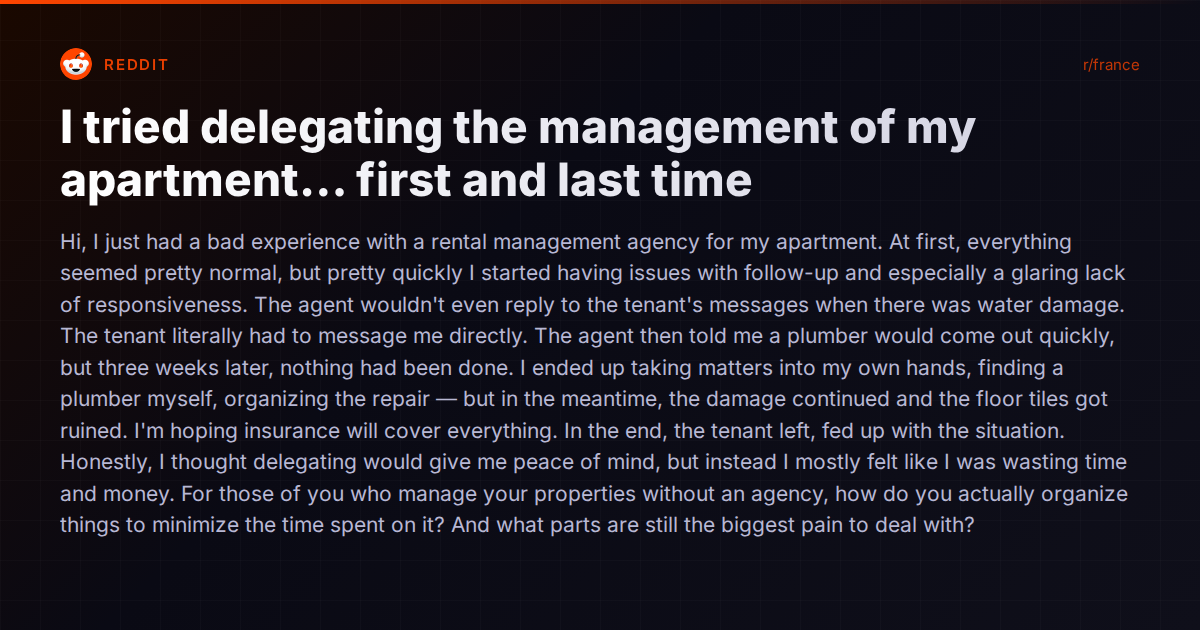
TL;DR: Owner delegated property management to an agency that failed to respond to tenant messages about water damage, leading to weeks of delay, worsened damage, and tenant departure — now seeking ways to self-manage efficiently.
A property owner recently shared a story on Reddit that will sound painfully familiar to anyone who has ever delegated rental management. They hired an agency to handle their apartment. When the tenant reported water damage, the agency went dark — no reply to the tenant, no follow-up with a plumber. Three weeks passed. The owner finally stepped in, found a tradesperson themselves, and coordinated the repair. By then the floor tiles were ruined, the tenant was fed up, and they moved out. The owner’s summary: “I thought delegating would give me peace of mind, but instead I mostly felt like I was wasting time and money.”
The comment thread was revealing. One owner described getting two repair quotes from the same agency — one for €2,000, another for €400 — with no investigation into the root cause of the mold problem. A tenant chimed in that they have literally no way to contact their landlord, so when the agency drops the ball, nothing happens. Another owner said they self-manage and keep tenants happy precisely because they respond within 24 hours. And one more reported that after cycling through two bad agencies, the third turned out to be excellent — a reminder that agency quality varies wildly.
This is not a story about one bad apple. It’s about a structural problem in property management: the gap between when a guest or tenant reports an issue and when someone actually does something about it.
Why the Responsiveness Gap Exists
Traditional property management agencies — whether handling long-term rentals or short-term vacation properties — rely on human agents juggling dozens or hundreds of units. Messages arrive across email, platform inboxes, phone calls, and WhatsApp. A single delayed reply to a maintenance request cascades: the tenant waits, the damage worsens, trust erodes, and eventually you lose the tenancy.
For short-term rental operators specifically, the stakes are even higher. A guest who reports a plumbing issue on day one of a five-night stay and hears nothing for 48 hours will leave a one-star review. The response window isn’t three weeks — it’s three hours.
The root causes are predictable:
- No single system of record. Messages come in on Airbnb, Booking.com, WhatsApp, and email. If the person monitoring the Airbnb inbox is off-duty, the message sits.
- No automated escalation. A maintenance request looks the same as a question about parking. Without triage logic, urgent issues get buried.
- No task tracking. Telling a plumber to “come quickly” is not the same as creating a tracked task with a deadline and an owner who gets notified when it’s overdue.
- No accountability loop. The owner finds out about the problem only when the tenant contacts them directly — weeks into the failure.
What Technology Can (and Can’t) Fix
The good news: most of these failure modes are solvable with the right tooling. The bad news: no tool replaces judgment. Technology handles triage, routing, tracking, and reminders. A human still needs to decide whether to approve a €2,000 repair or get a second quote.
Here’s how the current landscape maps to the problem:
Unified Inboxes
The first line of defense is making sure no message goes unseen. Hostaway aggregates messages from Airbnb, Vrbo, Booking.com, email, SMS, and WhatsApp into a single inbox with SLA tracking — so you can see at a glance which conversations have been waiting too long. Guesty offers a similar unified inbox and even a managed Guest Communication Service where their team handles messaging on your behalf, claiming 74% faster response times. Hospitable consolidates messages and can auto-reply to common questions, freeing hosts to focus on the exceptions.
These tools solve the “I didn’t see the message” problem. They don’t automatically solve the “I saw it but didn’t act” problem.
Task Management and Maintenance Workflows
Seeing a message is step one. Converting it into an assigned, tracked, deadline-bearing task is step two. Lodgify provides operational automation and booking management, though its maintenance workflow depth is more limited compared to platforms built around operations. Hostaway and Guesty both offer automation triggers that can convert booking events into tasks, but configuring them to handle ad-hoc maintenance requests (as opposed to scheduled turnovers) typically requires custom setup.
For operators who want cleaning and maintenance coordination as a first-class feature rather than an afterthought, dedicated operations tools like Breezeway and Turno focus specifically on task dispatch, checklists, and vendor coordination. They do this well but add another login and another silo to manage.
AI-Driven Triage and Response
The newest layer in the stack is AI that can understand the content of a message, assess urgency, and either respond or escalate appropriately. This is where the landscape is moving fast in 2026.
Hospitable is developing an AI feature called Copilot that aims to assign tasks automatically and recommend message edits. Guesty’s ReplyAI offers automated responses with sentiment analysis. Hostaway has an AI reply feature layered on top of its inbox.
The limitation with most of these implementations is that AI is bolted onto a PMS rather than integrated into it. The AI can draft a reply, but it can’t necessarily check whether a maintenance vendor is available, create a tracked task, notify the owner, and follow up if no action is taken — all in one step.
Vanio AI takes a different architectural approach here. Because the AI agent has native access to the entire system — messaging, task management, payments, smart locks, knowledge base — it can do things like: detect that a message describes a maintenance emergency, draft a response to the guest acknowledging the issue, create a maintenance task with a deadline, dispatch it to the assigned vendor via SMS, and flag the owner in the collaboration drawer if a policy decision is needed. The AI Skills feature lets operators define multi-step playbooks for specific scenarios (maintenance requests, noise complaints, lost items), and the Operations Watchdog runs a daily automated check across messaging, access codes, cleaning, and payments to catch anything that’s fallen through the cracks. For the scenario described in the original post — water damage reported, no response for weeks — this kind of system-level automation is precisely the gap that needed filling.
That said, Vanio AI is primarily designed for short-term rental operations. The original post describes a long-term rental scenario (a tenant, not a guest), and the tooling ecosystem for long-term rental management automation is less mature. Operators who manage both types of properties should evaluate whether their primary pain is on the STR side or the LTR side before choosing a platform.
The Self-Management Question
The original poster asked how self-managing owners stay organized. Based on what experienced operators consistently report, the pattern looks like this:
- One inbox, not five. Pick a platform that consolidates communication. Even for long-term rentals, having tenant messages hit a single dashboard instead of scattered across phone, email, and WhatsApp prevents things from being missed.
- Templated responses for common issues. Water damage, lockouts, heating failures — have a pre-written response and a pre-identified vendor for each. Speed of acknowledgment matters as much as speed of resolution.
- Tracked tasks, not verbal promises. “The plumber will come quickly” is not a task. A task has an assignee, a deadline, and a status. Whether you use a PMS, a project management tool, or a spreadsheet, the task needs to exist somewhere visible.
- Escalation triggers. If a task has been open for 48 hours without progress, someone should get a notification. Automated, not manual.
- Honest cost accounting. The owner in the original post paid agency fees and still ended up doing the work themselves. That’s the worst outcome — paying for delegation and getting neither delegation nor results. Whether you use an agency, a software platform, or pure self-management, track what you’re actually spending (in money and time) per issue resolved.
The Bottom Line
The fundamental promise of property management — “we handle everything so you don’t have to” — breaks down the moment responsiveness fails. Technology doesn’t eliminate the need for good judgment, but it does eliminate the most common excuses: “I didn’t see the message,” “I forgot to follow up,” “I thought someone else was handling it.”
The right tool depends on your portfolio size, rental type, and where your biggest pain actually sits. For a comparative look at how the major platforms stack up across communication, operations, and automation, the comparison hub is a good place to start digging.