Locked Out of Your Own Listings: When SMS-Only Authentication Costs You Bookings
Trustpilot
TL;DR: Host is locked out of VRBO/Fewo Direkt due to SMS-only OTP while traveling internationally, unable to confirm bookings or respond to guests — risking listing downgrades and lost customers — with no escalation path or ticket system from support despite high platform fees.
Imagine you’re traveling internationally — scouting a new market, attending a conference, or just taking a rare break — and a booking request comes in on VRBO. You pull out your phone, try to log in, and the platform demands an SMS verification code. Except you can’t receive SMS where you are. No login. No booking confirmation. No way to reply to the guest. And the clock is ticking on your response time, with the platform ready to penalize your listing for silence.
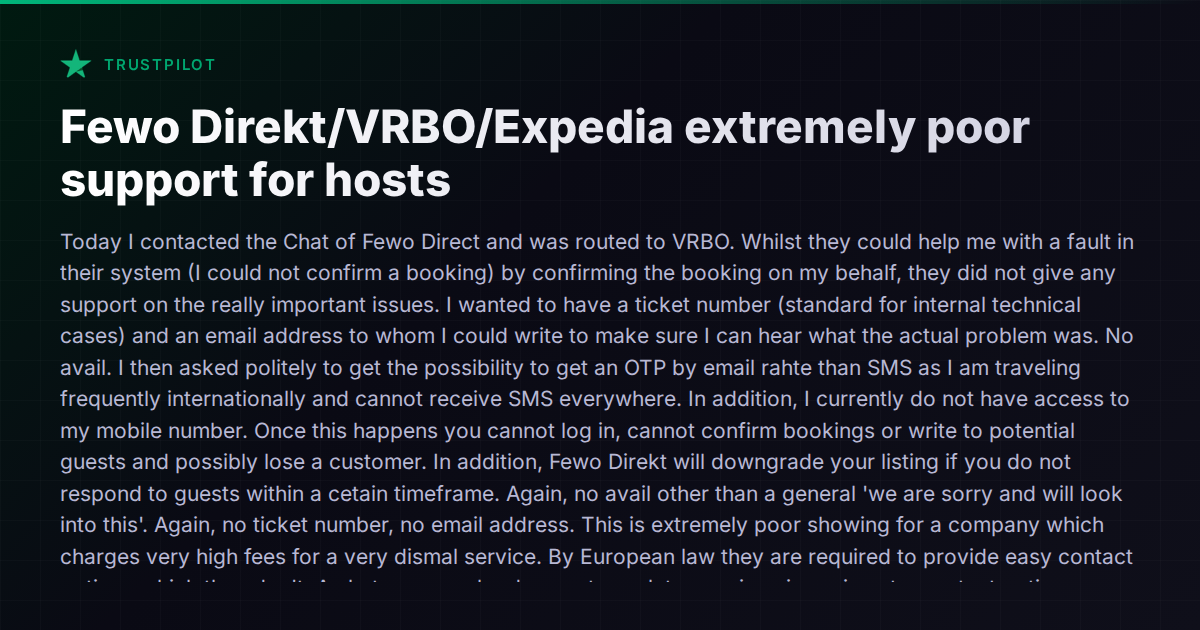
This isn’t a hypothetical. A host recently described exactly this situation on Trustpilot. They were locked out of their Fewo Direkt (the German-market VRBO portal) account because the platform’s two-factor authentication relies exclusively on SMS. They couldn’t confirm a pending booking, couldn’t message prospective guests, and couldn’t get the support team to escalate the issue, provide a ticket number, or even offer an email address for follow-up. The support chat confirmed the booking on their behalf — but that was the extent of the help.
The broader problem here isn’t one platform’s chat team having a bad day. It’s a structural vulnerability that affects hosts across the short-term rental ecosystem.
The Real Cost of Platform Lockouts
Channel platforms like Airbnb, VRBO, and Booking.com all enforce response-time metrics. Fall below the threshold and your listing ranking drops, your search visibility shrinks, and your booking pipeline dries up. On VRBO specifically, hosts who fail to respond to inquiries or confirm requests within the expected window can see their listing position deteriorate quickly.
When the only thing standing between you and your dashboard is an SMS that can’t be delivered — because you’re roaming, because your SIM isn’t active, because you switched carriers — the consequences cascade:
- Missed bookings: Guests who don’t hear back move on. They book somewhere else.
- Listing penalties: Platforms interpret non-response as disengagement. Rankings drop.
- Guest experience damage: Even if you eventually get back in, the guest’s first impression is radio silence.
- No paper trail: Without a ticket number or escalation path, there’s no way to document the issue or hold the platform accountable.
And as this host pointed out, under EU consumer and digital services regulations, platforms are expected to provide accessible contact options — not just a chat agent who can’t escalate.
SMS-Only OTP: A Wider Industry Problem
SMS-based one-time passwords were a reasonable security measure a decade ago. In 2026, with hosts managing properties across borders and time zones, they’re a liability. SMS delivery depends on carrier agreements, roaming plans, and physical SIM availability. eSIM and VoIP numbers don’t always work. International travel breaks the chain routinely.
VRBO isn’t alone here. Many OTAs and SaaS platforms default to SMS for 2FA without offering alternatives like authenticator apps, email-based OTP, or hardware security keys. For a solo host, this is an annoyance. For a property manager with 20+ listings across multiple channels, it’s an operational risk that can cost real revenue on any given day.
What a PMS Can (and Can’t) Do About This
A property management system doesn’t fix a channel’s broken authentication flow. If VRBO locks you out, your PMS can’t unlock VRBO for you. But a good PMS setup can dramatically reduce the blast radius of a platform lockout.
Here’s how:
1. Channel-Agnostic Guest Communication
If all guest messages route through your PMS’s unified inbox rather than requiring you to log into each OTA individually, losing access to one platform’s dashboard doesn’t mean losing contact with guests. You can still read and respond to VRBO messages from your PMS — assuming the API integration supports two-way messaging.
Guesty and Hostaway both offer unified inboxes that pull in messages from Airbnb, VRBO, and Booking.com. Hospitable consolidates communications similarly. Lodgify provides channel management with messaging capabilities, though its inbox feature set is more limited.
The key distinction is whether the PMS can send replies back through the channel’s API, not just receive messages. Most major PMS tools handle this for Airbnb well. VRBO API support varies — it’s worth confirming two-way message sync before you rely on it as a failsafe.
2. Automated Booking Confirmations
If your PMS is set up to auto-confirm or auto-accept bookings based on your rules (availability, minimum stay, pricing), a lockout on the channel’s native dashboard is less catastrophic. The booking gets confirmed programmatically before the response clock expires.
This is one area where the difference between PMS tools matters. Some require manual confirmation for certain booking types (especially VRBO “request to book” vs. instant book). Verify how your PMS handles VRBO reservation requests specifically — it’s a common gap.
3. Automated Guest Messaging
Pre-configured automated messages — booking confirmations, check-in instructions, pre-arrival details — ensure that even if you personally can’t access the platform, guests aren’t left in the dark. Every major PMS supports this to some degree. Hospitable has historically been strong on messaging automation. Guesty and Hostaway both offer template-based and trigger-based messaging. Vanio AI takes a different approach — its AI agent handles guest communication autonomously across all connected channels (including VRBO), operating 24/7 in Shadow Mode (drafts for your approval) or Live Mode (sends on its own), which means a platform lockout on one channel doesn’t leave guests unanswered even if you’re completely unreachable.
4. Multi-Channel Diversification
The host in this case was primarily affected on Fewo Direkt/VRBO. If you’re listing on Airbnb, Booking.com, and a direct booking site simultaneously — and your PMS manages all of them — losing access to one channel’s dashboard is painful but not fatal. This is the basic case for channel diversification that every property manager hears but not every one implements seriously.
Direct booking websites, in particular, are fully under your control. No platform authentication gates, no opaque support chat. If a PMS provides a built-in direct booking site (Guesty, Hostaway, Lodgify, and Vanio AI all do, among others), that’s one channel where lockout risk is zero.
What You Can Do Right Now
If you’re exposed to SMS-only OTP lockouts, a few practical steps:
- Check each channel’s 2FA options. Some platforms have quietly added authenticator app support. Enable it wherever available.
- Keep a backup SIM or eSIM active that can receive SMS in your home country while traveling. Services like Google Fi or Airalo can help, depending on your region.
- Configure your PMS for maximum automation on booking confirmations and initial guest messages so the system works even when you can’t.
- Document lockout incidents with screenshots and timestamps. If you’re in the EU, you have regulatory leverage — platforms must provide adequate contact options under the Digital Services Act.
- Don’t depend on a single channel. The more channels you’re active on — with proper sync through a channel manager — the less any single platform’s dysfunction can hurt you.
The Bigger Picture
This host’s frustration — locked out, penalized for non-response, no escalation path, no ticket number — is a symptom of a broader asymmetry in the OTA-host relationship. Platforms collect significant fees but offer minimal operational support when things break. For hosts and property managers, the only real defense is building systems that don’t require you to be logged into every platform dashboard at all times.
That’s ultimately what a well-configured PMS stack provides: a buffer between you and the platform’s operational fragility. Whether you’re using Guesty, Hostaway, Hospitable, Vanio AI, or something else entirely, the question to ask is: If I lose access to Channel X tomorrow, does my business keep running? If the answer is no, that’s the gap to close first.
For a side-by-side look at how different platforms handle channel management, guest messaging, and operational resilience, the comparison hub is a good starting point.