Double Bookings Still Cost Hosts Thousands — How Channel Sync Fails in 2026
Trustpilot
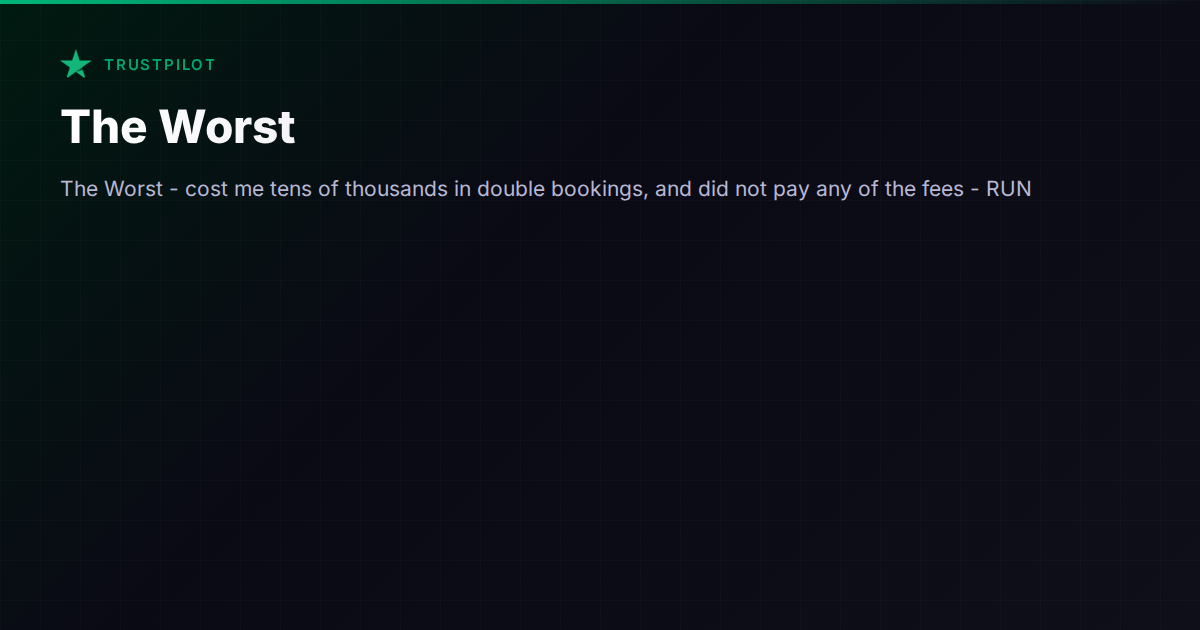
TL;DR: Host lost tens of thousands of dollars due to Guesty's double bookings and unpaid fees, explicitly warning others to leave the platform.
A property manager recently left a one-star Trustpilot review claiming their PMS cost them “tens of thousands” in double bookings — and that the platform refused to cover any of the resulting fees. The review was directed at Guesty, but the underlying problem — unreliable calendar synchronization across booking channels — is one of the most financially dangerous failure modes in short-term rental operations. And it’s more common than it should be in 2026.
The Real Cost of a Double Booking
A double booking isn’t just an awkward phone call. It’s a cascade of costs:
- Relocation expenses. You’re paying for a guest’s alternative accommodation, often at last-minute rates that dwarf your nightly revenue.
- Platform penalties. Airbnb, Booking.com, and VRBO all penalize hosts for cancellations caused by overbooking. Penalties range from fines to search rank suppression to outright suspension.
- Review damage. Even if you handle the situation gracefully, a canceled guest often leaves a review that poisons your listing for months.
- Refund and chargeback friction. Getting money back from OTAs or processing refunds through your PMS adds hours of manual work per incident.
- Lost trust from owners. If you manage on behalf of property owners, a double booking is one of the fastest ways to lose a contract.
When a host says they lost “tens of thousands,” it’s easy to imagine how the numbers stack up across multiple incidents — especially if the sync failures were intermittent and hard to diagnose.
Why Channel Sync Still Breaks
The job of a channel manager sounds straightforward: when a booking comes in on Airbnb, block the dates on Booking.com and VRBO (and vice versa). In practice, it’s one of the hardest technical problems in the vacation rental stack, and every PMS handles it differently.
There are a few common failure points:
1. iCal Lag
Some platforms still rely on iCal feeds for secondary channels. iCal is a polling-based protocol — the receiving platform checks for updates on a schedule (often every 15–30 minutes, sometimes longer). During high-demand periods when bookings come in rapid succession, a 15-minute gap is an eternity. Two guests can book the same dates on two different channels before either feed refreshes.
2. API Rate Limits and Retry Failures
Even platforms using direct API connections with OTAs can hit rate limits, especially during peak booking windows. If an availability update fails to propagate and the system doesn’t retry aggressively (or doesn’t alert you when a retry fails), you’re exposed.
3. Multi-Unit Edge Cases
Properties with multiple similar units — say, four identical studios in one building — add a layer of complexity. The channel manager needs to map bookings to specific units, not just block dates on a single calendar. Misconfigured unit mapping is one of the most common causes of phantom double bookings.
4. Stale State After Cancellations
A guest cancels on Airbnb. The PMS frees the dates in its own calendar. But does it push the availability update back to Booking.com and VRBO immediately? Some systems have asymmetric sync — fast on the way in, slow on the way out — leaving canceled dates blocked on some channels or, worse, opening dates that should still be reserved.
How the Major Platforms Handle It
No channel manager is perfect, but there are meaningful differences in architecture and reliability.
Guesty uses direct API connections with Airbnb, Vrbo, and Booking.com and markets itself as an enterprise-grade solution. It manages over 500,000 listings and targets professional operators. That scale generally implies mature sync infrastructure — but as the Trustpilot review above illustrates, scale doesn’t guarantee reliability for every account. When things go wrong, the financial exposure at the enterprise level is proportionally larger, and Guesty’s opaque pricing (no public tiers) means there’s often ambiguity about what’s covered when sync failures cause losses.
Hostaway similarly offers direct API integrations and positions its channel manager as having “highest-status OTA connections.” It’s a solid option for operators who need centralized management across multiple channels. Like Guesty, pricing isn’t disclosed publicly, so you’ll need to negotiate terms — including what happens when things go wrong.
Hospitable provides real-time calendar syncing across Airbnb, Vrbo, Booking.com, and Agoda. For smaller operators (under 20 properties), it’s one of the more straightforward options with a strong automation layer for messaging and tasks. The sync architecture is API-based for supported channels, which should minimize iCal-related lag.
Lodgify emphasizes real-time syncing and ease of use, with a particular strength in direct booking websites. For hosts whose primary concern is keeping a handful of listings in sync without enterprise complexity, Lodgify’s approach is worth evaluating.
Vanio AI takes a different architectural approach as an AI-native platform with a unified data layer. Because the channel manager, reservation system, and messaging all share one system, availability updates don’t need to traverse middleware or third-party integrations between internal components. The platform offers real-time two-way sync with Airbnb, Booking.com, and VRBO via direct API, and includes conflict detection for overlapping reservations and missing turnover time — surfacing problems before they become double bookings rather than after. The Operations Watchdog feature runs a daily automated check across messaging, access codes, cleaning, and more, catching stale state that might otherwise go unnoticed.
What to Look for When Evaluating Sync Reliability
If you’re shopping for a PMS or evaluating whether your current one is putting you at risk, here’s what matters:
- Direct API vs. iCal. Ask explicitly which channels use direct API connections and which fall back to iCal. If any of your primary channels are iCal-only, you’re accepting a window of exposure.
- Sync latency SLAs. Some platforms publish sync time guarantees (e.g., “under 60 seconds for direct API channels”). If yours doesn’t, ask.
- Failure alerting. Does the system notify you when a sync update fails? Can you see a log of sync events per listing? If sync is a black box, you won’t know about problems until a guest shows up to an occupied property.
- Cancellation propagation. Test this explicitly during onboarding. Cancel a reservation on one channel and measure how long it takes for the dates to open (or remain blocked, depending on your preference) on other channels.
- Financial liability terms. Read your contract. Does your PMS accept any liability for double bookings caused by sync failures? Most don’t — which means the “tens of thousands” in the Trustpilot review came entirely out of the operator’s pocket.
The Uncomfortable Truth
Channel synchronization is table stakes for any PMS, yet it remains one of the most common sources of catastrophic financial loss for STR operators. The technology to do it well exists. Direct API connections, conflict detection, real-time alerting, and automated reconciliation are all solvable problems. But implementation quality varies enormously across platforms, and the consequences of getting it wrong fall entirely on the host.
If you’re managing more than a handful of listings, auditing your sync reliability isn’t optional — it’s risk management. Compare how different platforms approach this at /compare/, and test the specific failure scenarios above during any trial period before committing to a contract.