Expanding From Airbnb to Booking.com: What Hosts Need to Know About Multi-Channel Growing Pains
Facebook forum
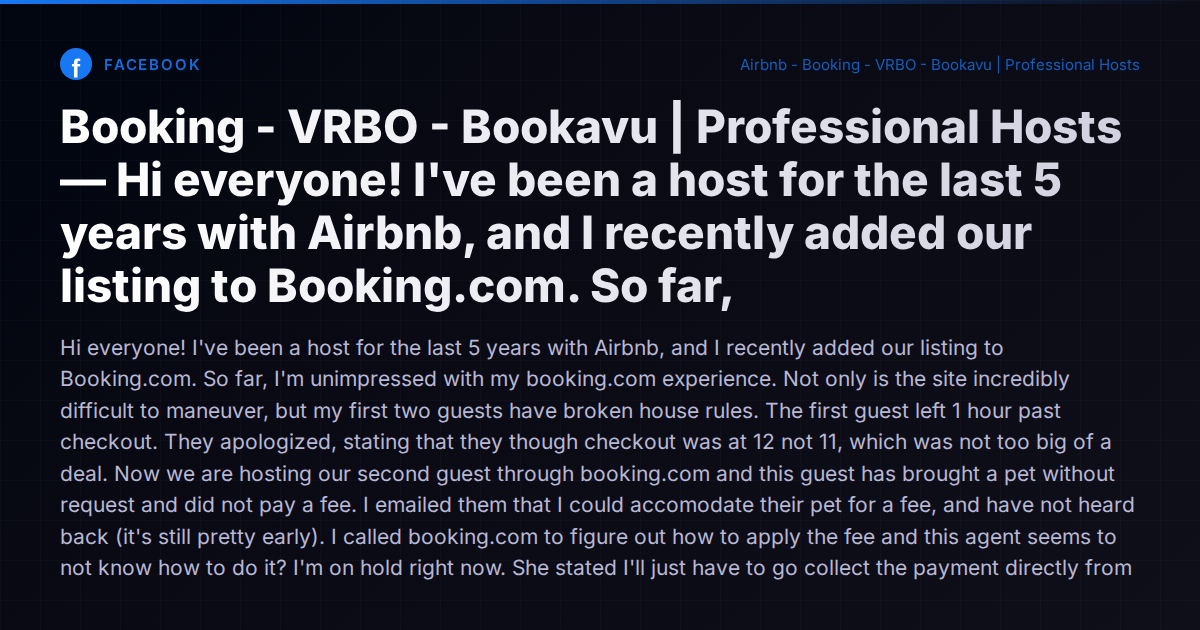
TL;DR: Host expanding from Airbnb to Booking.com is frustrated by the platform's difficult interface, guests breaking house rules, and inability to apply fees after booking through Booking.com support.
Most short-term rental hosts start on Airbnb. The onboarding is relatively smooth, the guest communication tools are decent, and the platform handles payments and rule enforcement in a way that mostly makes sense. Then, at some point, you decide to diversify. You add your listing to Booking.com — and discover that everything you took for granted on Airbnb works differently, or doesn’t work at all.
A host in a popular online community recently described this exact experience. After five years on Airbnb, they listed on Booking.com and immediately ran into friction: a guest overstayed checkout by an hour, a second guest brought an unauthorized pet without paying the required fee, and when the host called Booking.com support to figure out how to charge the fee, the agent didn’t know how. The host was told to collect payment directly from the guest.
This isn’t an isolated story. It’s one of the most predictable pain points in the short-term rental business: the operational gap between managing one channel and managing two or more.
Why Booking.com Feels So Different From Airbnb
Airbnb and Booking.com were built for fundamentally different hospitality models. Airbnb was purpose-built for individual hosts renting their homes. Booking.com was originally a hotel booking engine that expanded to accommodate vacation rentals. The result is a platform where many vacation-rental-specific features — pet fees, extra guest charges, house rule enforcement, late checkout penalties — are either buried in settings or functionally absent.
Some concrete differences hosts encounter:
- Fee collection after booking: On Airbnb, you can set pet fees, extra guest fees, and other charges that are collected at booking time. On Booking.com, adding charges post-booking is clunky at best. Many hosts report that support agents themselves are uncertain about the process.
- House rule enforcement: Airbnb presents house rules prominently during booking and gives hosts some recourse through the Resolution Center. Booking.com’s house rule visibility to guests is weaker, and enforcement mechanisms are limited.
- Guest communication: Airbnb centralizes messaging within its app. Booking.com uses its own messaging system, but many guests book through Booking.com without closely reading property details — partly because the platform’s UX was designed for hotel-style bookings where “just show up” is the norm.
- Cancellation and modification flows: Different policies, different timelines, different support escalation paths.
None of this means Booking.com isn’t worth listing on. It absolutely is — for many markets, it represents 30-50% of potential booking volume. But the operational overhead of managing it alongside Airbnb catches most hosts off guard.
The Real Problem: Channel-Specific Operations Don’t Scale
When you manage one channel, you learn its quirks and build habits around them. When you manage two, you suddenly need to remember which platform handles pet fees at booking versus which one requires manual collection, which one enforces checkout times through messaging versus which one doesn’t, and which support team can actually help with what.
Add VRBO as a third channel and you’ve got yet another set of rules, payment flows, and communication norms. This is where the “multi-channel tax” starts compounding:
- Inconsistent guest expectations: Guests on Airbnb behave differently than guests on Booking.com, partly because the platforms train different behaviors. A Booking.com guest may not even realize they’re staying at a private rental rather than a hotel.
- Manual fee collection: If your platform doesn’t collect a fee at booking, you’re chasing guests for money in person or via email. This is awkward, hurts the guest experience, and often goes uncollected.
- Fragmented support: When something goes wrong, you’re dealing with a different support team for each channel, each with different policies and competence levels.
How PMS Tools Address This
This is the core reason property management software exists. A good PMS doesn’t just sync your calendar across channels — it normalizes the operational differences between platforms so you don’t have to manage each one separately.
Here’s how the major tools handle multi-channel management, particularly the Booking.com pain points:
Guesty offers deep Booking.com integration and is built for professional managers operating at scale. Its channel manager handles rate parity, availability sync, and messaging across OTAs. For operators with 20+ listings, it’s one of the more robust options — though pricing is opaque and typically enterprise-oriented.
Hostaway similarly provides strong Booking.com connectivity and a unified inbox that pulls messages from Airbnb, Booking.com, VRBO, email, SMS, and WhatsApp into one view. Its automation tools can standardize check-in instructions and house rules delivery across channels, reducing the “guest didn’t read the rules” problem.
Hospitable (formerly Smartbnb) focuses heavily on automated messaging. Its strength is sending the right message at the right time on the right channel — booking confirmations, check-in instructions with house rules, checkout reminders. For the specific problem of guests not knowing checkout time or pet policies, Hospitable’s automated message sequences are genuinely effective and easy to set up.
Lodgify takes a slightly different approach, emphasizing direct booking websites alongside channel management. If you’re expanding to multiple OTAs partly to reduce platform dependency, Lodgify’s direct booking capabilities are worth evaluating.
Each of these tools has trade-offs in pricing, complexity, and feature depth. None of them magically fix Booking.com’s weaker house-rule enforcement — that’s a platform-level issue. But they can automate the workarounds: sending pre-arrival messages that spell out rules and fees, collecting damage deposits or pet fees through direct payment processing, and standardizing the guest experience regardless of which channel they booked through.
What an AI-Native Platform Can Add
Beyond calendar sync and message templates, there’s a newer category of tool that addresses the “guest broke a rule, now what?” problem more dynamically. When a guest messages that they’ve brought a pet, or when a checkout time passes without a departure, the response shouldn’t require the host to call platform support and sit on hold.
Vanio AI approaches this by combining channel management, guest messaging, payment processing, and task coordination in a single AI-driven system. Because the AI has context across all these domains simultaneously, it can handle situations like an unauthorized pet by messaging the guest about the fee, processing the charge through Stripe, and updating the cleaning team’s instructions — without the host needing to call anyone. The unified data layer means the AI doesn’t need to be told which channel the guest booked through; it already knows, and it adjusts its communication and actions accordingly.
This matters specifically for Booking.com guests, where the platform’s own tooling for post-booking charges is weak. Having a system that can collect fees directly — independent of the OTA’s limitations — removes one of the biggest friction points of multi-channel hosting.
Practical Steps for Hosts Expanding to Booking.com
Whether or not you adopt a PMS, there are immediate steps to reduce multi-channel friction:
- Pre-arrival messaging is non-negotiable. Send a message 24-48 hours before check-in that clearly states house rules, checkout time, pet policy, and any fees. Don’t rely on the OTA listing page to communicate these.
- Collect fees at booking whenever possible. Set up your Booking.com listing to include pet fees and extra guest charges in the nightly rate or as mandatory extras, rather than trying to collect them after arrival.
- Document everything in writing. If a guest violates a rule, message them through the platform’s messaging system first, not by phone or in person. This creates a paper trail for any dispute.
- Set realistic expectations. Booking.com guests often behave like hotel guests. Your messaging and check-in flow should account for this by being more explicit than you’d need to be on Airbnb.
The Bottom Line
Expanding from Airbnb to Booking.com is the right move for most hosts who want to increase occupancy and reduce platform dependency. But the operational complexity is real, and it only grows when you add VRBO or direct bookings. The hosts who scale successfully aren’t the ones who manage each channel separately — they’re the ones who invest in systems that normalize the differences so they can focus on the guest experience rather than platform-specific workarounds.
If you’re evaluating tools to manage this transition, our comparison hub breaks down the major platforms side by side. Start there, and be honest about which pain points matter most for your specific operation.