When Your PMS Can't Connect to Booking.com: The Hidden Revenue Cost of Channel Sync Failures
Trustpilot
TL;DR: Host has been unable to sync their guest house with Booking.com via Hostfully for weeks, losing revenue from empty rooms, and is considering cancelling their subscription due to unresolved channel connectivity and poor support accountability.
There’s a particular kind of frustration that comes from watching your rooms sit empty — not because demand is low, but because the software you’re paying for can’t complete a connection to one of the world’s largest booking platforms.
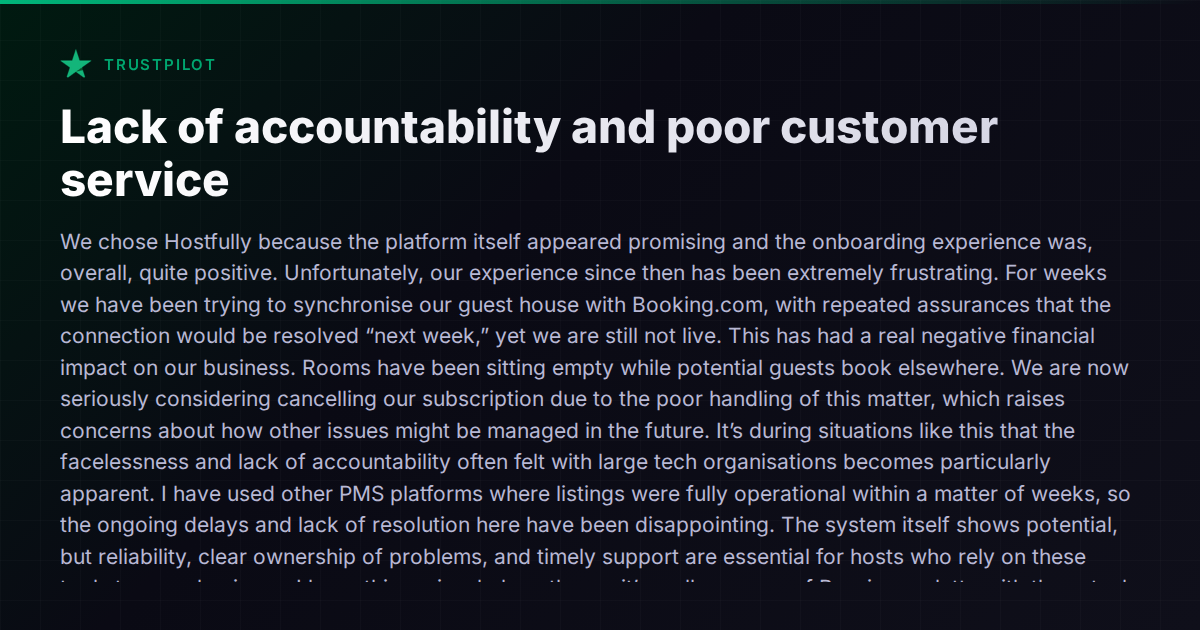
A recent Trustpilot review from a guest-house operator captures it well. They chose Hostfully after a solid onboarding experience, only to spend weeks waiting for a Booking.com sync that never went live. Each support interaction produced the same answer: “next week.” Meanwhile, revenue evaporated. Potential guests who would have booked were booking elsewhere. The host is now weighing whether to cancel their subscription entirely — not because the software was bad, but because the channel integration that makes the software useful simply didn’t work.
This story isn’t unique to Hostfully. Channel synchronization failures — especially with Booking.com — are one of the most financially damaging problems a short-term rental operator can face, and they come up across the PMS landscape far more often than most vendors will admit.
Why Booking.com Integrations Fail More Often Than You’d Expect
Booking.com’s connectivity architecture is more complex than Airbnb’s or VRBO’s. Where Airbnb offers a relatively open API that most PMS platforms can connect to directly, Booking.com operates through a certified connectivity partner program. A PMS must be approved as an official connectivity partner, and the integration involves mapping property types, room categories, rate plans, and policies in a way that matches Booking.com’s data model.
This means several things in practice:
- Property type mismatches delay activation. A guest house with shared spaces, multiple room types, or non-standard configurations can take significantly longer to sync than a single vacation rental unit. If your PMS doesn’t handle Booking.com’s room-level inventory model well, the integration can stall indefinitely.
- Certification doesn’t mean reliability. A PMS being “certified” with Booking.com means it passed a technical review. It doesn’t mean every property type syncs smoothly. Edge cases — mixed-use properties, seasonal pricing structures, unusual cancellation policies — often surface during activation, not during vendor QA.
- Support bottlenecks are structural, not incidental. When a Booking.com sync stalls, the PMS vendor often depends on Booking.com’s own integration support team to troubleshoot from their end. This creates a back-and-forth where the host is stuck between two organizations, neither of which fully owns the problem.
The Hostfully case is a clear example of this last point. The operator described feeling caught in a loop of deferred promises with no clear ownership. That’s not necessarily Hostfully dropping the ball internally — it can be the nature of a three-party integration where the PMS vendor, Booking.com’s partner team, and the property’s account all need to align.
But understanding why it happens doesn’t pay the rent on empty rooms.
How Different Platforms Handle This
Not all PMS platforms have the same track record with Booking.com connectivity. It’s worth looking at how the major options compare on this specific pain point.
Guesty is a certified Booking.com connectivity partner and handles Booking.com’s VCC (Virtual Credit Card) payment flow natively. For enterprise operators managing dozens or hundreds of units, Guesty’s Booking.com integration is generally considered mature. The tradeoff is that Guesty doesn’t publish pricing publicly, and the platform can be heavy for smaller operators.
Hostaway also emphasizes its “highest-status OTA connections” and positions Booking.com as a first-class integration. Operators in host communities generally report smoother Booking.com activation with Hostaway than with smaller PMS tools, though the same three-party troubleshooting dynamic applies when problems arise. Hostaway also uses quote-based pricing, so cost comparisons require a sales conversation.
Lodgify supports Booking.com and offers personalized onboarding. For single-property or small-portfolio operators, Lodgify’s hands-on setup process can reduce the risk of a stalled integration. However, Lodgify’s feature depth beyond channel management is thinner than competitors targeting professional managers.
Hospitable has Booking.com integration and positions itself as automation-first for smaller operators. Their channel sync is generally well-regarded, though their product emphasis leans more toward messaging automation than channel management infrastructure.
Hostfully, the platform in the original review, does support Booking.com integration and has a generally positive reputation for its guidebook feature and onboarding. But as the review illustrates, integration reliability after onboarding is a separate question from onboarding quality — and this distinction matters.
Vanio AI is a certified Booking.com connectivity partner with full API integration, including native VCC handling. Because its channel management layer is built into the same system as its AI operations engine, Booking.com sync issues surface in the same timeline where reservations, messages, and tasks live — which means the operator (and the AI) can see exactly where a connection is stalled rather than chasing emails between vendors. That said, the same underlying complexity of Booking.com’s partner model applies to every PMS: unusual property configurations can still require back-and-forth with Booking.com’s team.
What to Ask Before You Sign Up
If you’re evaluating a PMS and Booking.com is a meaningful revenue channel — and for many operators, it’s 30-50% of bookings — here’s what to verify during evaluation, not after:
-
“Are you a certified Booking.com connectivity partner?” This is table stakes. If the answer is no, or “we use a third-party bridge,” expect longer activation times and weaker sync reliability.
-
“What’s the typical activation timeline for my property type?” A single vacation rental is different from a guest house with six room types. Get a specific answer, not a generic one.
-
“What happens when the sync stalls?” This is the real question. Ask who owns the escalation. Does the PMS have a direct contact at Booking.com’s partner support? Will you be given visibility into the ticket, or will you just get weekly emails saying “still working on it”?
-
“Can I see the Booking.com connection status in real time?” Some platforms surface connection health in the dashboard. Others don’t. The ones that don’t are the ones where you discover a sync failure when a guest shows up to a double-booked room.
-
“What’s your SLA for channel issues?” Not general support SLA — specifically, how fast do they respond when a channel is disconnected or failing to sync? Every day offline is lost revenue.
The Bigger Picture: Channel Reliability as a Competitive Moat
Host forums are full of stories about PMS platforms that demo beautifully but fall apart at the integration layer. The original reviewer’s observation — that choosing a PMS sometimes feels like “Russian roulette” — resonates because it reflects a structural reality: the features you see in a demo are built by the vendor, but the integrations that actually generate revenue depend on third-party relationships the vendor may or may not manage well.
The most reliable PMS platforms tend to be the ones that treat channel connectivity as core infrastructure, not an afterthought. That means dedicated integration engineering teams, direct relationships with OTA partner teams, and transparent dashboards that let operators see sync status in real time.
If you’re evaluating options and Booking.com matters to your business, our comparison hub covers how major platforms stack up on channel management, integration depth, and operational reliability. Start there before you start a trial — it’s easier to compare architecture than to migrate mid-crisis.