Channel Sync Failures Are Still Costing Hosts Revenue in 2026 — And Refund Policies Make It Worse
Trustpilot
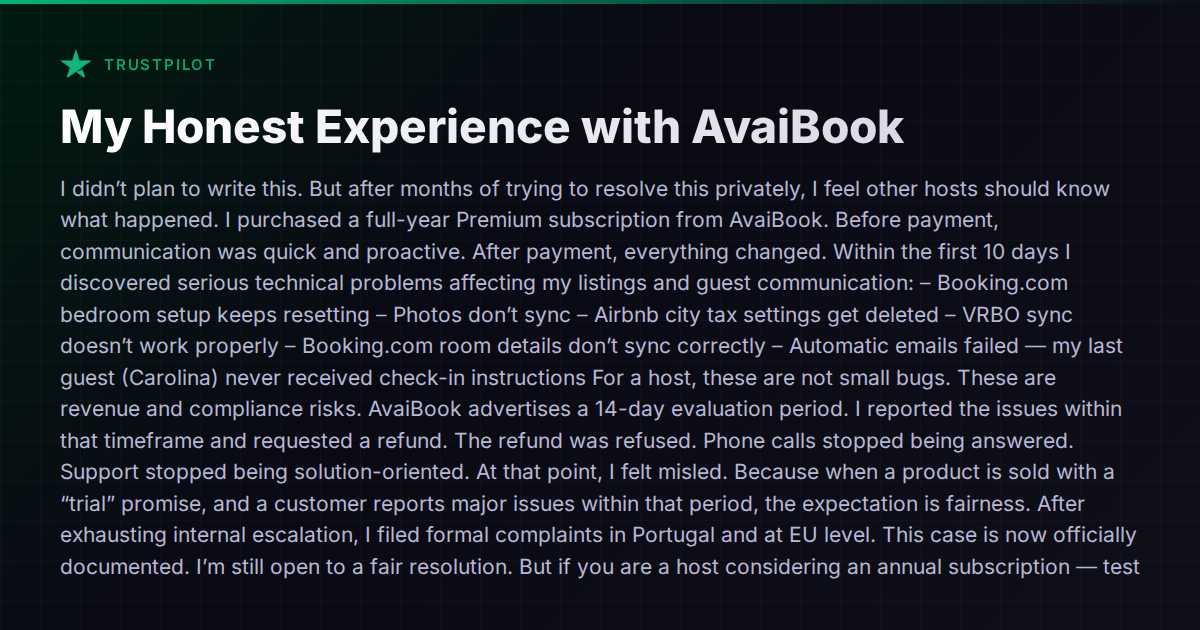
TL;DR: Host paid for a full-year AvaiBook (Guesty) Premium subscription and within 10 days discovered broken Booking.com bedroom/photo sync, deleted Airbnb tax settings, failed VRBO sync, and automatic check-in emails that never sent — then was refused a refund despite reporting within the advertised 14-day trial period.
A property management platform is supposed to be the single source of truth for your listings. When bedroom counts reset on Booking.com, photos fail to sync, tax settings vanish from Airbnb, and automated guest messages never fire, you don’t just have an annoying software bug — you have a revenue leak and a compliance exposure that compounds with every reservation.
One host recently shared their experience on Trustpilot after purchasing a full-year Premium subscription from AvaiBook, the channel manager that now operates under the Guesty umbrella. Within the first ten days they cataloged a list of failures that reads like a stress test gone wrong:
- Booking.com bedroom setup kept resetting
- Photos didn’t sync across channels
- Airbnb city tax settings were deleted
- VRBO sync wasn’t working properly
- Booking.com room details didn’t sync correctly
- Automated check-in emails failed entirely — their last guest never received arrival instructions
The host reported all of this within AvaiBook’s advertised 14-day evaluation window and asked for a refund. The refund was refused. Phone calls went unanswered. Support shifted from proactive to defensive. The host ultimately escalated to consumer-protection authorities in Portugal and at the EU level.
This isn’t an isolated story. It’s a pattern that repeats across the PMS landscape, and it reveals two distinct problems worth examining: sync reliability and vendor lock-in through rigid contract terms.
Why Channel Sync Is Harder Than It Looks
Channel management sounds simple in a demo. Connect your Airbnb, Booking.com, and VRBO accounts, and the platform keeps calendars, pricing, photos, descriptions, and amenity data in sync. In practice, each OTA exposes a different API with different data models, different rate limits, different lag times, and different rules about what can be pushed versus what has to be confirmed manually.
Booking.com’s property API, for instance, has a notoriously complex room-type and rate-plan structure. A PMS that maps “bedroom count” to the wrong field — or fails to persist it after a sync cycle — will produce the exact symptom the host described: bedroom setup that keeps resetting. Airbnb’s tax-configuration endpoints have their own quirks, particularly for European hosts subject to city-level tourist taxes that vary by municipality. If the PMS doesn’t handle tax-field persistence correctly, settings can vanish after a listing update round-trip.
VRBO (now part of the Expedia ecosystem) has its own integration complexities, especially for agency-style connections where availability and content sync don’t always behave identically.
None of this excuses the bugs. But it explains why channel sync is the single most common category of complaint across every PMS — not just AvaiBook/Guesty. Hosts evaluating any platform should treat channel sync as the first thing to validate, not the last.
The Automated-Message Failure Is the Worst Kind of Bug
Of everything on that list, the failed check-in email is the one that should alarm hosts the most. A photo that doesn’t sync is embarrassing. A guest who arrives without check-in instructions — no door code, no address details, no parking info — is an operational crisis. It leads to frantic phone calls, bad reviews, and in some cases, guests standing outside a locked property at midnight.
Automated guest messaging is table stakes for any PMS in 2026. But “automated” doesn’t mean “guaranteed.” Message-delivery pipelines can fail silently: an email bounces, an Airbnb API call times out, a workflow trigger misfires. The question isn’t whether your platform has automated messaging — it’s whether it monitors delivery, alerts you on failure, and has fallback channels.
Some platforms handle this better than others. Hospitable has long been recognized for reliable rule-based automated messaging, with clear logs showing what was sent and when. Hostaway offers a unified inbox with delivery tracking across Airbnb, Booking.com, email, SMS, and WhatsApp. Vanio AI takes a different approach entirely — its AI agent monitors the entire reservation timeline and, through an Operations Watchdog feature, runs daily automated checks across messaging, access codes, and cleaning tasks, auto-fixing what it can and escalating what it can’t. The point isn’t that any one tool is perfect; it’s that message delivery needs active monitoring, not just a “set and forget” template.
The Trial-Period Trap
The second problem this story exposes is subtler and arguably more damaging: the gap between an advertised evaluation period and the vendor’s actual refund willingness.
Many PMS platforms offer some form of trial or evaluation period. The implicit promise is: try the product, and if it doesn’t work, you’re not locked in. But the fine print often tells a different story. Annual subscriptions may be non-refundable after payment processing. “Evaluation periods” may apply only to specific plan tiers or require formal cancellation through a process that isn’t obvious. Support responsiveness often drops after the sale — a pattern hosts report across multiple vendors, not just AvaiBook.
This creates a perverse dynamic: the host discovers critical bugs during the trial window, reports them in good faith, and is told the subscription is non-refundable anyway. The vendor has no financial incentive to fix the bugs urgently because the money is already collected.
Here’s how to protect yourself:
- Never pay annually upfront for a platform you haven’t stress-tested. Monthly billing costs more per month but costs far less when things go wrong.
- Test every channel integration with real listings before committing. Create a test reservation on each OTA. Verify that room types, photos, pricing, taxes, and descriptions survive a full sync round-trip.
- Send yourself a test automated message. Book a fake reservation (or use a real one) and confirm the check-in email actually arrives with the correct details.
- Document everything during the trial. Screenshots, support ticket numbers, timestamps. If you need to dispute a charge later, contemporaneous evidence is what matters.
- Read the refund policy before you read the feature list. If the vendor won’t put a clear, written money-back guarantee behind their trial period, treat the “trial” as marketing language, not a contractual commitment.
How the Major Platforms Compare on Sync Reliability
No platform has zero sync bugs. But there are meaningful differences in architecture, transparency, and response time.
Guesty (which includes AvaiBook) manages over 500,000 listings and has deep OTA integrations, but its scale also means support queues can be long, and issues with acquired products like AvaiBook may not get the same engineering attention as the core Guesty platform. Hosts on AvaiBook specifically should verify whether they’re on the legacy AvaiBook stack or the unified Guesty platform — the experience can differ significantly.
Hostaway emphasizes its “highest-status OTA connections” and real-time sync, but like Guesty, it uses quote-based pricing with no public transparency, which can make it hard to evaluate total cost before committing.
Lodgify focuses on ease of use and direct booking websites, with real-time channel syncing as a core feature. Their onboarding support is generally well-regarded, though the depth of OTA-specific sync (room types, tax settings, etc.) varies.
Hospitable is strong on messaging automation and task management but positions itself more as a lightweight operational layer than a full-featured channel manager — which can actually be an advantage if you pair it with a dedicated channel management tool.
Vanio AI takes a different architectural approach as an AI-native platform where the AI agent has native access to reservations, channel data, messaging, and operations in a single data layer. This means sync issues surface in the same timeline as guest messages and task assignments, making failures harder to miss. The $5-per-reservation pricing model also means there’s no annual subscription trap — you pay as bookings flow.
The Bigger Lesson
Channel sync is the plumbing of short-term rental management. When it works, nobody notices. When it fails, everything downstream breaks: guest communication, tax compliance, review scores, revenue.
The host in this story did everything right — reported issues promptly, stayed within the evaluation window, escalated through proper channels. They still got stuck. That’s not a personal failure; it’s a structural problem with how PMS vendors sell annual commitments against products that may not be fully validated for a given host’s specific OTA configuration.
If you’re evaluating platforms right now, treat the first two weeks as an integration audit, not a feature tour. Verify every sync path. Confirm every automated message. And keep your payment terms flexible until you’ve seen the product survive a full booking cycle on every channel you use.
For a broader comparison of how current platforms stack up, our comparison hub breaks down the key differences across channel management, messaging, operations, and pricing.