Why iCal Sync Between Airbnb and VRBO Still Creates Ghost Conflicts in 2026
Airbnb Community
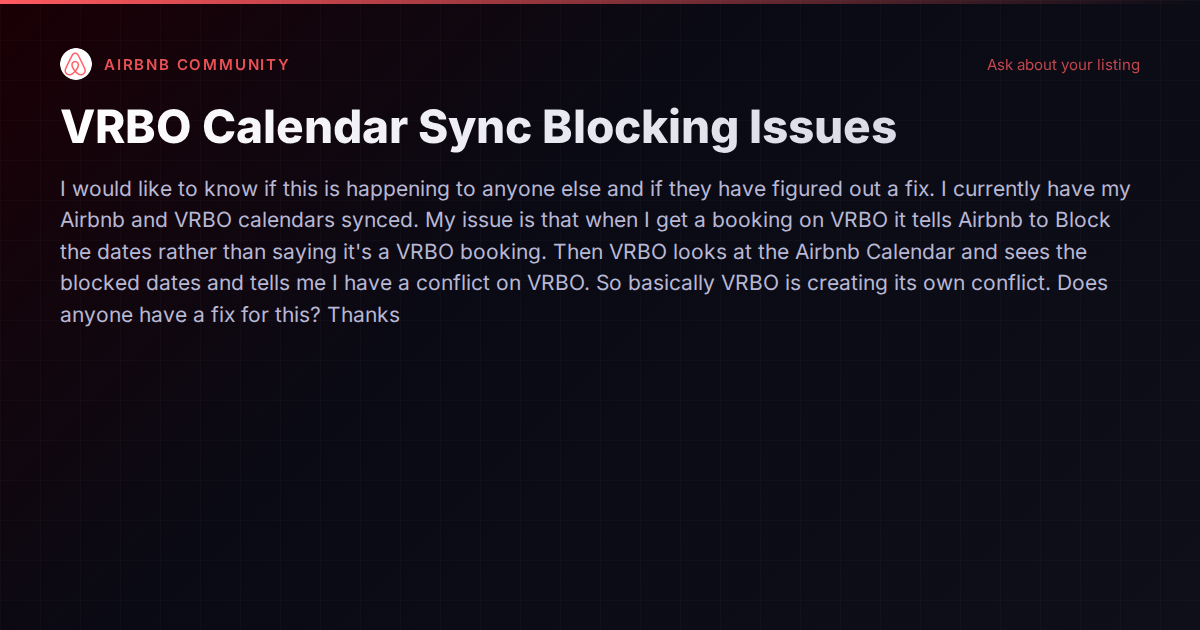
TL;DR: Author's iCal sync between VRBO and Airbnb is causing VRBO to create its own booking conflicts — VRBO bookings show as 'blocked' on Airbnb, which then reflects back to VRBO as a false conflict.
If you list on both Airbnb and VRBO and rely on iCal links to keep your calendars in sync, there’s a good chance you’ve seen this: a guest books on VRBO, the reservation pushes to Airbnb as a blocked date, and then VRBO re-reads its own reservation back from Airbnb’s calendar and flags it as a conflict. The result is a phantom double-booking warning created by the very system designed to prevent double bookings.
This isn’t a one-off bug. Hosts in Airbnb community forums have reported the issue going back years, with a notable wave of fresh complaints surfacing since 2023 and continuing into 2026. One host described syncing calendars since 2015 without incident, then suddenly encountering the loop after a platform calendar update. Another called both Airbnb and VRBO support and got the classic mutual blame — each platform pointed the finger at the other.
The underlying problem is structural, and it’s worth understanding before you try to fix it.
How iCal Sync Actually Works (and Why It Breaks)
iCal is a decades-old calendar standard. When you export a calendar link from VRBO and import it into Airbnb (or vice versa), each platform periodically polls the other’s feed — typically every few hours, sometimes up to 24 hours apart. The feed contains blocked dates, but it doesn’t carry rich metadata about why a date is blocked. A VRBO reservation, a personal block, and an Airbnb booking all look the same: just unavailable dates.
The ghost-conflict loop works like this:
- A guest books on VRBO.
- VRBO’s calendar feed marks those dates as reserved.
- Airbnb imports the feed and blocks the dates on its side.
- VRBO then reads Airbnb’s calendar, sees those dates blocked, and interprets it as a separate reservation on Airbnb.
- VRBO now believes there’s a conflict with its own booking.
The root cause is that neither platform tags outgoing blocks with an origin identifier that the other can recognize and ignore. Each platform treats all incoming blocked dates as foreign reservations.
Additional complexity creeps in when Airbnb’s preparation-time setting (the 1-, 3-, or 7-day advance notice window) blocks days around a reservation. Those extra blocked days leak into the iCal feed and can trigger conflicts on VRBO even when the actual stay dates don’t overlap.
Common Workarounds Hosts Use
Hosts in the thread shared a few approaches, none of them elegant:
- Sync in one direction only. Several operators reported that exporting from Airbnb to VRBO (but not the reverse) reduces the feedback loop. The trade-off is real: VRBO bookings won’t automatically block Airbnb dates, so you need to manually block them yourself every time a VRBO reservation comes in.
- Manual verification. One host described letting the conflict warnings pile up and simply checking manually. With low VRBO volume, the odds of a real collision are small — but the approach doesn’t scale.
- Delete and re-import. Some hosts tried removing and re-adding the calendar links. This occasionally clears stale cached data, but the structural loop returns with the next booking.
- Ignore the warnings. A few hosts simply trained themselves to disregard the phantom conflict notifications. Not exactly a confidence-inspiring workflow.
None of these workarounds solve the underlying problem. They reduce symptoms at the cost of either manual labor or reduced protection against actual double bookings.
Why a Channel Manager Exists for Exactly This Reason
iCal sync was designed for simple calendar sharing, not for real-time multi-platform reservation management. It has no concept of booking ownership, no instant updates, and no conflict resolution logic. When platforms started using it as a poor-man’s channel manager, these feedback loops became inevitable.
A proper channel manager connects to each platform’s API (not just its calendar feed) and maintains a single source of truth for availability. When a booking comes in on one channel, the channel manager pushes an availability update to every other channel via API — with the context that the block originates from a specific reservation, not from the destination platform itself. This eliminates the feedback loop entirely.
Several tools in the market handle this well:
- Guesty offers a full channel manager with API connections to Airbnb, VRBO, and Booking.com. It’s built for professional managers running larger portfolios and comes with enterprise-grade pricing to match (which Guesty doesn’t publicly disclose).
- Hostaway similarly provides API-level channel management with real-time sync across major OTAs. Like Guesty, pricing is quote-based, which can be a barrier for smaller operators who just want the sync problem solved.
- Hospitable offers channel management with real-time calendar syncing across Airbnb, VRBO, Booking.com, and others. It targets hosts who want automation without enterprise complexity and has tiered plans, though specific pricing isn’t publicly detailed.
- Lodgify provides channel management alongside its direct booking website builder. It tends to appeal to owners who want a simpler all-in-one setup and positions heavily on ease of use and onboarding support.
- Vanio AI takes a different architectural approach — it’s an AI-native platform where the channel manager, messaging, task management, and smart locks all share one data layer. Airbnb and Booking.com run on full API integrations, VRBO currently syncs via an agency-style integration with full sync in progress, and iCal import is available as a fallback for any platform. Because everything lives in one system, the AI has full context across channels, which means it can detect and resolve availability conflicts rather than just passing calendar blocks back and forth.
The key question for any host evaluating these tools isn’t “which has the best feature list” — it’s whether the tool connects to your specific channels via API rather than iCal. If your VRBO connection still relies on iCal under the hood, you’ll get the same ghost conflicts regardless of which platform wraps it.
What to Check Before You Switch
Before committing to a channel manager, verify:
- API vs. iCal for each channel. Ask specifically whether VRBO sync is API-based or iCal-based. Some platforms have full API connections for Airbnb and Booking.com but still rely on iCal for VRBO.
- Preparation-time handling. Does the tool properly interpret Airbnb’s advance-notice buffer days, or does it export them as generic blocks? This is a common edge case that cheaper integrations get wrong.
- Sync frequency. iCal feeds update every few hours at best. API connections can push updates in seconds. For high-demand dates, a 6-hour sync delay is a real double-booking risk.
- Cost vs. volume. If you run one or two listings with modest VRBO traffic, manual blocking after each booking might genuinely be cheaper than a monthly channel manager subscription. The math changes quickly at five-plus listings.
The Bottom Line
iCal sync between Airbnb and VRBO has a fundamental design limitation that neither platform seems interested in fixing. The feedback loop — where a reservation creates a block that gets re-imported as a conflict — isn’t a bug either platform acknowledges owning, which is why support calls end in mutual finger-pointing.
For hosts with low cross-platform volume, one-directional sync plus manual verification is a viable (if tedious) workaround. For anyone managing more than a handful of listings or getting meaningful booking volume from both Airbnb and VRBO, a proper channel manager with API-level connections is the only reliable fix.
Compare the options and their specific channel integrations at our comparison hub to find the right fit for your setup.