When Dynamic Pricing Tools Can't Sync With Booking.com: A Persistent Problem for STR Operators
Trustpilot
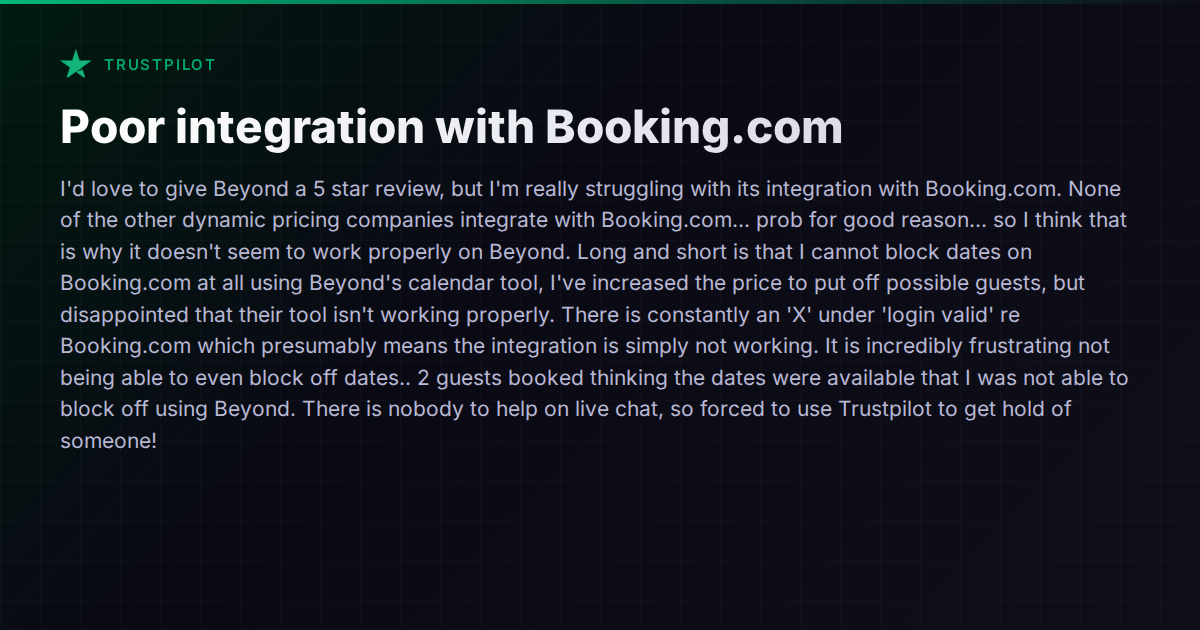
TL;DR: Author cannot block dates on Booking.com through Beyond Pricing's calendar tool, resulting in unwanted bookings on dates that should be unavailable, with no live support to resolve the broken integration.
If you’ve ever had a guest book dates you thought were blocked, you already know the gut-punch. It’s not just the awkward cancellation conversation — it’s the review risk, the platform penalty, and the operational chaos that follows. For hosts who rely on dynamic pricing tools to manage availability across channels, a broken Booking.com integration can turn a time-saving product into a liability.
A recent Trustpilot review crystallized this pain. The host wanted to give Beyond Pricing a five-star review but couldn’t, because the Booking.com integration was effectively dead. Dates couldn’t be blocked through Beyond Pricing’s calendar, the login status showed a persistent error, and two guests booked on dates that should have been unavailable. The host’s only escalation path was a public review — live chat was empty.
This isn’t an isolated incident. It reflects a structural tension in the STR tool landscape: Booking.com’s API is harder to integrate with than Airbnb’s, and most pricing tools either avoid it entirely or support it poorly.
Why Booking.com Integration Is Uniquely Difficult
Airbnb’s API has become relatively standardized for third-party tools. Booking.com, by contrast, has a more complex connectivity framework. Partners need to maintain certified connectivity status, handle virtual credit cards (VCCs), and deal with a more rigid availability model. Calendar sync isn’t just about pushing prices — it’s about managing room types, rate plans, and restrictions in a format Booking.com’s system expects.
For dynamic pricing tools that were originally built around Airbnb, adding Booking.com support often means bolting on a fundamentally different integration model. The result: partial functionality, intermittent login failures, and gaps in availability sync that lead to exactly the kind of phantom bookings the host described.
Most dedicated dynamic pricing tools — PriceLabs, Wheelhouse, Beyond Pricing — are strongest on Airbnb and VRBO. Their Booking.com support varies from limited to experimental. If Booking.com is a significant revenue channel for you, relying on a standalone pricing tool for availability management on that platform is risky.
The Real Cost of a Broken Calendar Sync
When availability doesn’t sync properly, the downstream consequences multiply:
- Unwanted bookings on dates you blocked (or thought you did), forcing cancellations that hurt your platform standing
- Double bookings across channels when a pricing tool fails to push updated availability to Booking.com
- Manual workarounds — logging into Booking.com’s extranet to block dates by hand defeats the purpose of the tool
- Pricing drift — if availability updates fail, price updates probably do too, meaning your rates are stale on one of your highest-traffic channels
- Support black holes — the host’s experience of finding no live chat is common with pricing-first tools that prioritize algorithmic features over operational support
The host’s workaround — jacking up the price to deter bookings on dates they couldn’t block — is creative but fragile. A guest who doesn’t mind the inflated rate books anyway, and now you’re stuck.
How Different Tools Handle This
The tooling landscape splits into two categories here: standalone dynamic pricing tools and full property management systems with built-in or integrated pricing.
Standalone Dynamic Pricing Tools
Beyond Pricing, PriceLabs, and Wheelhouse all focus on algorithmic pricing. Their Booking.com support varies. Beyond Pricing does offer a Booking.com integration, but as the source review shows, it can be unreliable — persistent login validation failures and inability to manage basic availability. PriceLabs integrates with Booking.com via a PMS connector in most cases, meaning you need a PMS in the middle. Wheelhouse has a similar model.
The core issue: these tools are pricing engines, not channel managers. When you ask them to also manage availability on a complex platform like Booking.com, you’re stretching them beyond their primary design.
Full PMS Platforms With Channel Management
This is where the problem is more consistently solved. A property management system with certified Booking.com connectivity handles availability, pricing, and restrictions through a proper two-way sync — not a pricing tool trying to do double duty.
Hostaway has direct Booking.com integration with real-time calendar sync and claims high-status OTA connections. Guesty similarly offers certified Booking.com connectivity and handles VCC processing natively. Lodgify emphasizes real-time syncing across channels, though specific Booking.com depth varies. Hospitable supports Booking.com through its channel manager with automated messaging and calendar sync.
The trade-off is clear: a PMS with native channel management gives you reliable availability sync on Booking.com, but you’re buying into a larger system. If you only need pricing optimization, that’s a heavier commitment.
PMS + Pricing Tool Combos
Many operators run a PMS for channel management and layer a standalone pricing tool on top for rate optimization. This can work well — the PMS handles the hard part of keeping Booking.com in sync, while the pricing tool focuses on what it does best. PriceLabs and Wheelhouse both integrate cleanly with most major PMS platforms. The downside is added complexity and cost.
The Support Problem Compounds Everything
The host’s inability to reach anyone via live chat deserves its own callout. When a calendar sync failure means guests are booking dates they shouldn’t be able to, response time matters enormously. Every hour the integration is broken is another potential phantom booking.
This is a known weak spot for standalone pricing tools. Their teams are typically small and engineering-heavy, optimized for algorithm development rather than operational support. If you’re running a portfolio where Booking.com represents meaningful revenue, factor support responsiveness into your tool evaluation just as heavily as pricing accuracy.
What to Actually Do About It
If you’re experiencing Booking.com sync issues with a standalone pricing tool, here’s a practical decision framework:
-
Assess channel importance. If Booking.com is under 10% of your revenue, manual management via the extranet might be tolerable. If it’s 20%+, you need a reliable automated solution.
-
Don’t use a pricing tool as a channel manager. If your pricing tool can’t reliably manage Booking.com availability, stop relying on it for that function. Use it for pricing only and manage availability through a proper channel manager or PMS.
-
Evaluate PMS options for Booking.com specifically. Ask vendors directly: are you a certified Booking.com connectivity partner? How is availability sync handled — real-time API or periodic push? What happens when the connection drops? Vanio AI is a certified Booking.com connectivity partner with full two-way API sync and handles VCC processing natively, which eliminates the class of problems described here. Other PMS platforms like Hostaway and Guesty offer similar certified connectivity.
-
Test before you trust. Block a few dates through your tool, then check the Booking.com extranet directly. If the blocks don’t appear within minutes, your sync is broken regardless of what the tool’s dashboard says.
-
Have a support escalation plan. Know in advance how to reach your tool’s support team urgently. If the answer is “email a ticket and wait,” that’s a risk factor for time-sensitive sync failures.
The Bigger Picture
Booking.com is the world’s largest accommodation platform by room nights. Ignoring it or treating it as a second-class channel is leaving money on the table. But integrating with it properly requires more engineering rigor than most standalone pricing tools are built to deliver.
The industry is gradually converging on a model where channel management and pricing live in the same system — either as a PMS with built-in dynamic pricing, or as a PMS with deep native integrations to pricing tools. The days of asking a pricing calculator to also be your channel manager are numbered.
For a detailed look at how different platforms handle channel management and Booking.com integration specifically, the comparison hub at /compare/ breaks down the key differences across the major PMS options.