When Calendar Sync Fails, Everything Else Falls Apart
Trustpilot
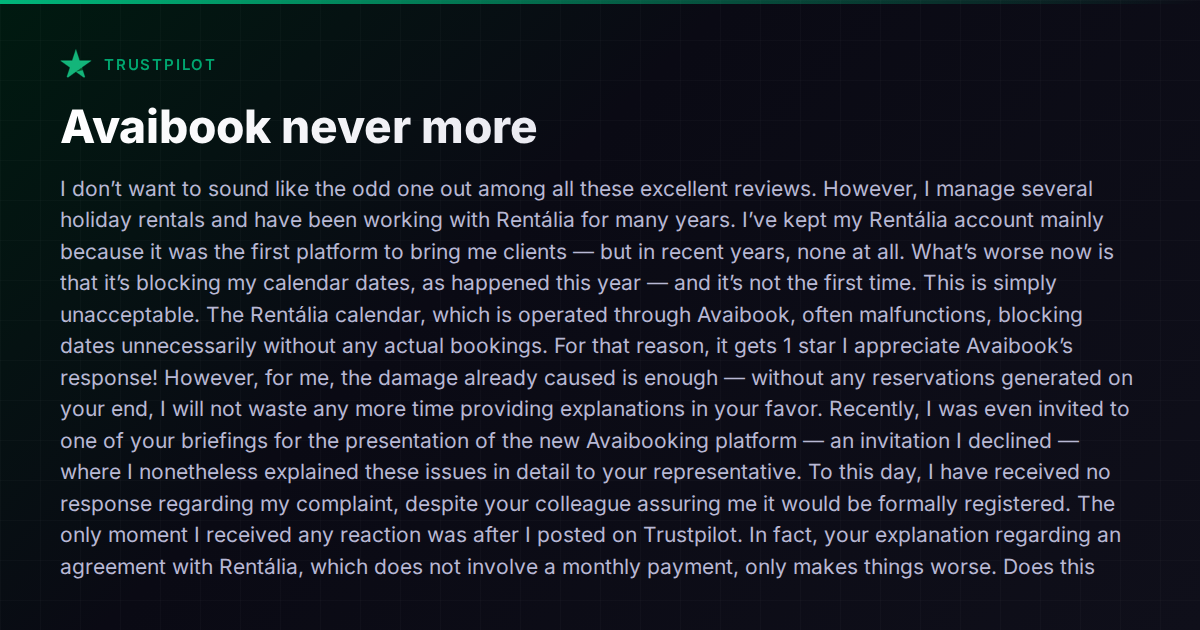
TL;DR: Host managing multiple holiday rentals is leaving Avaibook/Guesty due to persistent iCal calendar sync failures that block dates without actual bookings, zero reservations generated, unresponsive support, and frustration with the annual fee model for a service that doesn't perform.
Calendar synchronization is the unsexy backbone of short-term rental operations. When it works, nobody notices. When it doesn’t, phantom blocks eat revenue, double bookings torch guest trust, and hosts start questioning why they pay for a PMS at all. A recent Trustpilot review from a multi-property host using Avaibook (a Guesty subsidiary) is a textbook example of the slow damage that iCal failures inflict — and why the industry’s dependence on a 1998-era sync protocol is still causing headaches in 2026.
The Complaint: Blocked Dates, Zero Bookings, No Response
The host manages several holiday rentals and had been listing on Rentália — a regional platform whose calendar sync runs through Avaibook’s infrastructure — for years. Their grievance is specific and familiar:
- Ghost blocks. Dates appeared as unavailable on Rentália despite no actual bookings existing. This wasn’t a one-off; it happened repeatedly across seasons.
- Zero reservations generated. Over recent years, the channel produced no bookings whatsoever, yet still consumed calendar inventory by blocking dates on other platforms.
- Support black hole. The host explained the issue to an Avaibook representative in person and was promised a formal complaint registration. Nothing happened — until the Trustpilot review went live.
- Pricing disconnect. Avaibook’s response apparently referenced a distinction between paid and free iCal service tiers. The host’s rebuttal cuts to the bone: “There is no ‘iCal for paying users’ and ‘iCal for non-paying users’ — iCal is iCal, nothing more.”
That last point deserves unpacking, because it reveals a structural problem that extends well beyond any single platform.
Why iCal Sync Still Breaks in 2026
iCalendar (RFC 5545) is a file format. It describes events. It was never designed as a real-time synchronization protocol. When two platforms share availability via iCal, they’re essentially polling a static .ics file on a timer — usually every 15 to 60 minutes, sometimes longer. The failure modes are well-documented:
- Stale reads. Platform A books a date. Platform B doesn’t pick up the change for 45 minutes. A guest on Platform B books the same date. Double booking.
- Phantom blocks. A reservation is created and then cancelled on Platform A. The cancellation event doesn’t propagate cleanly (iCal cancellation semantics are inconsistent across implementations). Platform B still shows the date as blocked.
- Parse errors. Different platforms produce slightly different iCal outputs. A field that one platform treats as optional, another treats as required. The result: silently dropped events or incorrectly imported date ranges.
- Polling gaps. If the server hosting the
.icsfile is slow or temporarily down during a poll, the consuming platform may either skip the update or cache stale data.
The major OTAs (Airbnb, Booking.com, Vrbo) have moved toward API-based integrations for connected channel managers precisely because iCal can’t deliver the reliability that professional operators need. But smaller regional platforms — and some surprising corners of the big ones — still rely on iCal as the fallback glue.
When a PMS or channel manager sits in the middle and routes iCal feeds between platforms, it inherits all of these failure modes and sometimes adds new ones. If the PMS’s iCal implementation has bugs in how it generates or consumes .ics files, hosts get exactly what this operator described: dates blocked with no corresponding booking, and no clear way to diagnose the root cause.
The Real Cost Isn’t Technical — It’s Invisible
Blocked dates don’t throw error messages. They don’t send alerts. They just quietly remove inventory from sale. A host checking their calendar on Airbnb sees availability. A guest checking the same property on a connected regional platform sees “unavailable.” Neither party knows anything is wrong. The booking simply doesn’t happen.
For a host managing several properties, each with connections to three or four channels, even a 2-3% phantom-block rate across the calendar year translates directly to lost revenue. Multiply that across peak-season weekends and the damage compounds.
Worse, the host in this case had no way to audit the problem without manually cross-referencing every date across every platform. Most hosts discover phantom blocks only when they notice a channel has gone quiet for an unusually long stretch — exactly the scenario described in the review.
How Different Platforms Handle This
Not all channel managers are created equal when it comes to sync reliability, and the differences come down to integration depth.
API-first integrations are the gold standard. When a channel manager has a direct API connection to Airbnb, Booking.com, or Vrbo, availability changes are pushed in near-real-time (typically seconds to low minutes) rather than polled. Double bookings and phantom blocks become rare — not impossible, but rare.
Hostaway and Guesty both maintain direct API connections to the major OTAs and market their sync reliability as a core feature. Guesty in particular emphasizes its “highest-status OTA connections.” For hosts operating exclusively on Airbnb, Booking.com, and Vrbo, the API-connected sync from either platform generally works well.
The problem arises at the edges: regional platforms, niche OTAs, and legacy portals that don’t offer API access. For these channels, even sophisticated channel managers fall back to iCal — and suddenly the 2026 tech stack is only as reliable as the weakest link.
Lodgify positions itself as an all-in-one solution with real-time syncing, and Hospitable emphasizes calendar syncing across Airbnb, Vrbo, Booking.com, and Agoda. Both handle the major channels via API but face the same iCal limitations on smaller platforms.
Vanio AI takes an API-first approach for Airbnb, Booking.com, and Vrbo, and supports iCal import/export for additional channels. Its Operations Watchdog — an automated daily monitoring system — specifically checks for access code, cleaning, and booking anomalies, which can help surface sync-related issues before they silently eat inventory. That said, no platform can fix iCal’s fundamental limitations when the other end of the connection only speaks iCal.
What Operators Can Actually Do
If you’re stuck with iCal on one or more channels, a few defensive practices help:
- Audit regularly. Set a weekly calendar to spot-check availability on every connected platform against your PMS. This is tedious but catches phantom blocks before they cost you a peak weekend.
- Shorten poll intervals. If your PMS allows you to configure iCal refresh frequency, set it as low as the platform allows. Fifteen minutes is better than sixty. Five is better than fifteen.
- Reduce iCal chain depth. Every intermediary in the sync chain adds latency and potential failure points. If Platform A syncs to your PMS via iCal, and your PMS syncs to Platform B via iCal, you have two potential failure points. Direct connections — even imperfect ones — are better than daisy chains.
- Evaluate whether marginal channels are worth it. If a regional platform generates zero bookings over several years (as in this case) but still consumes calendar inventory, the math is straightforward. Remove it. The phantom-block risk isn’t worth the theoretical upside.
- Demand API integrations from your PMS. When evaluating or renewing your channel manager, ask specifically which channels have API-level sync and which rely on iCal. The answer should factor into your decision.
The Support Problem Is the Bigger Red Flag
Calendar sync bugs happen. They happen to every platform, including the ones with the best engineering teams. What separates a tolerable vendor from an intolerable one is how they respond when things break.
In this case, the host reported the issue in person, was promised a formal complaint, and heard nothing until a public Trustpilot review forced a response. That pattern — silence until public pressure — is unfortunately common in the PMS space and is a signal that an operator should evaluate alternatives regardless of the underlying technical issue.
When you’re paying for a platform (whether via subscription or commission), responsive support isn’t a perk — it’s the minimum viable product.
The Bottom Line
Calendar sync reliability is the most underappreciated feature in property management software. It’s never the flashy item on the comparison page, but it’s the one that directly costs you money when it breaks. If your current setup relies on iCal for channels that matter to your business, treat it as a known risk — audit it, mitigate it, and factor it into your platform decisions.
For a deeper look at how the major channel managers compare on integration depth, sync reliability, and the features that actually matter for multi-channel operators, the comparison hub is a good starting point.